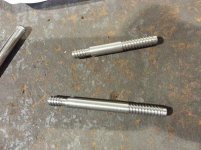
3/8-10 pin feeler

GatzkeCues

It used to be a hobby
Silver Member
At the moment, this is a feeler for an extended 3/8-10 pin. The pin has a longer locating barrel for added weight. The first one I weighed came out at about .45 oz heavier. I'm sure some can see pros and cons with the design but like I said, this is just a feeler at the moment.
Thanks in advance for looking.
 

Attachments

  • 20140308_102233.jpg
    20140308_102233.jpg
    99.7 KB · Views: 526
I am having some made up for myself. I figured I would ask if there was an interest in them, perhaps i would get some extras. So i guess the answer is sort of a yes.
EDITED,
It is kind of a long story on how I finally got these going and I will try to get the point across as easy as I can.
I have a friend that has a machine shop that was going to do it on his Swiss but one servo went out and he ended up not having the man power to do it.
So then I have another friend that just bought a used one and needed a project to see what kind of condition it was in. Well you know how that goes.
The finally got some bugs worked out and are running them without the glue relief and center drill at the moment because of lack of tool holders and such.
I am going to go down and do both of those steps on the mill, myself until they can get set up to do it all on the Swiss.
You have to understand that this might possibly be a one time thing until further notice as he does have government jobs lined up and I don't know how long I get to use the machine.
I originally bought 20 twelve ft bars and found that part of 2 are too damaged to use and of course some scrap, so I don't know how many I will end up with and how many will be on the market.
To answer the question,
They are 303 Stainless so far.
The should end up with center drilled holes.
They should end up with one glue relief slot on the barrel.
The first 25 I just picked up are holding .381 on the barrel with my cheap digital calipers.
The cost for the first run, since it is somewhat of a favor should be less than what is currently being sold on the market for the shorter ones. ( I can't say how much yet, until I work that out with him.
I'm trying to convince him that there is a slight possibility for these on the market so I don't know yet if there will be another run. If there is then I will consider brass and other materials.
I hope this answers all your questions.
 
Last edited:
Yes , I can see a need for something like that . There are times I add weight behind the pin for balance purposes . Cost ???? They are SS , right ?? Possibility of Brass ??? Jim
 
Available with a glue relief? What is the dimension on the centering barrel? Proposed cost?

Thanks Randy, those too were also questions that ran through My mind after I had already posted. I usually use full threaded, but I have some wood combos in mind where this may help. I modify those pins anyhow, so I suppose I could provide for glue relief, although It helps if they are center drilled, but then again I usually do that with full threads too, so I suppose I can handle that as well depending on price.
 
Last edited:
Mike,

I think it is a very good concept but I don't think your centering barrel needs to be that long. About .750 and the rest of the pin that is embedded as threaded should work just fine the way I see it.

If you make the pin even longer then you could cut off whatever you don't need for each cue.

I sometimes use an embedded 1/2"x 13 weight bolt behind my pin and it really helps me put my cue weight and the balance point right where I want it. You longer heavier pin concept does the same thing

Just my thoughts.

Rick
 
Last edited:
Greg,

I think it is a very good concept but I don't think your centering barrel needs to be that long. About .750 and the rest of the pin that is embedded as threaded should work just fine the way I see it.

If you make the pin even longer then you could cut off whatever you don't need for each cue.

I sometimes use an embedded 1/2"x 13 weight bolt behind my pin and it really helps me put my cue weight and the balance point right where I want it. You longer heavier pin concept does the same thing

Just my thoughts.

Rick


I usually just use the pre cut standard full threaded pins, and then machine/modify, and polish to My liking, but I was thinking of buying It in rod form, since I can basically do the same thing, and make them longer if need be like you say.
 
Greg,

I think it is a very good concept but I don't think your centering barrel needs to be that long. About .750 and the rest of the pin that is embedded as threaded should work just fine the way I see it.

If you make the pin even longer then you could cut off whatever you don't need for each cue.

I sometimes use an embedded 1/2"x 13 weight bolt behind my pin and it really helps me put my cue weight and the balance point right where I want it. You longer heavier pin concept does the same thing

Just my thoughts.

Rick

Comments removed after reading Mike's updated post.

Good job so far.
 
Last edited:
Mike,

I think it is a very good concept but I don't think your centering barrel needs to be that long. About .750 and the rest of the pin that is embedded as threaded should work just fine the way I see it.

If you make the pin even longer then you could cut off whatever you don't need for each cue.

I sometimes use an embedded 1/2"x 13 weight bolt behind my pin and it really helps me put my cue weight and the balance point right where I want it. You longer heavier pin concept does the same thing

Just my thoughts.

Rick
How does 1/2 13 fit a 5/16 hole ?
 
Last edited:
Thanks Randy, those too were also questions that ran through My mind after I had already posted. I usually use full threaded, but I have some wood combos in mind where this may help. I modify those pins anyhow, so I suppose I could provide for glue relief, although It helps if they are center drilled, but then again I usually do that with full threads too, so I suppose I can handle that as well depending on price.

I'm only asking because I just buy them with a glue relief in the barrel. They are also center drilled. Carmelli makes his own relief with the same pins I use. I also hit the threads on the bottom part with a small carbide slitting saw(takes 5 secs).

If you'd like to PM me, I'll give you the particulars.

Basically, you will have to reproduce the pin Atlas sells with a bit more length and sell them at a competitive price. It might be a pretty tall order.

I once shopped around locally trying to have pins made. It wasn't pretty. All my quotes were based on 1000 units and it felt like all the shops I talked to, based on the pricing, would just rather see me walk away.
 
Last edited:
How does 1/2 13 fit a 5/16 hole ?

Joey,

Establish a .421 hole for 1/2 13 bolt then epoxy the bolt into the blind hole with glue relief on the threaded plug and let slow epoxy cure.

Come back later and drill 1/2 hole to a bottom depth of 1.750 and epoxy in a 2" x 1/2" Garolite LE insert machined to .494. Let epoxy cure and put on a precision face and then install the pin.

A forward pin in conjunction with the option to tweak with a rear bolt gives you complete control of weight and the balance point of the cue. I don't have an A joint bolt on my cues so this lets me nail the weight and balance after the blank is at finished taper size so I never have to think about the weight until the cue is ready for a pin and the shafts are done.

Mike's long pin will do the same job.

From my experience I never have had to put more than a 1 oz bolt in the front of one of my cues and that was Padauk. This long pin with an A Jointed cue should never need more than 1 oz. unless the cue needs to be over 20 oz. if a cue is balanced the way you want it and you have to make the cue 1oz heavier just do 1/2 oz in the front and back. The balance point can be changed by playing with the weight combo differential. Simple algebra.

Rick
 
Last edited:
Rick, just out of curiosity, why not use heavier wood cores to begin with rather than having to put such a thick bolt up front? If your joint diameter is .850 and you have a .500 hole, then you have only .175" of wood at the joint. Once you install your .625" ID collar & rings, you're left with .0625" of wood that's actually connected to the forearm & holding everything together. You are putting almost 100% of the load on the epoxy that you're using.

If you would simply use a heavier core, say like bloodwood or bubinga, then you'd have the weight you need to begin with but with a more natural & better distributed balance. As a side effect, your cue would maybe even hit better. For certain it would be stronger at the joint. Jatoba, bloodwood, bubinga, angico, etc. all cost only a little more than maple but are stronger and heavier. Don't get me wrong, I'm not knocking maple for coring. It has its place. But there's no rule that says you have to use it, or that it's the only wood for every application. Food for thought.....

Sorry Mike for sidetracking your thread.

 
Rick, just out of curiosity, why not use heavier wood cores to begin with rather than having to put such a thick bolt up front? If your joint diameter is .850 and you have a .500 hole, then you have only .175" of wood at the joint. Once you install your .625" ID collar & rings, you're left with .0625" of wood that's actually connected to the forearm & holding everything together. You are putting almost 100% of the load on the epoxy that you're using.

If you would simply use a heavier core, say like bloodwood or bubinga, then you'd have the weight you need to begin with but with a more natural & better distributed balance. As a side effect, your cue would maybe even hit better. For certain it would be stronger at the joint. Jatoba, bloodwood, bubinga, angico, etc. all cost only a little more than maple but are stronger and heavier. Don't get me wrong, I'm not knocking maple for coring. It has its place. But there's no rule that says you have to use it, or that it's the only wood for every application. Food for thought.....

Sorry Mike for sidetracking your thread.

Eric,

I use only laminated maple cores I cut to dimension on my shaft machine.. They stay very straight even when hanging in my shop for long periods of time. They also deliver a soft or quite sound when the cue is hit.

Of coarse I could use Purple Heart or jatoba for the core when using the light wood forearm like Padauk.

I don't because by using the same core material all of my cues have a baseline hit from the laminated maple core. At the nose there is only .054 per side of the forearm material in cross section and obviously more about .125 per side at the AJoint area.

So the difference in how the cue plays it not much of a difference between most woods I use.

A cue with an ebony nose will have a slightly different flavor than soft curly but not so noticeable from straight grained maple.

My goal it to have my cues play and sound as close to the same as possible. I don't use light woods that often and really only deal with only about 6 or 7 varieties of species. When a customer wants a light wood I build the cue they want and make weight and balance adjustments as needed.

Rick
 
I was merely making a suggestion. It's not the thickness of the forearm wood that matters. It's the thickness of the wood between your partial phenolic core and the joint collar. That's where the weakness lies. Subsequently, it's also the point in the cue that suffers the most stress on shots like the break or a power draw, especially with the guys who force the shaft down into the table, flexing the cue like a bow. Of course none of us have ever seen anybody do that, nor have we seen anybody slap the shaft on the rail after missing a shot or wield their cue like a sword or pick a cue up by the tip end. That said, you're going to do whatever you do anyway & no doubt will have some reason why I'm wrong. But if anybody else comes across this, they can draw their own conclusions. I have had cues break in that area & they had much more wood for support. It's embarrassing to say the least, because it generally happens in front of an entire room on league night.
 
Mike, I would not have any use for a long joint pin like that .
I was taught a way to add weight without using bolts or set screws.

I don't use set screws but my late mentor showed me x-rays of cues . It is more common than you think. A hall of fame maker used it all over his cues. One on top of another, even.

This is where an A-joint can be your best friend in distributing the weight of the cue . You can place that set screw right in the middle of the cue where it's on neutral are . You can even use 3/8 16 if that's what your A-joint stud is .

P.S.
I've been grinding down my joint screws lately . I don't really need them more than 1 3/4 deep and 1.300 exposed. 1 3/4 deep is way past the joint collar and rings for me usually.
 
Last edited:
Update

I myself would only need to use a pin like this every once in awhile.
I quit using an a joint a few years ago and do not plan on going back.
A solid core is my preference for at least 20 reasons, which is more than
enough for me. I sent an email to you Eric last night and didn't update until
today for a couple of reasons. First I'm not exactly sure on the numerous post
law for bumping a thread and second, I still don't know how much longer he is
going to let me tie up his machine. Yes is the answer to the shorter standard
pin with a .308 minor but I do not know exactly how many of each I will end up with and how many I will end up letting go. I am trying my best to get as many as I can
now and hopefully (fingers and toes crossed) I might be able to pull of another
run down the road. I have a couple of people interested enough to bite so
far and they will have first dibs on what will be available. I do not want to
make promises that I do not know for sure I can keep, hence this feeler.
If it looks like there is enough of a demand and I can show it to him that he
is not wasting his time helping me out, then maybe it will convince him that
we are serious. If you are interested please pm, email or text me and I will put you on the list for first come first served. There will be no minimum and I'm not sure on a maximum for now. As for quality control, I am doing my best to make sure they will be good enough for your application. I will offer a money back guarantee with a return minus shipping. In other words I am confident if you don't think they are good enough for yours but I will think they are good enough for mine.
If there are more questions to be answered, I will try to update on an edit in this post.
By the way if you guys need to talk about weighting options on here, go ahead. I'm easy most of the time and it is kind of topic related, so have at it.
 
Back
Top