Banking for newbies

Patrick Johnson said:
Here's the diagram with the 9-ball added (since I mentioned it).

pj
chgo

CueTable Help


Yes, you can figure that as the corner 5 system, or, you could point your stick to the opposite pocket and then place it half way between the 9 ball and the pocket you are shooting towards, then take a parallel line to the shot.

I prefer to show the parallel line as noted above
 
you can figure that as the corner 5 system

?? It's not the corner 5 system - that's a three-rail system.

point your stick to the opposite pocket and then place it half way between the 9 ball and the pocket you are shooting towards, then take a parallel line to the shot.

?? I can't quite follow that, but it doesn't sound quite right either.

pj
chgo
 
I keep it real simple when I bank. I visually lay my cue over the object ball and rotate it until the cuetip is pointing at a diamond that's half the distance to the point on the butt's side. That establishes the contact point. Then modify contact point according to whether I cross over or not. It works well enough for me, but I'm no banking machine.:o This seems to approximate Patrick's and Klockdoc's systems as well IMHO.
 
Maybe its just me, but I understand how the systems work - believe me I understand the logic behind it and everything. However, as a "feel" player, I have trained my eyes to know when the bank is on and when it isn't on. I also have trained myself on how to manipulate the ball into the pocket, I may not be able to describe it as well as Freddy, and I may not bank as well as the top guys, but I do ok. It's just the way I have been trained. I could never sit there trying to figure out these angles, 1/8 of a ball or whatever... I'd probably pop a vein in my forehead before I figured it all out... lol I hope I'm not alone here! Great thread, its good to hear how others figure these things out!
 
TorranceChris said:
I keep it real simple when I bank. I visually lay my cue over the object ball and rotate it until the cuetip is pointing at a diamond that's half the distance to the point on the butt's side. That establishes the contact point. Then modify contact point according to whether I cross over or not. It works well enough for me, but I'm no banking machine.:o This seems to approximate Patrick's and Klockdoc's systems as well IMHO.

Exactly. The only thing I was pointing out to the newer players that do not understand this, this gives them a point to aim to and I think simpler to figure. Maybe not though. But, remember, you are individuals that are more knowledgeble than newer players to the game. It seems simple to you.

I visually look at the object ball now. In Patrick's diagram, I can see that the ball is slightly under 5 diamonds, I know that on the 5, I have to hit at 2 1/2 so I aim of take a parallel from there.
 
well if the topic is banking for "newbies", then here's a general "quick and easy".

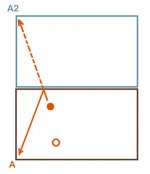
make an approximate an idea of where the mirror image of the pocket you want to shoot for is, and aim to that. in some pool rooms, the tables are close enough that you can get a decent approximation by shooting to the OTHER table's pocket.

A2 is the imaginary mirror of the corner pocket (A) you're aiming for. and in many rooms the tables are space about a table width apart, so you can aim to the other table's corner pocket. we ARE talking about "newbies", right?
 

Attachments

  • bank mirror.jpg
    bank mirror.jpg
    11.3 KB · Views: 195
Last edited:
bruin70 said:
well if the topic is banking for "newbies", then here's a general "quick and easy".

make an approximate an idea of where the mirror image of the pocket you want to shoot for is, and aim to that. in some pool rooms, the tables are close enough that you can get a decent approximation by shooting to the OTHER table's pocket.

A2 is the imaginary mirror of the corner pocket (A) you're aiming for. and in many rooms the tables are space about a table width apart, so you can aim to the other table's corner pocket. we ARE talking about "newbies", right?

Great post. That's another way too look at also.

Again, I am not trying to change those who have a system. I am not trying to force this on anyone.

I am posting this to show those that do not have a system or do not know how to recognize where to aim those shots. New Players.
 
hint: your pool cue is "58 or about the width of a table. so use it if you have to to measure off.
 
bruin70 said:
hint: your pool cue is "58 or about the width of a table. so use it if you have to to measure off.

Another great point. However, the thread started off for long rail banks. Some of those are harder to see the angle/spot all the way at the other end of the table.
 
Your bank will usually bank short

klockdoc said:
I specifically stated in the explanation though, that the butt of the stick comes over the 2 3/4 diamond mark, taking half of that is an aim point of 1 3/8 over from the pocket. If "The Beard" thinks this calculation is incorrect, maybe I don't want to buy his book!

Your calculation is incorrect, whether you buy my book or not. Your solution comes up with an angle that will come up short unless you hit it with an easy speed or add english. It is not a natural angle. Your math is 2 divided by 1 plus 1 3/8" (which is almost a 1/8 diamond) is what you claim to be the natural angle for a medium speed, center ball dead -on hit, which is referred to as the universal starting point for a natural shot. The actual math for a natural bank angle that will work on most pool tables and most cushions is divide the angle (diamond 2 divided in half = diamond 1) and then subtract approx. 1/4 diamond. You are adding approx. 1/8 diamond |(1 3/8"). This will work only if you add something to the shot, ie. english, draw or slow speed. I will still have a life if you dont buy my book. There are thousands of satisfied customers that are now robbing their previous bank nemeses with the help of my solutions.

the Beard
 
freddy the beard said:
Playing by feel is not bad, but someone who plays by feel will lose to that rare player who incorporates feel with bank pool science.

the Beard

Especially if the one who plays by feel doesn't "feel" like banking that day. I always backup my feel with a quick look at the diamonds or a system and how hard I'm hitting the q ball and whether or not I'm putting in side spin on the q ball.

For those of you who doubt Freddy's book, "Banking with the Beard", you are missing out on a lot of banking techniques/pointers that will make you a better banker.
 
freddy the beard said:
Your calculation is incorrect, whether you buy my book or not. Your solution comes up with an angle that will come up short unless you hit it with an easy speed or add english. It is not a natural angle. Your math is 2 divided by 1 plus 1 3/8" (which is almost a 1/8 diamond) is what you claim to be the natural angle for a medium speed, center ball dead -on hit, which is referred to as the universal starting point for a natural shot. The actual math for a natural bank angle that will work on most pool tables and most cushions is divide the angle (diamond 2 divided in half = diamond 1) and then subtract approx. 1/4 diamond. You are adding approx. 1/8 diamond |(1 3/8"). This will work only if you add something to the shot, ie. english, draw or slow speed. I will still have a life if you dont buy my book. There are thousands of satisfied customers that are now robbing their previous bank nemeses with the help of my solutions.

the Beard

So let me get this correct. On a natural angle shot, as you stated, (coming off the second diamond from the pocket), I am supposed to shoot into the first diamond on the other end of the table minus 1/4 diamond, or, the 3/4 diamond mark? I don't see the correct angle there.

Believe me, I am trying to understand your logic here. I'm sorry for not following you. I am not adding anything to the angle. I am just dividing the angle in half. If I do as you suggested above, I will have to really fire at the ball.
 
klockdoc said:
Another great point. However, the thread started off for long rail banks. Some of those are harder to see the angle/spot all the way at the other end of the table.

99.9 % of all the long banks i've seen are 1 pocket banks which is not a newbie game.
 
klockdoc said:
Here is a quick system that I encourage newer players to use for banking. ...
This system is only accurate if the object ball is a certain distance from the right end cushion, as I see the geometry. Try moving the object ball to one diamond off the left end rail and see what happens.

If the ball is nearly along the correct line but near the center of the table, the correction will be in the needed direction, but it will be the wrong amount.

For mirror systems, there is a simple, easy way to test how good they are: put a target at the mirror location of the pocket you are going to and then see if the system says to drive the ball towards that target. How to place a target at the mirror location is diagrammed in http://www.sfbilliards.com/articles/1996-10.pdf but you have to make the target the long-bank way rather than the short-bank way.

Because your system has error built into it, I think it would be better to teach one of the other mirror systems that has no error in constructing the ideal mirror line. Some of them are about as easy to use as your system.

(And I should add that the ideal mirror system will only work for the certain conditions that Freddy mentioned.)
 
Last edited:
bruin70 said:
99.9 % of all the long banks i've seen are 1 pocket banks which is not a newbie game.

You never ran across one of those long rail banks in the end of 9 ball or 8 ball??
 
Bob Jewett said:
This system is only accurate if the object ball is a certain distance from the right end cushion, as I see the geometry. Try moving the object ball to one diamond off the left end rail and see what happens.
I think it's ok.

If you draw a line from the object ball to the mirrored pocket, it will intersect the first cushion (left end cushion) at 1 diamond plus x, (1+x). The extension of this line back to the right end cushion will be at 2(1+x), or 2 diamonds plus 2x. He's saying to take that 2x and divide it by 2 to get the correction, x. Seems perfectly reasonable.

Of course, this all assumes a mirror reflection rebound and that the mirror is located at the cushion. Because of the finite contact time with the first cushion, and the fact that the ball scoots over a little bit while in contact with it, the geometrically exact location of the mirror is not easy to place. But this is splitting hairs.

Jim

 
Mirrors for under the cushion ?

I recall seeing a nifty product some years back, a long triangular-section mirror that fit under the nose of the cushion. The idea was to allow you to really see the bank pocket in the mirror, and of course the natural bank angle to that pocket. I seem to recall they came in two lengths, one for an 8' table and a slightly longer one for 9'ers. Does this ring a bell ?

Dave
 
After reading the responses to the original post, I am inclined to agree with Freddy. Personally, I am also more of a "feel banker" myself, although I have been working on incorporating more of the science aspect as of late. Think I'll go hit some now, cya laterz.
 
Jal said:
I think it's ok.

If you draw a line from the object ball to the mirrored pocket, it will intersect the first cushion (left end cushion) at 1 diamond plus x, (1+x). The extension of this line back to the right end cushion will be at 2(1+x), or 2 diamonds plus 2x. He's saying to take that 2x and divide it by 2 to get the correction, x. Seems perfectly reasonable.

Of course, this all assumes a mirror reflection rebound and that the mirror is located at the cushion. Because of the finite contact time with the first cushion, and the fact that the ball scoots over a little bit while in contact with it, the geometrically exact location of the mirror is not easy to place. But this is splitting hairs.

Jim
That would be correct, but I don't think that's what doc is saying (correct me if I'm wrong, doc). I think he said to aim the OB at the #1 diamond on the far side (line A in the diagram below), then pivot until your butt is halfway back to the #2 diamond on the near side (line B).

In the diagram below, if the OB is anywhere along line A (so your butt is over point A), then your butt must be pivoted over to point B for the adjusted bank. But there's only one correct mirror path from point B to the pocket, which is line B in the diagram. So the OB must be on line A *and* on line B (at their intersection) in order for the adjusted angle to = the mirror angle. Anywhere else and the angle is off.

This problem is reduced as the two angles get closer together (mine are farther apart for illustration), and for small adjustments like in doc's diagram its probably an OK approximation, but it's not exactly "true geometry".

pj
chgo

CueTable Help

 
Back
Top