Bob Jewett...tip diam. discussion

psykoyow said:
I've officially opened the can of worms, I'm sure. But, in my (short) years in the game, I have't come across anything certain on the issue.

For kicks, on the billiard table, I shot from the head spot into the 2 diamond on the long rail (so I shot along the headstring) with max left. I marked the place it hit on the opposite rail and kept doing it over and over with my 13mm sniper McDermott until I was satisfied that I found the place where I got the most spin. Of course I varied my speed, stroke, and other variables. Then, I did it all over again with my 12mm sniper Joss with Z2 shaft. Again, using max left, I was able to duplicate the same amont of spin, maybe even just a little more, but without certainty that I was hitting the exact same spot on the first rail, I can't be sure either way.

In sum, my test was inconclusive. My test would yeild better results if I had a 14 mm vs 8 mm or something. But again, all other variables must be equal to be conclusive.

I'll let Tom know what we've (failed to) come up with on the matter. For now, I've got other things to think about. Thursday I'll be in NYC practicing with Miguel Torres and Mike Massey for the ESPN gig. I'll ask Miguel what he thinks about our tip diameter question. I'll get back to ya'll on the matter later.

-yow!
Yow,
A thought that comes to mind regarding masse shots, is that I suspect extreme off center striking is not the critical issue for maximizing spin.

The elevated cue changes the relationship between spin to speed ratio compared to a flat shot. With a flat shot, to achieve the highest spin to speed ratio, extreme off center hitting is required. But with masse shots, all that is required is maximum spin, as the speed variable can be altered by changing the elevation of the cue. Steeper = less horizontal speed.

It may be that it is easier to produce more actual spin, consistantly with a larger diameter tip, due to lessening the chance of a miscue when striking firmly at the outer edges...a larger sweet spot one could say. Which gives you confidence to strike with the high speeds required to generate more spin.

And that generating maximum spin for many masse shots requires offset hitting of around 10-12mm, rather than at the maximum offset range of around 16-18mm.

btw: I cannot see a reason why a small diameter tip can effectively contact a CB further off center than a large diameter tip, unless perhaps a more tightly rounded tip has better gripping capabilities with extreme offsets. But a larger tip could be shaped such that on extreme offset shots, the angles of the connecting surfaces are more or less the same as for a smaller tip.

Colin

Note: I'm pretty certain there would be a relationship between maximum gripping offset and speed of hit. Such that the miscue point for a soft stroke may be 18mm while a very hard shot maybe 15mm. Also, the tip shape / curvature (which changes the surface area of contact) would be a variable with similar effect.

While surface area does not necessarily influnce the amount of spin, or the amount of friction in most cases, I suspect it is crucial at the maximum offset position.
 
Last edited:
Steven!!!!!!!!!!

Any statement I make is from practical experience. Trick shot pros have strokes from another planet. They might do things with a cueball that seem impossible to the average player. They can do things with large dia.
tip an conical tapered shafts with consistency an control because of their stroke. The average player might not be able to get a reaction from such a set up. Predator sells Z shafts to many players starting out (beginners) because they are able to get a lot of action on the cueball. Holman plays
with a Z shaft probably because of snooker background. He is a ball spinner. I have watched him try to play with more conventional shafts an they won't work for him without changing his stroke. There are probably around 10 specially shafts an 47,000 different tapers on conventional shafts. In a nutshell its what works for you not what someone says you need by introducing some scientific formula into the game. I say try this try that find out what works for you an go with it. I been playing with the old pred. 314 going on 8 yrs. thats what works for me. Anecdotal not hardly scientific by experience of trying to find the combination that works for this indivual.
 
I don't think I know who Holman is.

Regardless, I wasn't attacking you. Just seems that this thread gets interesting when we try and dissect why one diameter may produce more spin than another. I personally manage to get more spin with smaller-diameter tips, but that doesn't seem to add anything of note to the discussion.

Pinocchio said:
Holman plays with a Z shaft probably because of snooker background. He is a ball spinner.
 
Bob Jewett said:
No, the amount of spin relative the speed of the cue ball -- that's the important thing -- is proportional to the lever arm -- how far from the center you hit the ball.
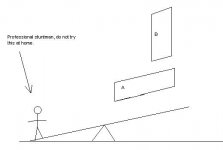
You mention lever and it made me think of this. In the earlier diagram, contact points were identical, which can be clearly seen. I think, the tip will conform to the ball, which will effect the result. I made my own diagram. Assuming, both weights "A" & "B", fall the same distance and each have identical mass. Which weight will send the little guy higher into the air, or would it be equal? My thought is, some of the weight closest to the fulcrum, would offset some of the weight furthest from the fulcrum.

Tracy
 

Attachments

  • lever.JPG
    lever.JPG
    12.3 KB · Views: 217
Steven!!!!!!

I must confess I don't know who Holmon is either. I meant to say Ralph
Souquet. Sorry bout that!!!!!
Pinocchio
 
Colin Colenso said:
Yow,
A thought that comes to mind regarding masse shots, is that I suspect extreme off center striking is not the critical issue for maximizing spin.

The elevated cue changes the relationship between spin to speed ratio compared to a flat shot. With a flat shot, to achieve the highest spin to speed ratio, extreme off center hitting is required. But with masse shots, all that is required is maximum spin, as the speed variable can be altered by changing the elevation of the cue. Steeper = less horizontal speed.

It may be that it is easier to produce more actual spin, consistantly with a larger diameter tip, due to lessening the chance of a miscue when striking firmly at the outer edges...a larger sweet spot one could say. Which gives you confidence to strike with the high speeds required to generate more spin.

And that generating maximum spin for many masse shots requires offset hitting of around 10-12mm, rather than at the maximum offset range of around 16-18mm.

btw: I cannot see a reason why a small diameter tip can effectively contact a CB further off center than a large diameter tip, unless perhaps a more tightly rounded tip has better gripping capabilities with extreme offsets. But a larger tip could be shaped such that on extreme offset shots, the angles of the connecting surfaces are more or less the same as for a smaller tip.

Colin

Note: I'm pretty certain there would be a relationship between maximum gripping offset and speed of hit. Such that the miscue point for a soft stroke may be 18mm while a very hard shot maybe 15mm. Also, the tip shape / curvature (which changes the surface area of contact) would be a variable with similar effect.

While surface area does not necessarily influnce the amount of spin, or the amount of friction in most cases, I suspect it is crucial at the maximum offset position.

You don't impart more spin with masse shots. It's just a different spin. When applying english with a level cue, the rotation axis is close to vertical. When you elevate your cue, the axis becomes more and more horizontal. The difference is that a ball hit with a level cue spins like a top while an elevated cue would look something like a bowling ball.

The tip can spin the cb because it sticks. Essentially the tip rolls over the surface of the ball. Since the tip cannot spin, all the perpendicular force is applied to the ball. In order to spin the cb at a higher rate, you must lengthen the contact time between the tip and the cb. You must also ensure that the tip remains in contact with the cb. To lengthen the contact period, you use a rounder tip. For the most spin possible, you would use a tip shaped like a ball, or exactly 1/2 a sphere. So with a 13mm tip, you round it off to a curve with a 13 mm diameter. It should be perfectly round from the very tip to the ferrule. Unfortunately, with a tip shaped this way, it would be impossible to shoot without spin. To ensure that the ball and tip stay in contact throughout the hit, you use a smaller diameter shaft. You want the ball to remain as stationary as possible. The smaller tip has less mass will therefore deflect more than the cb. CB stays put, tip deflects to the side. The shaft however has some recoil properties and will push the tip back into the ball so you maximize the friction between tip and ball.
 
RSB-refuge:
I'm not sure how your question relates to the tip diameter/spin topic, but I'll take a first cut at a solution.

If both masses were released from the same CG height, mass A would end up falling further (because at its final position, its CG would be lower) and therefor impart more energy to the jumping guy.

I assume that this is not the answer you wanted, so lets try to solve the problem where both masses start at a CG height such that they will end at a final position the same distance from the starting position (I believe this is your original intent). We'll also have to assume that the jumper is an expert, and can adeptly absorb all of the incoming energy of the falling mass by flexing his leg muscles at the right time. Then the solution is simple. Both masses will launch the guy to the same final height. Its a simple energy conservation issue - all of the kinetic energy of the falling mass is transfered to the jumper. The kinetic energy of the falling mass is only proportional to the distance it falls and nothing else.

I don't think this contributes to the thread, but there it is...
Jon
 
jondrums said:
RSB-refuge:
I'm not sure how your question relates to the tip diameter/spin topic, but I'll take a first cut at a solution.

If both masses were released from the same CG height, mass A would end up falling further (because at its final position, its CG would be lower) and therefor impart more energy to the jumping guy.

I assume that this is not the answer you wanted, so lets try to solve the problem where both masses start at a CG height such that they will end at a final position the same distance from the starting position (I believe this is your original intent). We'll also have to assume that the jumper is an expert, and can adeptly absorb all of the incoming energy of the falling mass by flexing his leg muscles at the right time. Then the solution is simple. Both masses will launch the guy to the same final height. Its a simple energy conservation issue - all of the kinetic energy of the falling mass is transfered to the jumper. The kinetic energy of the falling mass is only proportional to the distance it falls and nothing else.

I don't think this contributes to the thread, but there it is...
Jon
I don't understand the CG lower etc.. :o
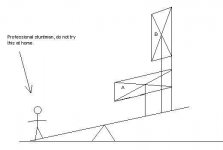
Here is more illustration of what I was thinking. I drew lines from the centers down to the lever. I was thinking since "B's" center is further from the fulrum, it would have more leverage. Assuming both weights, free fall for 2 seconds, before impact with the lever. I know what seems right, sometimes isn't, so if you could explain why not, I'd appreciate it.

Thanks,
Tracy
 

Attachments

  • lever2.JPG
    lever2.JPG
    14.5 KB · Views: 179
Pinocchio said:
Smaller tip imparts more english! Try masse with 14mm an with 12mm. I rest my case! The reason is there is a 12mm shaft behind a 12mm tip.
Pinocchio

THANK YOU! Smaller tip, more english. End of story.
How do I know? 40 years of on-the-job training. Experience counts.
Thanks again Pinocchio for saying this. You are 100% correct!

We don't need a physics dissertation to tell us what we already know.

I will add one caveat. With a smaller diameter tip, the cue ball is harder to control, and requires a better and more precise hit. Just a little bit off and you will miss the shot. But you can do a little more with the smaller tip, if you're good enough.
 
Last edited:
jay helfert said:
THANK YOU! Smaller tip, more english. End of story. ...
Nope, not end of story. If you can't put a number on it, it's not a fact as far as I'm concerned, it's just an impression. How much more can you spin a ball with an 11mm tip than I can spin it with a 13.5mm tip? 1%? 10%? Are you sure your impression is not simply from the fact that the smaller tip hits farther from the center of the ball than a larger tip for a given center-of-cue-stick offset?
 
Last edited:
Someone brought up a dragstrip analogy, and the more I think about it the more it makes sense....

If you take a quality 12 inch wide drag slick, on a prepped track, and run the 1/8 or 1/4......and then take same brand, same height, same compound, only in a 10.5 inch wide drag slick.....well, the difference would likely be minimal......the 12 has more grip, the 10.5 weighs a bit less and has less resistance.....but both tires make a huge difference over a set of street tires :D

A smaller tip can hit lower, but a larger tip has a larger contact patch.....methinks that the actual grip of the tip.....proper scuff, chalk, stroke, shaft....all that stuff is much more important than tip size...

Yeah, I know it's anecdotal, but it sounds right ;)
 
Big Perm said:
Someone brought up a dragstrip analogy, and the more I think about it the more it makes sense....

If you take a quality 12 inch wide drag slick, on a prepped track, and run the 1/8 or 1/4......and then take same brand, same height, same compound, only in a 10.5 inch wide drag slick.....well, the difference would likely be minimal......the 12 has more grip, the 10.5 weighs a bit less and has less resistance.....but both tires make a huge difference over a set of street tires :D

A smaller tip can hit lower, but a larger tip has a larger contact patch.....methinks that the actual grip of the tip.....proper scuff, chalk, stroke, shaft....all that stuff is much more important than tip size...

Yeah, I know it's anecdotal, but it sounds right ;)

This makes no sense...You're comparing a tire on a road to a tip on a ball. A tire on the road is a flat surface contacting another flat surface. The tip is a rounded surface and it contacts a sphere. The only way to increase the contact area between the two surfaces is to change the roundness of the tip, much like changing the air pressure in the tire. Does your tip have a ridiculously larger contact patch on the cb than another ball?? Another ball is significantly bigger than your tip but the difference in contact area is negligible.

As I said before, the most important factor with regards to spin is the roundness of the tip. I would think the next most important factor is the material of the tip. Tip size does have a small role but mostly because the thinner shaft and less so because of the actual size of the tip. I mentioned earlier that there would be a difference in inertia, but again, probably negligible.
 
Drew said:
This makes no sense...You're comparing a tire on a road to a tip on a ball. A tire on the road is a flat surface contacting another flat surface. The tip is a rounded surface and it contacts a sphere. The only way to increase the contact area between the two surfaces is to change the roundness of the tip, much like changing the air pressure in the tire. Does your tip have a ridiculously larger contact patch on the cb than another ball?? Another ball is significantly bigger than your tip but the difference in contact area is negligible.

As I said before, the most important factor with regards to spin is the roundness of the tip. I would think the next most important factor is the material of the tip. Tip size does have a small role but mostly because the thinner shaft and less so because of the actual size of the tip. I mentioned earlier that there would be a difference in inertia, but again, probably negligible.

Drew, I think we were going the right direction with the discussion last night. Smaller tip = more spin.

I say someone starts a poll and sees what the majority of the forum thinks...
 
despotic931 said:
Drew, I think we were going the right direction with the discussion last night. Smaller tip = more spin.

I say someone starts a poll and sees what the majority of the forum thinks...

I agree with bob that it might seem so because you're able to hit further away from the center. A smaller tip is capable of putting more spin on the cb but mostly because of the ability to hit such extremities. Also the fact that it's harder to hit center ball with a smaller and rounder tip you might think that your tip spun the ball a lot when in reality you just missed your hit. I think that the stiffness of the shaft has a much more significant role in the issue than the size of the tip. So, smaller tip = thinner shaft = more spin
 
Wow, my head is spinning a bit!! I do not claim to really know this answer, but I am leaning a bit more towards a smaller tip being easier to get maximum spin. I have to be honest that this is mostly a gut feelin from my experience ( or at least what I believe is happening in my experience). I have no facts or figures to quote to back it up.

Just a couple thoughts.

I believe that a smaller tip is better for maximum spin, but I feel that the diff between a 12mm or 13 mm is mostly inconsequential to fuss about.

I do believe that if you used extreme diff in size it would be evident, but you will still favor one over the other due to how it feels in your hand, and the feel of the hit. I do not think that the slight diff in available spin would change your preference in which to use in play.

I feel that a smaller tip gives you more options of places to hit on the cue ball, and therefore more control ( and subtle vaiations) , assuming you have a developed stroke.

This is the reason why there is a preference of larger tip diameter for break and jump cues. It reduces the chance of mis hitting the cue ball when you are trying to get maximum power or lift. It is essentially reducing one of the variables of a shot where typically there are greater concerns than pin point cue ball control.

I think a smaller tip will get more spin ( all other variables being equal), but more is not always better. You want to have a lot of spin available, but also have it be controllable.

There is almost always a trade off of some sort when it comes to variables. If we hypothetically prove that smaller gets the most spin, everyone will not run out and buy 9 mm shafts because of it. There is more to consider than that. Also, type, condition,and radius will have quite a bit to factor in. The biggest diff, would be the players stroke!! If I can get x amount of spin with my shaft compared to only x amount that you are getting with yours, it really does not prove a thing.
 
Drew!!!!!!!!!

Smaller tip-smaller shaft=more spin Seems to me like I've heard thar some where before. Good rep for you!!!!!!!!
 
Some backgroung on this debate

Well Bob...I thought for a minute that we were gonna be on the same side... but now that I see what’s going on…I'm going to take a minute to try to get everyone up to speed...this will be the Nth time this has been argued on this and several other forums. Apparently 2 years is enough time for me to forget and try again...a position I will most likely be sorry for.
What is being argued is the conclusions of an early model/study, written by a fellow named Shephard, which is generally considered the seminal treatise on the physics of pool and the ‘phenomenon’ of squirt or deflection. I’m truly sorry but the only link to it I am aware of does not work for me right now.
http://www.sfbilliards.com/Shepard_squirt.pdf
Possibly someone can suggest an alternate source so those who are interested will have an opportunity to read/study it.
The basis of the argument is succinctly stated in a thread I innocently started in Feb ’05 titled Deflection, Endmass and Shaft Design. It is easily searched in the archives of this site.
Basically I questioned the completeness of the model and suggested some additions/changes to the model and methods to experimentally disprove/prove several shortcomings that are commonly written off as “not intuitive” when , in fact, the divergence between what is learned/observed is so diametrically opposed to the findings of the model it literally begs an answer to the central question “Are you going to believe me or your lying eyes”. My advice is to not be too quick to adopt or give up on a pursuit based on ‘scientific evidence’ of persons marketing products or images.
It is, in my humble opinion, a cautious exercise of blind faith (the kindest possible explanation) for the many who are invested (financially and academically) in the precise outcome of this fledgling model of the dynamics, statics and finite element analysis of the interaction of pool balls. At this point I would like to point out that each of these disciplines traditionally begins with a few assumptions, a prediction and a model then vigorously pursues how to improve it. Anything less invites gross error.

I would like to improve on the model. I believe as we approach a worthy solution we will be rewarded with results that will intuitively resemble observed behavior.

just my opinion,,,you be the judge.
 
I suppose this could be argued to the last degree. It really doesn't mater what I think or anyone else thinks. If a small/large tip does in fact produce more spin how much more can it be? If you "can" draw/follow 18 feet (just as a number) what more is needed? After some point your beyond the realm of control. I can spin the ball with either but prefer a fat shaft.

Debating this is really pointless. Its the player that spins the ball. Its obvious that every player has limitations so what difference does it make?

Rod
 
I think it is easiest to visualize a draw shot. My 2 cents.

With a smaller shaft you are able to hit lower on the ball, becuase with a thicker shaft you reach the limit of how low you can hit before the tip actually hits the table. Therefore the hit is a more focused hit with a smaller diam.

With a larger diam. the hit is less focused and hits a larger area and lays on the cue longer. Therefore pushing the cue ball for a longer time and distance before begining the spin. Meaning that the striking force has more push with a larger tip.
Assuming tip radius, weight of cue, tip hardness, speed of stroke and follow thru are all the same.
 
Back
Top