Fact or Fiction - Drawing a ball without hitting anything

While having dinner at the MGM last month at the Mosconi a group of us brought up that topic. One of the group mentioned that they witness someone attempting to draw from a ball that was at the other end of the table and it was hit pretty firm. The cue ball traveled across the table and then came to a full stop just before striking the object ball.

I can see this happening but not with a level cue. It would have to be somewhat elevated and struck firm. Almost like a pique shot but not quite as elevated. A pique shot will move forward and then stop and reverse back to you. I'm not sure of the spelling of pique
 
Last edited:
He claimed he could do it with a level stroke, but did he say anything about the table's orientation? :grin:
 
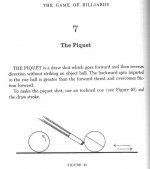
The page from Clive's book on the Piquet shot.
 

Attachments

  • Piquet.jpg
    Piquet.jpg
    53.6 KB · Views: 435
Last edited:
If that's what he did, it was with some kind of gaff. Maybe a loaded/trick cue ball that he had palmed onto the table. I'm sure he didn't do it with a regular cue ball with a legal shot and a level stroke.

This was an older gentleman that was showing a different proposition shot at the time. He could only shoot a few shots a night before he gave out but his stroke was incredible. I am certainly not saying that I can verify how level his cue was, but the ball was not loaded and his stroke looked totally normal (of course I was at the other end of the table). It was amazing to see as I was standing right by the rail before the ball slowed DRAMATICALLY.

BTW, I bring up your 90 degree cut shot quite often. I've made a little money with it (not making it).
 
For Bob-a similar but different shot

1ball and CB are frozen, aimed directly at the corner(1ball closest to pocket)six or seven diamonds away. 2ball near the short rail near the other corner at the same end where the 1 ball is aimed. Traffic at that end. Since they are frozen-stroke straight through with considerable draw with a level stroke and a smooth follow through. About 2/3 the way to the corner-the two balls separate-the 1ball pockets and the CB slows and stops or slows and comes to rest in position for the 2ball. I forget where I saw it demonstrated-maybe a Grady tape.

Bob-certainly this is a different shot since another ball is involved. But once the balls separate-how different is it? I agree with Grey Ghost-If anybody knows-it will be you or Dr. Dave or Grady or The Beard or????


CueTable Help

@

OK-maybe 5-10 degree cue elevation to check up cb

Thanks
 
Last edited:
The page from Clive's book on the Piquet shot.

What would be the practical use of this shot? The idea is that it goes straight forward and then straight back, right? Why not just shoot the other way and save yourself the trouble? Maybe I've missed something.
 
What would be the practical use of this shot? The idea is that it goes straight forward and then straight back, right? Why not just shoot the other way and save yourself the trouble? Maybe I've missed something.

A good money maker as a proposition shot. That is practical.
 
While having dinner at the MGM last month at the Mosconi a group of us brought up that topic. One of the group mentioned that they witness someone attempting to draw from a ball that was at the other end of the table and it was hit pretty firm. The cue ball traveled across the table and then came to a full stop just before striking the object ball.


Frank, I remember this conversation. The person said that Jay Swanson had such a sweet stroke that he did this shot by accident. It seemed as if he heard this second-hand though and I have my doubts that it actually happened.
 
Frank, I remember this conversation. The person said that Jay Swanson had such a sweet stroke that he did this shot by accident. It seemed as if he heard this second-hand though and I have my doubts that it actually happened.

Thanks Ernie. I wouldn't be surprised if Larry Nevel could do it. He might even be able to do it one handed but definitely not with a level cue.
 
What would be the practical use of this shot? The idea is that it goes straight forward and then straight back, right? Why not just shoot the other way and save yourself the trouble? Maybe I've missed something.
Pique' is a technique in carom billiards in which you get a lot more draw on the ball than you can with a level stick. An example would be where you need to draw almost straight back 6 inches from one ball to another but you don't want to move the first ball more than two diamonds. Try that with a level stick.

Just going out and coming perfectly straight back is not useful except in a very few situations in ball-to-ball caroms. A shot like this from the Artistic Billiard Competition is a kind of pique' but with a little side.
 
... Bob-certainly this is a different shot since another ball is involved. But once the balls separate-how different is it? ...
Well, draw with a level stick can remove up to about 1/3 of the ball's speed before it starts rolling smoothly. With the second ball there, I think that roughly doubles, so the draw will slow the cue ball by a factor of 3.

There is a standard trick shot -- page 140 in Byrne's Treasury of Trick Shots book -- where you have three object balls in line frozen to the cue ball and you can get the cue ball to go out three diamonds and then rocket back with a level stroke.

The double stroke shot mentioned above -- hit the cue ball to the far cushion, hit it again when it comes back, it goes forward a diamond and then draws back -- was in Joe Hood's book in 1908, so it is over 100 years old.
 
Thanks for the post. The illustration seems to show less than 45 degrees elevation. I'd bet against.

It was not uncommon for book illustrators to change things round a little to get them to fit or look better. Not so much of a problem these days, since getting proofs to the author is so easy.

BTW, who came up with the 60 degree rule? Is it empirical or perhaps another of M. Coriolis's gems?
 
... BTW, who came up with the 60 degree rule? Is it empirical or perhaps another of M. Coriolis's gems?
That's from Coriolis and is one result of his technique for aiming masse shots. The actual angle depends on how well your chalk works, so that's empirical.
 
Siz:
... BTW, who came up with the 60 degree rule? Is it empirical or perhaps another of M. Coriolis's gems?
Bob:
That's from Coriolis and is one result of his technique for aiming masse shots.
Bob earlier:
The amazingly simple rule is that when you are in your elevated position, the line of the stick has to point to a spot on the cloth behind where the cue ball is resting in order for the ball to come back without hitting anything.
FYI, Coriolis's technique for aiming masse shots is to aim your tip at a point on the cloth that's on a line from the CB's resting point which is parallel with the desired final rolling path of the CB. This is described in one (or both) of Byrne's books.

pj
chgo
 
Last edited:
Frank, I remember this conversation. The person said that Jay Swanson had such a sweet stroke that he did this shot by accident. It seemed as if he heard this second-hand though and I have my doubts that it actually happened.

Ernie
It was I who told the story and yes it was SECOND HAND. LOL My BS radar went beserk when I first heard it but I have heard it more than
once :eek:

The video Jamison posted reminded me of a trick shot I once saw. Might have been Mike Massey that did it.
The shot was to make the one nine combo hitting the one ball between the
two stripes on the endrail.
He did what Jamison did but when he hit it the second time it went back a little sideways and then came forward.
The layout below is at least close to what I remember.

CueTable Help

 
Well, draw with a level stick can remove up to about 1/3 of the ball's speed before it starts rolling smoothly.
Just a nitpick, but with a tip offset approaching (1/2)R, shouldn't that be almost 2/3'rds of ball speed that's lost (V' = (5/7 X 1/2)V)?

Jim
 
Don't forget to allow for deflection :)

Robert
To the extent that the cloth concedes the squirt component of the CB's initial velocity, the squirt angle will be magnified by its projection onto the horizontal plane--the one that's important as far as determining the CB's direction as it reaches roll. For instance, with a cue elevation of 80 degrees, a squirt angle of 2 degrees in the inclined plane becomes about 11 degrees in the horizontal one. I don't practice masse shots, so I don't know how much of a concession there is by the cloth. If it moves or stretches, does it undo the "damage" as it springs back?

Jim
 
Back
Top