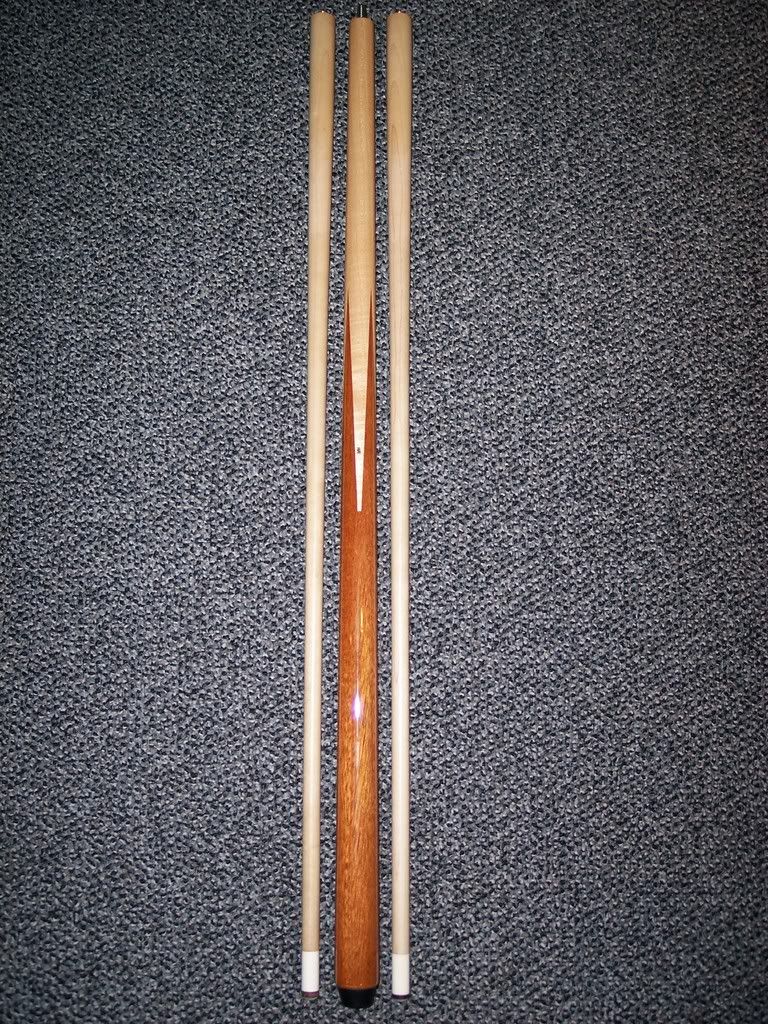
I've read a lot that v groove points have structural benefits because they add stiffness to the forearm. I'm guessing that means it flexes less.
So why is that stiffness in the forearm so important?
Is a sneaky pete like the one pictured going to have a whippy hit because the points are so low and the forearm is basically solid maple?
Is the taper more important than points regarding stiffness?
How does a core affect stiffness? If the cue pictured were partially cored with maple or a rosewood, what affect would this have on stiffness?
Thanks
Ian
Ian, I am certain that many opinions will be expressed throughout this thread so here is mine.
First let me say two cue makers have influenced me more personally than all other combined, and they are Burton Spain and David Paul Kershinbrock.
According to Burton, your statement concerning V-Grooved points would be not be correct, because V-Grooved Points are actually an inlay. Burton believed that any points used in a cues forearm other than Full Spliced Points weakened the structural integrity of the cue and detracted from the solid feel of the cue. I also agree with this and while it is not common that V-grooved points fail I do think they can effect the firmness of the cues hit.
When it comes to firmness of hit, I think taper has a great effect on how a cue feels when the tip strikes the cue ball where firmness of hit is concerned. A pioneer in this thinking and the man most responsible for experimenting with and designing cues built in this manner is David Paul Kershinbrock. David developed what is now know as the Parabolic Taper or Double taper of a cues forearm. This design is made using a Parabolic Curve which focuses this power in a manner that intensifies the transmission of power at contact with the cue ball. This technique has been adopted by ever cue maker who had the opportunity to work with Paul and by many others who want their cues to be firm to stiff hitting. Some examples of Cue Builders who are currently using or used this technique or a variation of it are South West, Bender, Omega DPK, and many others.
Coring can also be done to stiffen the hit of cue. This is normally done when softer hitting woods are used as a forearm wood. Each wood has it's own hit and this can even differ when using wood from the same family. Coring is also done when using woods that are not straight grained, have intense figure, or have know structural instability such as Burls, intense Birdseye, and many other beautiful variations of either.
Purple Heart is a Good coring wood if you want a stiff hitting cue, and it is used to strengthen many softer or non-straight grained woods for this purpose. Straight grained Sugar maple which is the hardest variety of Maple is also used for this purpose by many cue builders. But in the end the type of wood used in a core will reflect how a cue maker wants his cues to hit whether stiff, soft or in between.
Hope this helps