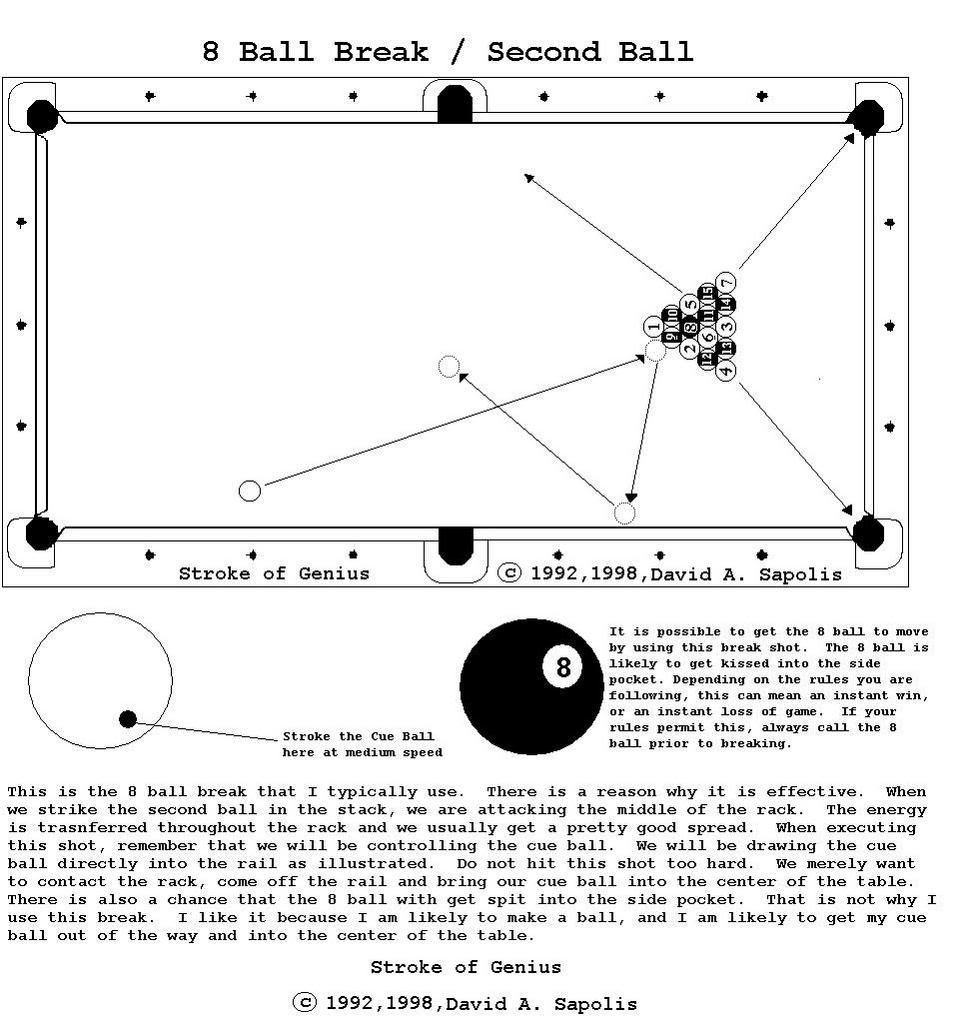
hitting head ball or 2nd ball in 8 ball break

A little over a week ago, I was playing in a local 8-ball tournament. Using the 2nd-row break, I snapped the eight twice in four matches.

The kicker was, when I was warming up between matches, I snapped the 8-ball *three times in a row*. It was sick. :D

Naturally, I haven't been able to replicate that perfect break stroke I had that day since. :(
 
I like second ball w/low inside english. The inside english throws the cb back into the back for a second break.
 
Head ball vs 2nd ball

manwon said:
Hello Partner, the current break you are using I think is the easiest to attain good results from. I find that using your current break from the position you have outlined, I generally can keep the cue ball in the center of the table after the break. (When aiming at the head ball no matter where from, you must attempt to hit as full as possible, or it will glance off the rack and go behind the rack) I do this by hitting the cue ball about a tip below center and about a half tip off center left if breaking from the left, and just the opposite if breaking from the right. Upon hitting the head ball with the cue ball it will deflect to the side rail and back out to the center of the table, and also remember that when breaking, do not hurry your break.

This is a problem that many people have, and they just do not understand why they do not not have good results. The number of warm-up strokes taken also should be very numerous, I normally take between 8 and 11 for break shots due to the force with which I hit the cue ball. Another thing that will improve your break is a more up right stance. Normally when shooting a shot my chin is almost touching the shaft, however, when I break, I am at a almost erect stance. This way I can put my upper body into the break for additional follow through and power.

Last of all remember when breaking and only when breaking it matters not which ball you look at last. Normally when going through your warm-strokes you glance back and forth between the cue ball and the object ball. But you must be focused on the object ball when contact with the cue ball is made. This is not the case with the break shot however, in fact I would recommend looking at the cue ball upon contact. Again the force used and the follow through necessary for a good break, along with the importance of keeping the cue ball under control throughout this process, I like to focus on the point where I strike the cue ball.

The thing I have found when breaking near the side rail into the second ball, is that many times you will get so much action that a ball will rebound into the cue ball and change it's final position. When using this break I hit the cue ball a little more center than the break above, but still slightly left of center when breaking from the left. When I hit the second ball I like to hit as close to the head ball as possible, and I use a draw stroke so that it will rebound off the rail and head toward the center of the table between the side pockets.

By the way, if you continue to come up empty on your breaks move the position of the cue ball a little right or left from your normal breaking point, or move to the other side of the table.

Hope this helps, and have a great night!!!!!

If you use both the head ball & 2nd ball break, what determines your preference?
 
I use the second ball break from the right rail almost exclusively and am pretty successful both making the 8 or something else. The key I feel is low inside english. Hit it at about 75% with a very level cue. You can not hit down on the cueball or it will be in the air when it hits the rack and will fly off the table.
It must work, remember when the pros play 8-ball in IPT they used a break box to negate this type of break.;)
 
Russ Chewning said:
Exaggerated follow through is also key..

Ace... You are putting inside english on the cueball during this break? Is this a typo? When I use outside english, the cue ball is often stopped in the middle of the table by colliding with a ball from the opening stack. It's nearly impossible to get through the rack and scratch in the opposite side pocket, and I have never scratched in the opposite corner pocket..

I would think that putting inside english would tend to cause a scratch if you hit the second ball too thin, whereas usng outside just causes a less effective impact on the rack..

Russ

I know what you're saying, it just seems I get better breaks with the inside english. Maybe it's my imagination. I'll experiment next chance I get.

BTW, another caution is not to elevate the cue too much. Just so happens that last night I made the eight on the break but sent the cb off the table. Take it from me, this is not an especially enjoyable way to lose. :mad:
 
Hmmm....we seem to be running about 50-50 on whether or not low inside or low outside is used on the second ball 8-ball break (if breaking from the right hand long rail). Maybe somebody ought to start a poll :D :D :D !!!

I've tried every conceivable position/english possible for the second ball break and all I can come up with for certain is that the second ball MUST be hit squarely. At least to work for ME it does. But then, I possibly have the WORST stroke of anyone here on the Az forum. Therefore I now exclusively use the front ball break.

Maniac
 
Maniac said:
Hmmm....we seem to be running about 50-50 on whether or not low inside or low outside is used on the second ball 8-ball break (if breaking from the right hand long rail). Maybe somebody ought to start a poll :D :D :D !!! Maniac

It just seems to me that the action off the rail that the inside english provides is what results in more balls being pocketed. The cb spins into balls that are moving toward the pocket and gives them an extra nudge. :)

The cb struck with outside english, though safer, seems to move against the flow.
 
If we are polling, then I vote for the inside english on the 2nd ball break. That way I get the CB to go 2 rails w/running english back into the rack and smack the 8 somewhere.

I'm trying to develop a front ball break for 8 ball, but it seems all I can do on some tables is break the rack all over hell's half acre w/o dropping a ball (runouts ensue :( ).
 
8_Ball_Break_2nd_Ball_instr.jpg
 
Spooky!! I was just going to mention your article about the side rail break Blackjack. I saw this on your old site at least a few years ago and it has helped me a lot.Thanks for sharing it again with the group:)
 
Blackjack said:

"trasnferred"

:D

I always figured outside english would contribute to shooting the cue into the corner pocket. I'll have to give this a shot next time I'm at a table.
 
oy relax R.C., wasn't meant as a potshot at you... honestly I thought you'd get a chuckle out of it. Oh well, back on topic -

Blackjack's pic was a diagram of this break with either a really nice stroke or a pretty slow speed because it draws the cueball moving backward quite a bit relative to the second ball (hitting the side rail a bit above the rack). When I do this break I don't get that kind of action usually, I hit the side and the ball is moving mostly sideways. It almost always gets kissed by something. When it doesn't, and if I did unusually crappy low outside, it banks cross corner for a scratch.

I tried low inside but didn't like it, hard to say why. I didn't see any obvious improvement over low outside. I guess you could keep the cueball a touch closer to the rail with the new aiming point.
 
I've tried the second ball break but I have trouble with the cue ball flying off the table. Maybe I hit it too hard.

I finally settled on breaking from the headspot and try to hit the front ball flush. I hit the cue ball hard. If you you do it right (and the balls are racked tight) it spreads the balls out nicely.
 
CreeDo said:
oy relax R.C., wasn't meant as a potshot at you... honestly I thought you'd get a chuckle out of it. Oh well, back on topic -

Blackjack's pic was a diagram of this break with either a really nice stroke or a pretty slow speed because it draws the cueball moving backward quite a bit relative to the second ball (hitting the side rail a bit above the rack). When I do this break I don't get that kind of action usually, I hit the side and the ball is moving mostly sideways. It almost always gets kissed by something. When it doesn't, and if I did unusually crappy low outside, it banks cross corner for a scratch.

I tried low inside but didn't like it, hard to say why. I didn't see any obvious improvement over low outside. I guess you could keep the cueball a touch closer to the rail with the new aiming point.

No problem, man..

Yeah, the draw action is what I get when I hit the low outside stroke well.. Key is to get a full hit on the second ball. This usually doesn't happen unless you aim the second ball thin and put a good stroke on it. The deflection "bends" the cueball into the correct path to get a full hit on the 2nd ball, which creates the draw action.

Russ
 
head ball & 2nd ball -WHEN?

manwon said:
Hello Partner, the current break you are using I think is the easiest to attain good results from. I find that using your current break from the position you have outlined, I generally can keep the cue ball in the center of the table after the break. (When aiming at the head ball no matter where from, you must attempt to hit as full as possible, or it will glance off the rack and go behind the rack) I do this by hitting the cue ball about a tip below center and about a half tip off center left if breaking from the left, and just the opposite if breaking from the right. Upon hitting the head ball with the cue ball it will deflect to the side rail and back out to the center of the table, and also remember that when breaking, do not hurry your break.

This is a problem that many people have, and they just do not understand why they do not not have good results. The number of warm-up strokes taken also should be very numerous, I normally take between 8 and 11 for break shots due to the force with which I hit the cue ball. Another thing that will improve your break is a more up right stance. Normally when shooting a shot my chin is almost touching the shaft, however, when I break, I am at a almost erect stance. This way I can put my upper body into the break for additional follow through and power.

Last of all remember when breaking and only when breaking it matters not which ball you look at last. Normally when going through your warm-strokes you glance back and forth between the cue ball and the object ball. But you must be focused on the object ball when contact with the cue ball is made. This is not the case with the break shot however, in fact I would recommend looking at the cue ball upon contact. Again the force used and the follow through necessary for a good break, along with the importance of keeping the cue ball under control throughout this process, I like to focus on the point where I strike the cue ball.

The thing I have found when breaking near the side rail into the second ball, is that many times you will get so much action that a ball will rebound into the cue ball and change it's final position. When using this break I hit the cue ball a little more center than the break above, but still slightly left of center when breaking from the left. When I hit the second ball I like to hit as close to the head ball as possible, and I use a draw stroke so that it will rebound off the rail and head toward the center of the table between the side pockets.

By the way, if you continue to come up empty on your breaks move the position of the cue ball a little right or left from your normal breaking point, or move to the other side of the table.

Hope this helps, and have a great night!!!!!


Obviously, you have both the head ball & 2nd ball breaks in your arsenal. Many make the case for using the 2nd ball exclusively. Having mastered both, do you personally use each of them in different circumstances? If so, when? For example, bar table vs 9 footer? or ...?
 
Endymion said:
If we are polling, then I vote for the inside english on the 2nd ball break. That way I get the CB to go 2 rails w/running english back into the rack and smack the 8 somewhere.

I'm trying to develop a front ball break for 8 ball, but it seems all I can do on some tables is break the rack all over hell's half acre w/o dropping a ball (runouts ensue :( ).

I must disagree with the posters who are advocating the use of inside english on the second ball break shot. I believe that our difference of opinion stems from different concepts of what the proper goal of a break shot is. IMHO, the object of the break is NOT to move the 8-ball around or to send the cue ball into the stack a second time. In my mind there are two huge reasons why those are improper goals. First, making the eight-ball on the break is still a relatively low-percentage proposition under any circumstances, and in official tournament play it doesn't even result in a win, so why try for it at the expense of cue ball control? The second, related to sending the cue ball into the rack a second time, is that sending the cue ball back into the rack can often lead to it ending up in the rack, which nobody wants.

To my mind, the object of the break should be to put yourself in a position to control the table either by running out, or by getting to a point where you can lock up your opponent or put him in some other unfavorable situation. Towards that end, you want to make a ball, spread them out reasonably well, and put the cue ball in the center of the table to maximize your chances of having a shot after the break. If that is what you want to do, and you're contacting the second ball, you would WANT to use outside english!

Edit: BTW, I usually contact the head ball, and I've found that it helps to experiment with different speeds and cue ball locations. All tables break differently, and the same table may break differently from hour to hour based on changing conditions, such as humidity or accumulated dirt on the balls and/or the cloth.
 
Last edited:
Back
Top