
How fast is this table?

Is your table faster tan this one?

  • Yes

    Votes: 12 48.0%
  • No

    Votes: 7 28.0%
  • Don't know

    Votes: 6 24.0%

  • Total voters
    25

JoeW

AzB Silver Member
Silver Member
How fast is your table?
I would like to know if my table is “fast” or “slow” and have devised a way that I can compare it to others if there are some people willing to test their table.

I have a Gold Crown III with one year old Simonis 860 cloth. The table was wiped down with a damp cloth and I waited about one hour before testing.The Super Aramith balls are about six months old and were cleaned with Aramith ball cleaner, polished with a papertowel and then a microfiber cloth.

Balls 1 through three were balanced on the head rail diamonds between the cloth and the rail. I nudged them off balance and let them roll. The cue ball in photo1 shows how the balls were balanced. As can be seen in photo one balls one and three rolled about 1.5” short of three diamonds.
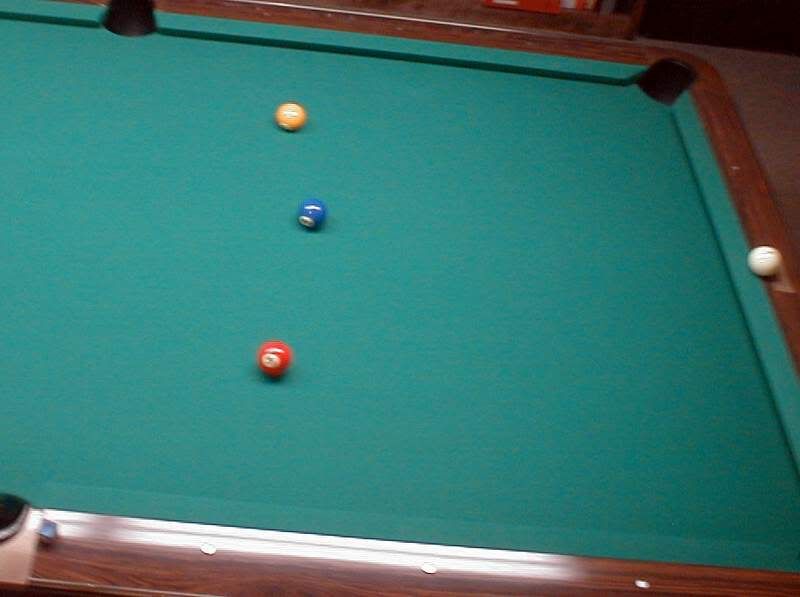
Tablespeed1.jpg


The same procedure was used from the foot rail (see photo 2) and the balls rolled about 1.5” less than two diamonds.
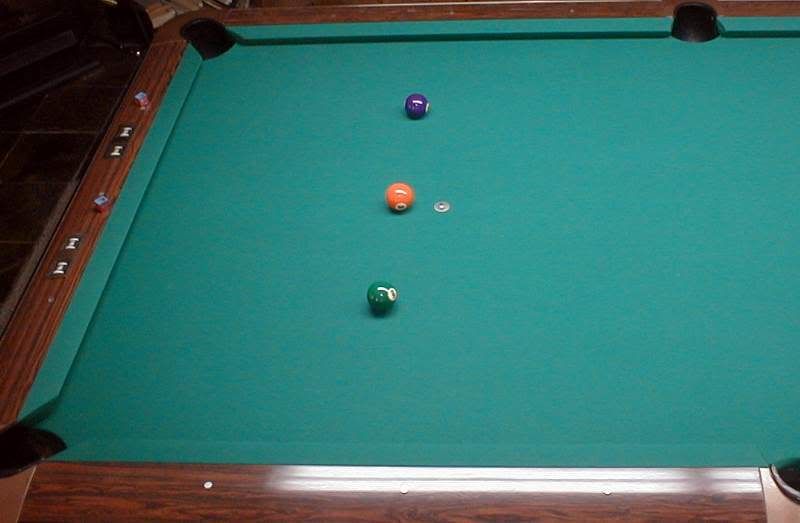
Tablespeed2.jpg


Is this a fast or a slow table?
 
this is a good test.

I used to test the speed of a table by taking both my shafts from my playing cue, putting the joint ends against the short rail, and putting them together, then rolling a ball down the shafts. Similar to your test. I did this to get a speed on tables new to me at tourneys, and compare it to my home table.

any edge is a good edge!

Gerry
 
Would it not also be dependent on what size the table was? Since on a 7 ft bar table, the ball might roll the same distance but it would be different according to the diamonds...
 
It would also depend on what kind of rail rubber is on the rails. K66 is shorter therefore the balls would drop off sooner and roll less compared to K55 which is an 1/8" longer, therefore the balls would have more time to roll forward before dropping off. And this test wouldn't work very well with the Artimus Intercontinental K55 rail rubber because of the profile of the rail rubber being so much different than normal K55 or K66. Why not just make a ramp meter? Or how about the Olhausen Accu-fast rail rubber, the rails are only 1 1/2" thick, yours are 1 3/4" high...wouldn't that make a difference in your test?

Glen:confused:
 
Please forgive me for not knowing this; but is a Gold Crown III always a 9' ? I have a 8' (standard)Olhausen and my balls stop about an inch or 2 shy of your mark (Mine are about 2 1/2 diamond +- 1") . I haven't cleaned my balls recently, and my cloth is about 1.25 years old with about 5 hrs or less a week average play on it. Also Simonis 860. I am curious now I want to do this same test at the hall where I shoot league to see how fast there tables are.

Therefore I voted "no" my table isn't faster.
 
Hey Joe (where you goin' with that gun in your hands ...) (sorry, that just slipped out, must be the wine :p ) ,

I'm very impressed with your idea for every-tables-builtin-stimp-meter ! What a great and ultra-simple idea, the finest kind ! Just be carefull not to nudge too hard, and hope that the rails are not terribly different in height and slope/length, and you've come up with a winner. I'll test out what I consider a fast table later this evening at the hall and post the results.

Dave, thinking this would be a good thing to do at every different table he steps up to
 
I have a Metro so it has the same rails as your gold crown. Super Aramiths roll right to the 3rd diamond.
 
Last edited:
If I place mine where you do, it rolls to the third diamond. I can't remember which cushion profile I ordered when I replaced them...

If i hold the ball on the edge of the cushion and let it drop, it rolls 2 diamonds like yours...

I have Simonis 860 correctly installed with clean balls.
 
oh yeah, I tested both ends of the table and had identical results.

I'd suspect that your cloth is not stretched correctly if one end rolls 2 and the other rolls three diamonds.

You may want to redo it. When it comes to cloth, the old saying really holds true - "if you want it done right, do it yourself"

I've never seen a professional installer even think about evenly stretching cloth... They just slap it on as fast as they can. You should have seen the Sixshooters in Phoenix after they had several tables redone. None of the tables were even close to the same :) The guys they had doinf them had no clue what they were doing or even cared /sigh
 
I like the idea of the chinese-pool style roll test, where two sticks are held side by side and the ball rolls down them. But even that won't be a fair test because some rails are just lower than others. The table with the fastest cloth at my hall happens to have slightly low rails which cause the cueball to hop if it runs into a rail with some speed + topspin (I know that can happen anywhere but trust me it's different on the fast table).

It's hard to say what would be a truly independent test of a table's speed. The balls should be rolled off a ramped surface that's indisputably the same everywhere, and doesn't need to be placed on a rail to make a slope. Something that's universal like a can of soda (but not an actual can of soda, something flat). It's late and I'm not coming up with anything.
 
a couple years ago I saw a ramp product offered for sale on some billiard site. There were two different ones. about 6 inces long I think. I think one of them was angled high enough to make the ball roll the length of the table very slowly. The other was to go half.

These were to level a pool table durring installation. I wanted to buy them but failed to find the site that had them when I ordered all my supplies a few years ago :(

Ever since then, when I get ready to install my table (or a friends) I say I am going to make some but I never do :)


these would work perfect for guaging speed...
 
If you have the Beards Book

CaptiveBred said:
oh yeah, I tested both ends of the table and had identical results.

I'd suspect that your cloth is not stretched correctly if one end rolls 2 and the other rolls three diamonds.

You may want to redo it. When it comes to cloth, the old saying really holds true - "if you want it done right, do it yourself"

I've never seen a professional installer even think about evenly stretching cloth... They just slap it on as fast as they can. You should have seen the Sixshooters in Phoenix after they had several tables redone. None of the tables were even close to the same :) The guys they had doinf them had no clue what they were doing or even cared /sigh
H addresses this phenomena The grain of the clothh will have a diffrent effect from top to bottom than from bottom to top
 
TJLmbkla, my Gold Crown is 9’ I don’t know if all GC III are. Seems to me that one can customize a table when it is ordered from Brunswick

BVal, the purpose of the test is a standard of comparison. I often here people talk about a table as fast or slow. One way to learn what this means is to learn about the speed of the cloth. Once there is a standard then you can drop a ball off the rail on any table and have some idea about how fast it is. This affects the way one plays position.

Rail speed is another matter, for another test that has not, to my knowledge, been made.

I did not know that there was a half diamond difference from head to foot rail until I ran this test. And I do not know if it is the grain of the cloth or improper installation. I have installed cloth four times and it seem to play the same each time. I thought the cloth was installed right as I get obsessive about such things. Now I don’t know and will only find out when I test several tables or several others tell us what they find. Currently I think it is the grain of the cloth but it sounds like at least one other person does not find a difference.

A ½ diamond difference in ball roll depending on the direction of the shot needs to be given consideration during play for many of the positional shots I play.

I don’t know what to do about the different length of rails and I agree it will change the roll. I tried using two pieces of chalk as the platform for the ball. This may work but the ball doesn’t seem to roll very far. Have to think about it.

The ramps are obviously the best way but this would not allow for comparisons unless one had the ramps. Besides I wouldn’t carry them around with me.
 
Last edited:
JoeW said:
The ramps are obviously the best way but this would not allow for comparisons unless one had the ramps. Besides I wouldn’t carry them around with me.
I was thinking about this last night, and if we could find something that is readily available to use as a ramp, something that most people would have or could get easily, would make for a good test. The ramp could be put on pieces of chalk on one end, chalk being a standard size.
 
Go back to the basics put a real level on the table first and look at the slate seams how much wax, bondo or junk is ontop of the slate most installers cant level @ the seams more filler on one side of the seam then the other you have an unleveled slate may only be 10,000 of an inch or more. look @ some realkingcobra's posts and look at he's seams. I have seen seams 4" wide hence a speed bump. On your test your not hitting the seams but that doesen't mean you have leveled slates are you on carpet or concrete are there shims under your feet that might obsorb water and swell etc. etc.....

Most machinist level can level to .00010" @ a foot a mitoyo level is .00025 , so if your slate is 29" wide or deep that adds upto a small number if done right. so if you look @ the seam filler and more is on one slate then the other common sence says stop were not flat we got a hump go back relevel. put any straight edge or ruler on a seam and see if it rocks up and down if it does you got unleveled slates or lots of seam sealer ontop of the slate.

The most common sence answer why the foot are is slower then by the headstring is anyone anyone????? chalk chalk chalk you use it everyshot. Most people dont relize it but upto 75% of all play is down by the rack area more chalk under the cloth here then by the headstring. think about it 8ball, one pocket, straight pool, rotation and 9ball gets a good spreed out.

I can list some more things to look at but I think I opened up big can already so i wont go into the cloth stretch yet but if you can move your cloth its slow and loose..

Craig
 
JoeW said:
TJLmbkla, my Gold Crown is 9’ I don’t know if all GC III are. Seems to me that one can customize a table when it is ordered from Brunswick.....[snip]

It seems then my table is way slower then yours. If you have a 9' and I have an 8' if stop at about at even the exact equivalent of your table, consider that I have 6" less on that side because of the size differences. This calculates that my table in a distance of few feet of Simonis cloth tells me that my table is toooooo slow like I thought! Not to mention I wasn't almost to the 3rd diamond like you.

Maybe it is time to revisit my old thread HERE. I have always felt the the fibers on my Simonis were "broken" in a way I wish I could get a magnifying glass to show you what I mean.

Don't get me wrong, I will do the test again after I really clean the balls, and I'll give the cloth a wipe down before hand first. But don't expect much more then a few more inches.
 
JoeW said:
How fast is your table?
I would like to know if my table is “fast” or “slow” ...
A different method that actually gives you the equivalent up-hill slope of the cloth is described in this article on types of friction. It requires a stop watch and the ability to lag the ball fairly well. This method also allows you to measure the speed of tables you see on videos when there is a shot that rolls most of the length of the table.

Usually the speed of the table is given as the reciprocal of the slope, so a table that calculates out as a 1% slope (0.01) would be described as a 100-speed table. That's sort of slow for pro tournaments, but maybe typical of pool rooms. This topic has been discussed several times in rec.sport.billiard (see Google Groups).
 
Thanks Bob this is a better test. I revised your calculations to come up with a way to quickly evaluate table speed. Rather than use reciprocals I just use the direct calculation and can think in terms of seconds.

Use lag speed from the head of the table so the returned ball does not touch the head rail and start the stop watch when the CB hits the foot rail.

High speed table (5 second to return) = (5 X 5) X 2 = 50
Fast table (6 seconds to return) = (6 X 6) X 2 = 72
Competition table 7 seconds to return = (7 X 7) X 2 = 98
Slow table (8 seconds to return) = (8 X 8) X 2 = 128
Very slow table (9 seconds to return) = (9 X 9) X 2 = 162

Using a 9’ competition table as the standard I come to the following conclusions:
Ball speed is about one diamond slower for each second greater than 7.
Ball speed is about one diamond faster for each second less than 7.

Easy to remember and easy to use. The magic number 7, plus or minus 2!

BTW, my GC III table is about a “7” or competition speed so I can conclude that with my “dropped ball” method, clean cloth and clean balls, the ball should roll just under 3 diamonds from the head and two diamonds from the foot of the table. If other rolls are found it suggests the table is faster or slower.

It would seem that your method is more accurate if one has a stop watch and lags well. My method is quick and dirty but comparable for a GC III. Perhaps you have different thoughts?

It is good to know what you play on and what you can expect on a different table with these quick estimates.

I have been told that the difference between a physicist and an engineer is simple. When told they could take three jumps but each could only be half way to a beautiful naked girl across the room, the physicist said why, as he would never get to her. The engineer immediately jumped. Now we know what a psychologist would do – “Hey miss you wanna step this way please.”
 
Last edited:
Back
Top