It's Geek to Me - Maximum Draw Effect

Patrick Johnson

Fargo 1000 on VP4
Silver Member
How "tight" can your angle of draw be under different ball/cloth conditions?

On Disc 1 of Dr. Dave's excellent Video Encyclopedia of Pool Shots he describes a fairly well known way of estimating the "tightest" angle of draw you can get - essentially triple the cut angle. In order to get the tightest angle of draw you have to hit the CB as low and slow as possible (so it has maximum draw spin when it hits the OB but minimum speed so it doesn't slide very far along the tangent line before curving back).

My question to Dr. Dave (or anybody else) is this: how does ball/cloth slipperiness affect the tightness of the angle you can achieve with a draw shot? With slippery cloth the CB will retain more backspin with less speed, but will also slide farther along the tangent line before curving back. These effects counter each other, so I wonder which one wins? Can you get a tighter draw angle on slipperier cloth or not?

Thanks in advance,

pj
chgo
 
How "tight" can your angle of draw be under different ball/cloth conditions?

On Disc 1 of Dr. Dave's excellent Video Encyclopedia of Pool Shots he describes a fairly well known way of estimating the "tightest" angle of draw you can get - essentially triple the cut angle. In order to get the tightest angle of draw you have to hit the CB as low and slow as possible (so it has maximum draw spin when it hits the OB but minimum speed so it doesn't slide very far along the tangent line before curving back).

My question to Dr. Dave (or anybody else) is this: how does ball/cloth slipperiness affect the tightness of the angle you can achieve with a draw shot? With slippery cloth the CB will retain more backspin with less speed, but will also slide farther along the tangent line before curving back. These effects counter each other, so I wonder which one wins? Can you get a tighter draw angle on slipperier cloth or not?

Thanks in advance,

pj
chgo


PJ: I believe that the answer is yes....SPF=randyg
 
On Disc 1 of Dr. Dave's excellent Video Encyclopedia of Pool Shots he describes a fairly well known way of estimating the "tightest" angle of draw you can get - essentially triple the cut angle. In order to get the tightest angle of draw you have to hit the CB as low and slow as possible (so it has maximum draw spin when it hits the OB but minimum speed so it doesn't slide very far along the tangent line before curving back).
PJ,

Thank you again for your kind and supportive words about VEPS. Tom and I appreciate it.

BTW, the trisect system gives you the angle for a "good action" draw shot, but you can actually achieve a tighter draw angle than this, under any conditions (if the CB is close enough to the OB before the shot).

How "tight" can your angle of draw be under different ball/cloth conditions?

My question to Dr. Dave (or anybody else) is this: how does ball/cloth slipperiness affect the tightness of the angle you can achieve with a draw shot? With slippery cloth the CB will retain more backspin with less speed, but will also slide farther along the tangent line before curving back. These effects counter each other, so I wonder which one wins? Can you get a tighter draw angle on slipperier cloth or not?
The final draw angle depends only on the amount of backspin at impact, which will typically be more with slicker conditions. Now, as you point out, with slicker conditions, and with more speed, the CB shifts in the tangent-line direction more before the CB curves to the final direction (final angle). This causes the CB to swing out wider initially, but if the amount of backspin is greater at impact, the CB will eventually come back at a tighter final draw angle. The final draw angle actually does not depend on conditions for a given amount of backspin at impact. Now, as you point out, what does change with conditions, and ball speed, is the amount the CB shifts down the tangent line before curving back to the final angle. In VEPS, we show how to account for this by shifting your peace sign down the tangent line (for trisect draw or 30-degree-rule roll).

I think the answer to your question depends on how close the CB is to the OB to begin with. If it is close, not much CB spin will wear off on the way to the OB, and stickier conditions will result in "quicker" draw (less shift down the tangent line). However, with larger distance, less backspin is lost with slick conditions. As you point out, this results in a tighter final draw angle, but more tangent-line shift. Here, the "tightness of the draw" will depend on how far back you go from the OB. For an example of what I mean here, see Diagram 4 in my March '08 article. Here, draw has a larger final swerve angle than follow, but follow swerves sooner, so the effective swerve depends on the shot speed and distance. I hope this analogy makes sense.

Regards,
Dave
 
Last edited:
PJ,

Thank you again for your kind and supportive words about VEPS. Tom and I appreciate it.

It's well deserved, Dave. You and Tom have created an instructional and reference resource that surpasses anything else I've seen. I recommend it to everybody I know or meet at every level of play, and those who have bought it also rave about it.

Tom, I apologize for referring to VEPS as "Dr. Dave's" - I recognize your valuable role, but I'm lazy when I type.

BTW, the trisect system gives you the angle for a "good action" draw shot, but you can actually achieve a tighter draw angle than this, under any conditions (if the CB is close enough to the OB before the shot).

The final draw angle depends only on the amount of backspin at impact, which will typically be more with slicker conditions. Now, as you point out, with slicker conditions, and with more speed, the CB shifts in the tangent-line direction more before the CB curves to the final direction (final angle). This causes the CB to swing out wider initially, but if the amount of backspin is greater at impact, the CB will eventually come back at a tighter final draw angle. The final draw angle actually does not depend on conditions for a given amount of backspin at impact. Now, as you point out, what does change with conditions, and ball speed, is the amount the CB shifts down the tangent line before curving back to the final angle. In VEPS, we show how to account for this by shifting your peace sign down the tangent line (for trisect draw or 30-degree-rule roll).

I think the answer to your question depends on how close the CB is to the OB to begin with. If it is close, not much CB spin will wear off on the way to the OB, and sticker conditions will result in "quicker" draw (less shift down the tangent line). However, with larger distance, less backspin is lost with slick conditions. As you point out, this results in a tighter final draw angle, but more tangent-line shift. Here, the "tightness of the draw" will depend on how far back you go from the OB. For an example of what I mean here, see Diagram 4 in my March '08 article. Here, draw has a larger final swerve angle than follow, but follow swerves sooner, so the effective swerve depends on the shot speed and distance. I hope this analogy makes sense.

Regards,
Dave

Thanks for the info, Dave, but I'm not sure you answered the question I was trying to ask (maybe I didn't put it clearly - or maybe the answer is unknown). Let me put it this way:

Set up identical shots (same CB/OB distance and cut angle) on two tables. One table has sticky cloth and balls and the other has slippery cloth and balls. On which table will I be able to draw the CB back so that it passes closest to its original position (the smallest distance to the side)?

You seem to say that the answer depends on the CB/OB distance. Does this mean that at one distance the CB can draw back tighter with sticky balls/cloth and at another distance it can draw back tighter with slippery balls/cloth? If this is the case, which CB/cloth condition is better for shorter CB/OB distance and which for longer CB/OB distance?

Sorry if this is already answered above but went over my head.

pj
chgo
 
Last edited:
It's well deserved, Dave. You and Tom have created an instructional and reference resource that surpasses anything else I've seen. I recommend it to everybody I know or meet at every level of play, and those who have bought it also rave about it.

Tom, I apologize for referring to VEPS as "Dr. Dave's" - I recognize your valuable role, but I'm lazy when I type.
Thanks again PJ. We have been getting excellent feedback on the first two discs. I hope people think the last three are good also. I'm almost finished with the first draft of Disc III.

Thanks for the info, Dave, but I'm not sure you answered the question I was trying to ask (maybe I didn't put it clearly - or maybe the answer is unknown). Let me put it this way:

Set up identical shots (same CB/OB distance and cut angle) on two tables. One table has sticky cloth and balls and the other has slippery cloth and balls. On which table will I be able to draw the CB back so that it passes closest to its original position (the smallest distance to the side)?

You seem to say that the answer depends on the CB/OB distance. Does this mean that at one distance the CB can draw back tighter with sticky balls/cloth and at another distance it can draw back tighter with slippery balls/cloth? If this is the case, which CB/cloth condition is better for shorter CB/OB distance and which for longer CB/OB distance?

Sorry if this is already answered above but went over my head.
Thank you for clarifying.

I think that with a closer distance between the CB and OB, stickier conditions will result in tighter draw (provided the shot speed is not too slow). With short distance (and enough speed), very little spin is lost on the way to the OB, and stickier conditions will have less tangent-line shift, creating "quicker" or "tighter" draw.

I would expect slick conditions to result in tighter draw with greater CB-OB distance (especially at slower speeds), because the lost spin becomes a significant factor. Cue elevation can also be a factor, but I'm assuming you are thinking about a near-level cue.

When I can find some time, I'll combine the analyses in TP B.8 and TP A.4 to provide graphs to answer your questions for all distances, speeds, and cut angles.

Regards,
Dave
 
I think that with a closer distance between the CB and OB, stickier conditions will result in tighter draw (provided the shot speed is not too slow). With short distance (and enough speed), very little spin is lost on the way to the OB, and stickier conditions will have less tangent-line shift, creating "quicker" or "tighter" draw.

I have never considered this before, but my experience on napped cloths does seem to agree with the theory.

Moving to a fast cloth I find that some draw shots become more difficult - and some unplayable - since the c.b. 'runs away from you', and control is lost. But thinking about it, this is only at shorter distances: At long distance I much prefer playing 'tight' draw shots on a fast cloths.

PS
Impressed by the accolades for VEPS from PJ and others - looking forward to receiving discs 1 & 2 soon!
 
Last edited:
How "tight" can your angle of draw be under different ball/cloth conditions?

On Disc 1 of Dr. Dave's excellent Video Encyclopedia of Pool Shots he describes a fairly well known way of estimating the "tightest" angle of draw you can get - essentially triple the cut angle. In order to get the tightest angle of draw you have to hit the CB as low and slow as possible (so it has maximum draw spin when it hits the OB but minimum speed so it doesn't slide very far along the tangent line before curving back).

My question to Dr. Dave (or anybody else) is this: how does ball/cloth slipperiness affect the tightness of the angle you can achieve with a draw shot? With slippery cloth the CB will retain more backspin with less speed, but will also slide farther along the tangent line before curving back. These effects counter each other, so I wonder which one wins? Can you get a tighter draw angle on slipperier cloth or not?

Thanks in advance,

pj
chgo

Edited - never mind, it's been answered.

Learned how to draw a curve on WEI - old dog, new trick.

Chris

CueTable Help

 
Last edited:
How does that work?

Edited - never mind, it's been answered.

Learned how to draw a curve on WEI - old dog, new trick.

Chris

CueTable Help


Do you mind sharing how that is done? Thank you in advance. I have tried, but have not figured it out.

Old dog-already forgot the old tricks

3railkick
 
TATE:
Learned how to draw a curve on WEI
3railkick:
Do you mind sharing how that is done?

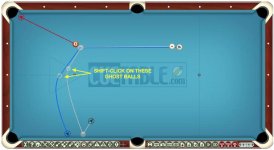
First, draw the lines with sharp corners (be sure "ghost balls" is turned on):

CueTable Help


Then just SHIFT-CLICK on the ghost balls you want to become curves:

wei curves.jpg

pj
chgo
 
re: curve

or you could, as you start drawing your line, press the "C" key and it will curve it automatically. ;)
 
First, draw the lines with sharp corners (be sure "ghost balls" is turned on):

Then just SHIFT-CLICK on the ghost balls you want to become curves:
pj
chgo

I actually did it without the ghost balls. You just draw the line as usual and hold down the shift key and click where you want the curve to begin. You can release the shift key, or if you want to keep curving it you can hold it down.

Cool stuff - now I know about ghost balls too.

By the way, I did experiment with hitting the slow moving draw shot to cereate a tighter angle. It's tricky. It did come back at a tighter angle but it's a touchy shot for sure if there is any distance between the CB and OB.

Chris
 
Last edited:
Back
Top