Kicking Accuracy

So let me see if I have this right:

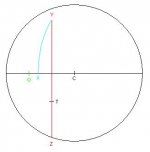
In the attached picture, I find point C which is center ball as I look toward the spot on the rail I'm going to hit. Then I find point O which is the point on the ball's equator opposite the cushion I'm kicking off. I then find point X such that CX = (.4)CO. I then find point Y such that XY = (.4)XA (where A is the top of the ball). I then go back to the frame of reference where C is center ball, and trace line YZ straight down from point Y. And last, I choose point T along YZ for my Tip placement such that I'll have a sliding cue ball when it contacts the rail.

Is that what he's describing?

-Andrew
 

Attachments

  • contact_point.JPG
    contact_point.JPG
    9 KB · Views: 293
Andrew Manning said:
...

Is that what he's describing?

-Andrew
Almost. The vertical line should not be vertical. Z should be at the bottom of the circle, not off to one side. The line YZ should be a sort of diagonal.
 
Andrew Manning said:
So let me see if I have this right:

In the attached picture, I find point C which is center ball as I look toward the spot on the rail I'm going to hit. Then I find point O which is the point on the ball's equator opposite the cushion I'm kicking off. I then find point X such that CX = (.4)CO. I then find point Y such that XY = (.4)XA (where A is the top of the ball). I then go back to the frame of reference where C is center ball, and trace line YZ straight down from point Y. And last, I choose point T along YZ for my Tip placement such that I'll have a sliding cue ball when it contacts the rail.

Is that what he's describing?

-Andrew
Point Z should be the base of the ball. So, the line YZ will be coming at an angle not perpendicular to the bed of the table.

Fred
 
Andrew Manning said:
Hey everyone,

I'm sick of seeing pro 9-ball players play kick safes. It drives me crazy, because it seems to me an impossible thing to make hits that accurate on any but the simplest and shortest kick shots.

How do the pros make difficult kicks and hit not only the correct side of their intended ball, but frequently an exact contact point for a difficult safe? Are a large percentage of those kick-safes lucky, or is their some secret to kicking that I don't know that enables them to have such accuracy?

I'm not just looking for diamond systems, because those are about calculating approximate aim points for complicated kicks. I'm talking about straightforward kicks like long one-railers where I don't need any math to tell me what diamond I'm hitting towards, I just need to know how to make such an accurate hit that I can pocket the ball or play an intentional safety. So instead of finding an approximate aim point for complicated kicks, how do you find an EXACT aim point for more straightforward kicks?

-Andrew


There is an excellent system for making kick shots that may suprise you. It is shown to you on the Jimmy Reid video "Almost Everything I Know". While much of his instruction is mathmatical this particular segment is very simple without using numbers.

I do not feel right about giving his work away--so buy the DVD of one of the really great players who spent time developing his techniques.
 
Andrew Manning said:
..."The natural running sidespin can be a bit trickier, but
there is a geometrical system that you can use to find the right contact
point. This sidespin gives the rebound angle that is closest to the ideal
mirror-system angle. When viewing the cue ball from the rear, find the
point that corresponds to the exact opposite from the cushion on the ball
equator. Then find the point that corresponds to .4 of that distance from
the center equator to that point, and .4R above center; this point would
correspond to natural roll with natural running sidespin. Now imagine a
straight line (from your perspective) from this point toward the exact
bottom of the cue ball, where it touches the table. Find the point along
this line that corresponds to stun (this depends on shot speed, of
course). That is the contact point on the cue ball that will correspond
to stun with natural running sidespin. This sounds complicated in words,
but it takes only a split second to do all this in real time."

Can anyone explain that in simpler terms? He loses me in the description of how to find the exact point he's talking about.

-Andrew
Andrew, for what it's worth, I don't think the above construction is correct, or that natural running english will get you the equal angle rebound off the cushion.

As far as the construction goes, eliminate the point at .4R above center (Y in your diagram). This should be located at the equator, 2/5 of the distance between the ball's center and the point opposite the cushion (the latter being point O in your diagram). Point Z should be located at the base of the ball, as has been indicated. The correct contact point is somewhere on the line between Y and Z, determined by how much draw you need to apply to stun the ball into the cushion.

I can't justify this without getting into a derivation (it's pretty simple), but I'll refrain at this point.

As far as using natural running english, consider that the ball is slowed in the direction perpendicular to the cushion because of its less than perfect elasticity. In order to achieve a mirror-like reflection you need to also slow it down in the parallel direction, proportionately. Natural running english won't do it since its whole purpose is to eliminate the friction.

To get the right amount of spin on the cueball, a somewhat educated estimate is that the 2/5 fraction mentioned above should actually be about 1/5; you need about 1/2 of natural running english. (The correct number may be closer to 1/3.)

Jim
 
Jal said:
As far as the construction goes, eliminate the point at .4R above center (Y in your diagram). This should be located at the equator, 2/5 of the distance between the ball's center and the point opposite the cushion (the latter being point O in your diagram). Point Z should be located at the base of the ball, as has been indicated. The correct contact point is somewhere on the line between Y and Z, determined by how much draw you need to apply to stun the ball into the cushion.
Jal, I think I agree with you so far, but shouldn't the line between Y and Z appear curved instead of straight...at least from the shooter's point of view? If you are looking at the ball as Y being the center, then YZ line should look like a perfectly vertical line. But from the shooter's vantage point, it should look curved. Maybe I'm wrong.

Jal said:
I can't justify this without getting into a derivation (it's pretty simple), but I'll refrain at this point.
Don't know about anyone else, but I would be entertained by your derivation. :p

Jal said:
As far as using natural running english, consider that the ball is slowed in the direction perpendicular to the cushion because of its less than perfect elasticity. In order to achieve a mirror-like reflection you need to also slow it down in the parallel direction, proportionately. Natural running english won't do it since its whole purpose is to eliminate the friction.

To get the right amount of spin on the cueball, a somewhat educated estimate is that the 2/5 fraction mentioned above should actually be about 1/5; you need about 1/2 of natural running english. (The correct number may be closer to 1/3.)
What you say makes sense, but I think it depends on how steep the banking angle. If the angle is pretty steep, then I would agree that you probably do not want full running english. However, if the angle is pretty shallow, then I don't think the CB will be slowed down in the perpendicular direction significantly, so the former derivation would seem quite accurate. I guess it all depends on the perpendicular velocity component of the CB.
 
I think kick shots are very *touchy* due to not hitting the cue ball where you think you are hitting it or where you should be hitting it.

For example try hitting the cue ball straight down the table so it hits the far rail and comes back to hit the tip of your cue. Try this 10 times in a row. Not easy! Any off center hit of the cue ball (left/right) and you put a little spin on it and it will not come straight back.

I think this is the *key* to kick shots. Being able to hit the cue ball *exactly* as you intended - each time, every time.

Then next is using the aiming systems for kick shots along with being able to precisely hit the cue ball.

And then time/experience. I notice I make more kick shots the longer I play. I notice that other people I know who have played (seriously) for say 20 years are quite good at kick shots - much much better than I am.

I made a kick shot last night and pocketed the ball. While it may have appeared that I just walked up and shot it, I actually was taking great care to hit the cue ball in an exact spot and hit the far rail in a very exact spot. I was concentrating about 10 times more when making this shot than with my other shots. Also I have probably shot that same exact shot about 500 times before and missed! So plenty of experience missing with this kick shot before I can finally make it.
 
Jal said:
Andrew, for what it's worth, I don't think the above construction is correct, or that natural running english will get you the equal angle rebound off the cushion....
I think you may be right about the construction. As for whether the "no-rubbing stun" on the cue ball gets you an equal angle of rebound is a good question. The reason for stun (no follow or draw) when the ball hits the cushion is to prevent it from curving after it leaves the cushion. I think that's a good thing. What side spin is needed to bring the angle to the ideal mirror angle is best found in practice, which you need to do anyway to get used to the system. I think the best way to practice is with a mirror or a ball placed at the "spot on the wall" where the mirrored target would appear.
 
jsp said:
Jal, I think I agree with you so far, but shouldn't the line between Y and Z appear curved instead of straight...at least from the shooter's point of view? If you are looking at the ball as Y being the center, then YZ line should look like a perfectly vertical line. But from the shooter's vantage point, it should look curved. Maybe I'm wrong.
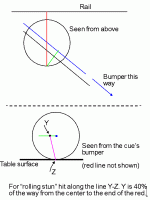
I think you can view all of the relevant lines as lying on a plane perpendicular to the shaft and containing the point O (the point on the surface of the cueball opposite the cushion). From a bird's eye view, the plane would contain the green line in this picture:

Running_English.jpg


Point Y (relocated from Andrew's diagram and Ron Shepard's construction) is at centerball height and located at the intersection of the broken black arrow and the green line. Point Z is in the plane at bed height and underneath the intersection of the blue and green lines.


jsp said:
What you say makes sense, but I think it depends on how steep the banking angle. If the angle is pretty steep, then I would agree that you probably do not want full running english. However, if the angle is pretty shallow, then I don't think the CB will be slowed down in the perpendicular direction significantly, so the former derivation would seem quite accurate. I guess it all depends on the perpendicular velocity component of the CB.
I'm not sure. I did take measurements off of Dr. Dave's videos for kick shots straight into the cushion, and they seem to indicate that the percentage of speed loss in the perpendicular direction is remarkably constant over a wide range of incoming velocities. However, the data was scattered quite a bit so as to not inspire full confidence. But if it's true for essentially all speeds, then even though the perpendicular speed is smaller for shallower angles, you need to remove the same percentage of the much larger parallel speed. This is taken care of by the geometry of the above construction, namely, the location of the point opposite the cushion relative to centerball.

There are at least two other things which vary with incoming angle, bed friction direction and post-impact masse'. They are relatively small but add to the difficulty of pinning down that 1/3 to 1/2 fraction (of natural running english).

Jim
 
Andrew Manning said:
Hey everyone,

I'm sick of seeing pro 9-ball players play kick safes. It drives me crazy, because it seems to me an impossible thing to make hits that accurate on any but the simplest and shortest kick shots.

How do the pros make difficult kicks and hit not only the correct side of their intended ball, but frequently an exact contact point for a difficult safe? Are a large percentage of those kick-safes lucky, or is their some secret to kicking that I don't know that enables them to have such accuracy?

I'm not just looking for diamond systems, because those are about calculating approximate aim points for complicated kicks. I'm talking about straightforward kicks like long one-railers where I don't need any math to tell me what diamond I'm hitting towards, I just need to know how to make such an accurate hit that I can pocket the ball or play an intentional safety. So instead of finding an approximate aim point for complicated kicks, how do you find an EXACT aim point for more straightforward kicks?

-Andrew

Some Observations...

I think speed plays a big factor. What I have noticed and found is that "smooth speed" kicks work much more effectivly than kicks that are struck too hard.....

Choosing the correct kick also plays a big part. I have noticed and found that "good kicks" are not always the "easy" kick.

Most of the time (unless you are in jail) you will have a couple options on the kick. If you really look at the layout, you will notice that some kicks have a better chance of ending "safe" due to clusters of balls on the table or just the general direction the two balls will be going.

In short...When I am forced to kick, I look at the table and ask myself...What kick has the best chance to "get lucky"...

Also....I am not knocking the science behind all this, I think it is very important info to help you understand how this game "works" so to speak....but, even thought they may have vast amounts of knowledge and experience...most good bankers and kickers will tell you when it really comes down to it...You can use systems and math etc. as tools to get you close, but the final equation is "feel"

I know a player that regularly kicks balls in..I have seen him kick three or four in during one match..albeiet on a bar box, but they were not hangers......He uses nothing more than as he puts it "I just look at the contact point on the OB to make the shot and triangulate the shot off the rail until it looks right"

Lastley... I watched Jason Miller hit banks for an hour by himself while he was in AZ, and he only stopped because he had a match to play....I am sure that was only scratching the surface of how many hours of banks he has practiced

How many people have ever practiced even one straight hour of banks or kicks....(If you answer yes, you are probably a good banker or kicker)
 
GADawg said:
Right! PRACTICE is the key. Watch Buddy Halls "How to Win from Here" ( or whatever) video for some good ideas. It is all CB control but on a very precise level. No easy answer other than study and practice.

To kick and just hit a ball you have a window three balls wide. To kick and hit the right spot/side on the OB, the window decreases to less than one ball wide.

Funny you should mention Buddy Hall--he told Grady on an Accu-Stats tape that he has never practiced kicking.
 
Jal said:
Running_English.jpg


Point Y (relocated from Andrew's diagram and Ron Shepard's construction) is at centerball height and located at the intersection of the broken black arrow and the green line.
Okay, now I am thoroughly confused. I would imagine point Y would be the point on the black arrow that is on the surface of the CB, which is basically where the black arrow changes from a solid line to a dotted line. So you're saying point Y is actually inside the CB?

Jal said:
Point Z is in the plane at bed height and underneath the intersection of the blue and green lines.
I don't think there is a point that is on the felt and directly underneath the intersection of the blue and green lines that is still on the CB. Don't you mean the intersection of the blue and red lines?

What I imagine line YZ should be is a longitudinal line that goes from the exact top of the CB to the exact bottom of the CB that interesects my point Y, which is the point where the solid black arrow turns into the dotted black arrow. If you look at this YZ line from above (the bird's eye view), the line will appear to be a ray going from the center of the circle (top of the CB) to my point Y. From the shooter's point of view (direction of the blue arrow), the YZ line will look curved. Am I totally off?
 
jsp said:
Okay, now I am thoroughly confused. I would imagine point Y would be the point on the black arrow that is on the surface of the CB, which is basically where the black arrow changes from a solid line to a dotted line. So you're saying point Y is actually inside the CB?


I don't think there is a point that is on the felt and directly underneath the intersection of the blue and green lines that is still on the CB. Don't you mean the intersection of the blue and red lines?

What I imagine line YZ should be is a longitudinal line that goes from the exact top of the CB to the exact bottom of the CB that interesects my point Y, which is the point where the solid black arrow turns into the dotted black arrow. If you look at this YZ line from above (the bird's eye view), the line will appear to be a ray going from the center of the circle (top of the CB) to my point Y. From the shooter's point of view (direction of the blue arrow), the YZ line will look curved. Am I totally off?
One way to visualize it is: if you take the plane that is perpendicular to your stick and goes through the center of the cue ball (this cuts the cue ball in half and is the 2-D surface often shown in english diagrams), and project the black line (axis of the cue stick, roughly) through to that plane, it intersects the plane at Y. Z is the point of the 2-D ball-sized disk that touches the cloth.

If you consider all of the lines and points and cue ball surface from the direction of the bumper of the stick, you see a 2-D image with a spot that is the farthest point on the cue ball away from the cushion, and a green line that goes from that spot to the apparent center of the disk, and the black dot (from that direction) that is the axis of the stick, and the blue dot that is the line going through the center of the cue ball parallel to the axis of the cue stick. I'll try to include a figure. stun.gif
 
PoolBum said:
Funny you should mention Buddy Hall--he told Grady on an Accu-Stats tape that he has never practiced kicking.


That's really interesting. The entire "How to Win From Here" tape is examples of defensive kicks. Maybe Buddy's CB control is so good that he doesn't have to practice them specifically.
 
jsp said:
Okay, now I am thoroughly confused. I would imagine point Y would be the point on the black arrow that is on the surface of the CB, which is basically where the black arrow changes from a solid line to a dotted line. So you're saying point Y is actually inside the CB?
I'll put up my confusion against yours Jsp, and we'll see whose really befuddled by this whole thing. :confused:

But seriously, I'm pretty sure both of our ways of drawing the lines and locating the points are nearly equivalent, as far as the end results go. We're dealing with tip offsets (or a locus of offsets in the case of the line YZ) which are measured perpendicular to the shaft. As such, you can project them onto any plane which is perpendicular to the shaft. I thought that the plane whose "edge" is the green line was convenient because point O lies on it. That puts point Y inside the cueball, but your way of visualizing it on the surface is perfectly legitimate too. Agreed?


jsp said:
I don't think there is a point that is on the felt and directly underneath the intersection of the blue and green lines that is still on the CB. Don't you mean the intersection of the blue and red lines?
I completely agree, it's not on the CB. To my way of thinking, it doesn't have to be. Any parallel plane will do.

jsp said:
What I imagine line YZ should be is a longitudinal line that goes from the exact top of the CB to the exact bottom of the CB that interesects my point Y, which is the point where the solid black arrow turns into the dotted black arrow. If you look at this YZ line from above (the bird's eye view), the line will appear to be a ray going from the center of the circle (top of the CB) to my point Y.
With some reservations over your first sentence, from what you said after that I also think this is equivalent (functionally) to my way of viewing it. The line YZ, which for you starts on the surface and ends at the contact point with the cloth, when projected onto the aformentioned plane yields the same locus of tip offsets as if you just drew the line directly on this plane

jsp said:
From the shooter's point of view (direction of the blue arrow), the YZ line will look curved. Am I totally off?
Here's where we disagree a little. I guess you're seeing YZ as a curve along the surface, whereas I see it as a straight line from Y to Z, no matter from where it's viewed, and regardless of whether it starts and ends at your Y and Z or mine. I believe the straight line interpretation is the right one, again, because of how the offsets are measured. I'm all ears if you think this is wrong.

By the way, I just wanted to note that although I think Mr. Shepard's construction is a little off - the early version presented here that is - I'm almost certain that he modified it and that's the one I learned about on RSB. I didn't dream this up myself. But I did do the math out of curiousity. On a nearly identical problem in his APAPP - finding the locus of offsets that yield constant spin/speed ratios at natural roll - we get identical results, for what that's worth. The problems are so similar that I have some confidence that the above method is correct.

Jim
 
Last edited:
Bob Jewett said:
One way to visualize it is: ..............I'll try to include a figure. View attachment 24308
Bob,
Your diagram is the same as I pictured in my mind, when I read Ron's quote.
Here is another related question. Is there a line above the cue balls equator that when hit gives the same result? Would it be on the other side of the cueball? IOW, if hitting with follow, does the cue ball need to be "checked"? If there is such a line, would it mirror the other line in reverse? It seems there should be such a line, but the two lines would have to meet at the equator, which is confusing me.

Tracy
 
Thank you Bob and Jal for your clarifications. Although I know now what Ron is trying to describe, I still do not agree with it.

Jal said:
jsp said:
What I imagine line YZ should be is a longitudinal line that goes from the exact top of the CB to the exact bottom of the CB that interesects my point Y, which is the point where the solid black arrow turns into the dotted black arrow. If you look at this YZ line from above (the bird's eye view), the line will appear to be a ray going from the center of the circle (top of the CB) to my point Y.
With some reservations over your first sentence, from what you said after that I also think this is equivalent (functionally) to my way of viewing it. The line YZ, which for you starts on the surface and ends at the contact point with the cloth, when projected onto the aformentioned plane yields the same locus of tip offsets as if you just drew the line directly on this plane
I do not think that my line projected to the aforementioned plane is the same as the straight line that Ron is describing.

Again, if you imagine the line YZ on the surface of the CB, I believe the line should be "longitudinal" in appearance. Try to imagine the lines of longitude on a globe. Each longitudinal line intersects the top and bottom points of the globe. If you project all the longitudinal lines on the 2-D plane that is perpendicular to the plane encompassing the equator and also the plane encompassing the prime meridian, then these projected lines of longitude will not look straight but curved (with the exception of the prime meridian).

Jal said:
I believe the straight line interpretation is the right one, again, because of how the offsets are measured. I'm all ears if you think this is wrong.
I think it's clear that what I describe and what you describe are not the same thing, considering I see a curved line on the 2-D plane and you see a straight line. So one of us must be wrong. Most likely, I'm the one who is wrong considering you, Bob, and Fred seem to agree with what Ron proposed. So please let me know where my reasoning breaks down...

First, try to imagine slicing the CB into thin slabs (or discs) with each cut being parallel to the table surface. The CB will turn into many stacked circular discs, with the disc encompassing the equator (centerball height) as the largest disc. Now, keep in mind the algorithm used to locate point Y on the surface of the CB of this middle disc. Then for the other circular discs, use the same algorithm to find the corresponding point Y on those discs. If you connect all of the Y points of all the discs, you have a longitudinal line on the surface of the CB, connecting the original point Y at the equator and the top and bottom points of the CB. Again, projecting this line to the 2-D plane will not be a straight line.

If I had to guess a place where I err, it would have to be my reasoning to use the same algorithm to locate the point Y on the other discs. Though, without busting out some serious equations, this seems like the logical thing to do.

 
Last edited:
jsp said:
Thank you Bob and Jal for your clarifications. Although I know now what Ron is trying to describe, I still do not agree with it.
I think Bob's second diagram clearly shows what I was trying to put into words. I was writing up my post at the time and didn't see his.

jsp said:
I do not think that my line projected to the aforementioned plane is the same as the straight line that Ron is describing.

Again, if you imagine the line YZ on the surface of the CB, I believe the line should be "longitudinal" in appearance. Try to imagine the lines of longitude on a globe. Each longitudinal line intersects the top and bottom points of the globe. If you project all the longitudinal lines on the 2-D plane that is perpendicular to the plane encompassing the equator and also the plane encompassing the prime meridian, then these projected lines of longitude will not look straight but curved (with the exception of the prime meridian).
Ahh, I now see what you meant by "longitudinal" and agree with you here. For some reason I didn't connect it up with 'lines of longitude'.

jsp said:
First, try to imagine slicing the CB into thin slabs (or discs) with each cut being parallel to the table surface. The CB will turn into many stacked circular discs, with the disc encompassing the equator (centerball height) as the largest disc. Now, keep in mind the algorithm used to locate point Y on the surface of the CB of this middle disc. Then for the other circular discs, use the same algorithm to find the corresponding point Y on those discs. If you connect all of the Y points of all the discs, you have a longitudinal line on the surface of the CB, connecting the original point Y at the equator and the top and bottom points of the CB. Again, projecting this line to the 2-D plane will not be a straight line.

If I had to guess a place where I err, it would have to be my reasoning to use the same algorithm to locate the point Y on the other discs. Though, without busting out some serious equations, this seems like the logical thing to do.
Jsp, another crystal clear description from you.

You did surmise correctly as to where we differ. Looking at the cueball from the shooter's perspective, as per Andrew's and Bob's diagrams, let the positive y-axis point to the left from the center of the cueball, and the z-axis straight up. The equation describing the relationship between the sideways tip offset By, and the vertical offset Bz is:

By = (1 + Bz/R)(2/5)(R)sin(theta)

where theta is the approach angle to the cushion with respect to the perpendicular. It's a linear relationship. The factor (1+Bz/R), where Bz goes from zero to -R, describes the slowing of the cueball from any initial backspin (in order to stun it into the cushion). The rest of it, (2/5)(R)sin(theta), is the offset needed to get the surface speed along the cushion equal and opposite to the ball's linear speed parallel to the cushion. I'm sure your familiar with this: hitting at (2/5) R above center produces immediate natural roll. Sin(theta) selects the parallel linear speed component as the relevant one. (There should also be a divisor of cos(15.7 deg) on the right side of the equation to account for the cushion's height above the ball's equator, but this is nearly equal to 1.)

I'm not sure what choosing the offsets along the line of longitude produces. It seems like it should be the solution to some useful problem, but which one I don't know.

Jim
 
Last edited:
> I used to have a close friend that I played a variation of 9-ball with that helped this. You rack the balls like normal,but you are not rewarded for pocketing a single ball,the only way to win was to 3-foul your opponent. The opening break is a nice soft thin hit on the one from the side rail that brings the cue ball 2 rails to behind the stack. Try that with someone the same speed or better,and see if it helps you the way it did us. Tommy D.
 
Back
Top