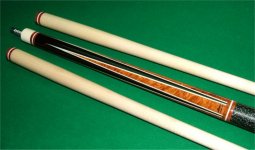
Okay - Lets have it out! CNC vs. Non CNC'd made cues

Jaden said:
So in final answer to this question. CNC has its place, Traditional has its place.

For intricacy of design, CNC can't be beat for the price.

For quality of craftsmanship, feel of hit, and beauty of understanding, traditional cannot be beat.

the first two i agree with but craftsmanship, feel and hit are not exclusive to traditional mehtods by no means. builders who use cnc have as little or as much of those in their work as who don't use cnc.
 
Danny 314 said:
I did not know that till i really looked at a few of his cues... Thanks for correcting me... I'm not reaaly a fan of JW cues, but I always thought the points were sharp...

his earlier work was. i use to have a real nice 8 pointer with loads of mop. i sold it to get my g.szamboti in the 80's and soon after lost the szamboti in a car fire.:eek: i miss them both.:(
 
skins said:
his earlier work was. i use to have a real nice 8 pointer with loads of mop. i sold it to get my g.szamboti in the 80's and soon after lost the szamboti in a car fire.:eek: i miss them both.:(

A car fire!?!?! Ouch... I had a nice Schon stolen out of my car years ago... If i had a choice, i would have rather it burn in a car accident... Then some a**hole would not be shooting with it today... lol
 
Running any kind of machine shop equipment, such as a manual lathe or CNC lathe, is as much art as science.

I am a machinist, and I have had extensive experience programming CNCs, running CNCs, and operating manual equipment as well. Don't think that it is easy to use a CNC. Once the program is written a person just has to load the part in, set up the tooling, make sure their offsets are correct etc., then run the part. It still requires knowledge of RPMs, surface feed rates, tool pressure, linear feed rates, and more. CNCs just do it faster and very very accurately. But it's a moot point. You guys get mad because there is a ten year waiting list for some maker that does it by hand, so you complain. "I wish they would make more cues, blah blah blah". Well there is a way. If the maker uses CNC, they will have accurate work, with more production, better part finish, and less setup time. As Hightower said, if they know nothing about how to make a good playing cue, then it will be a beautiful cue that sucks to shoot with. All CNCs do is allow the maker to save time and/or make more cues. If it is a good maker, the end product will be the same. So if you want nostalgia and insist on strictly non-CNC made cues, then sign up on the ten year waiting list for some guy that does it.
 
i think John Showman said it best to me. "all things being equal what would you rather have a cue from a maker who has made a thousand cues or one who made ten thousand" ( paraphrased ). i believe a makers name and liniage has played a part in the past and will play a part in the future. but as it was before the "name" makers existed a cue makers art, attention to detail, cue building knowledge and anual production is what will make todays and future makers cues more desirable cnc or not imo.
 
macguy said:
Can you explain this, I don't get what you mean by "not a 90 degrees bit".
The answer is that he doesn't understand what CNC means. He's talking about one thing: a CNC router/mill. That's part of the shortsightedness in these posts.

Fred
 
Jaden said:
OH by the way, if they use a CNC in the way you stated to make the v groove, then it really isn;t CNC'd. It's manually done on a CNC..
.

You're definitely confused. Making a V-groove like Joey said with a CNC is still CNC. You can even add automatic indexing if you'd like. It's not "manually done on a CNC."

Fred <~~~ thinks this is why we need more education
 
TellsItLikeItIs said:
Jaden, Your contribution is appreciated, but I'm afraid you have been ill advised on a few things. It sounds to me you are confusing full spliced with half spliced. What you are referring to as "traditionally done points" in the paragraph above, is actually the full splice method (similar to a house cue if you will).

I'm referring to both, and I haven't been ill advised as I do this myself....

The only difference between full spliced and half spliced is that in half spliced, there are four separate points or six or eight, that are individually spliced into the v grooves, with full splice you have two solid pieces of wood that are joined with both having the v groove and then they are fitted together. I'm actually experimenting with doing what would normally be the veneers with four separately full spliced pieces of wood to eliminate the join lines in the individual veneers....
 
Jaden said:
CNC's use a square or round bit which as it turns is moved according to computer coordinates that are programmed in. I guess depending on the CNC machine you might be able to use a 90 bit, but I don't know of any, and it would take more time to set up as opposed to using a traditional router or mill.

There are two main types of ninety degree bits. The conical ninety degree bit and the spherical ninety degree bit which when run along the wood at a an angle will cut the v groove
That is not true.
 
Jaden said:
By completely creating the forearm in square format and THEN turning it down. It allows greater flexibility in the amount of cure time between turning sessions. If you want the cue to resist warping, you have to let the wood rest as you turn it down. With CNCing it is turned down before the inlays are added, this gives less cure time for the joined woods in between turning sessions. It may be negligable, but all of these small negligable things add up to a higher quality cue and a better feel of hit.
This is also not necessarily true. You don't think you can cut CNC v-grooves in a square piece of stock???
 
Jaden said:
I didn't say true V points weren't possible with CNC, they just aren't as true because it's being cut with a smaller bit that will leave fine, well very fine imperfections but still imperfections, But the main point is that I know of no one that uses cnc for points that does V's with them. The biggest difference between the majority of CNC'd points and traditionally made points is the square or flat bottom joining and the v groove. In square bottom, even if the were glued with a press, The sides are flat so there will be gaps and more air pockets and glue bubbles I don't care how closely they are cut. With v Groove and a press, the presure and the forty five degree angle of each side of the square causes there to be NO gap inbetween the wood layers, effectively making it one piece of wood.

OH by the way, if they use a CNC in the way you stated to make the v groove, then it really isn;t CNC'd. It's manually done on a CNC..

.....
Ok. I'm out. :rolleyes:
 
skins said:
no there not. the outer veneer is rounded it's not razor sharp. his inner veneers are though and their put in just like inlays into flat bottom pockets. this being said he is one of if not the greatest traditional cue designer ever in my a****** opinion. :)
Amen, Brother!!! :cool:
 
ScottR said:
This is also not necessarily true. You don't think you can cut CNC v-grooves in a square piece of stock???


Morons like you are why it's impossible to have discussions on topics like this. I NEVER SAID IT WASN'T POSSIBLE. I said of the people I know that use CNC they don't DO IT. I also said that because the majority of people who use CNC use flat bottom, then MOST CNC'd work is inferior to the other techniques. The guy that I replied to with if they do it the way you dexcribe it then it's not CNC'd. Is exactly true. If you put a ninety degree router bit on a CNC router lathe, and just run the bit at an angle to the wood, then there is no difference between that and the other methods. There's no computer control to it. It would in fact take more work and be a waste of effort to do it that way.


Oh by the way if there are other ninety degree bits, then what are they?
 
Last edited:
Cornerman said:
You're definitely confused. Making a V-groove like Joey said with a CNC is still CNC. You can even add automatic indexing if you'd like. It's not "manually done on a CNC."

Fred <~~~ thinks this is why we need more education
You're so right, Fred.

I guarantee that this cue/forearm was built on a CNC machine. The v-grooves were cut with CNC using a 90 degree cutter. The veneers were mitered with CNC. The point stock was squared with CNC. And the whole cue was tapered with CNC.

Tell me how the end result is different than cutting the same parts with different tools.

I'll say it again..... how far back do we go to make "non-CNC" people happy? A foot-treadle-driven lathe, cutting with a bowl gouge? :rolleyes:
 

Attachments

  • forearm 2.jpg
    forearm 2.jpg
    71.3 KB · Views: 186
Jaden said:
Morons like you are why it's impossible to have discussions on topics like this. I NEVER SAID IT WASN'T POSSIBLE. I said of the people I know that use CNC they don't DO IT. I also said that because the majority of people who use CNC use flat bottom, then MOST CNC'd work is inferior to the other techniques. The guy that I replied to with if they do it the way you dexcribe it then it's not CNC'd. Is exactly true. If you put a ninety degree router bit on a CNC router lathe, and just run the bit at an angle to the wood, then there is no difference between that and the other methods. There's no computer control to it. It would in fact take more work and be a waste of effort to do it that way.


Oh by the way if there are other ninety degree bits, then what are they?
And, because you know one way, then there are no other ways?

Who is the moron here?

The reason people cannot have this discussion on here is because people resort to name calling when they have no case.

http://www.grizzly.com/products/C1537
http://www.mlcswoodworking.com/shop...rthtml/pages/bt_ogee.html#edge_banding_anchor

Open your eyes and learn something, Jaden.

Can you prove that flat-bottomed is inferior? How? What about the v-groove cutting away part of the wood that has grown together and introducing new components that potentially have flaws and are not as interconnected?

If a computer runs the bit at an angle to the wood to create a v-groove, then the computer is not controlling it? HUH? Why is that more work? More work than what? What waste of effort?
 
Cornerman said:
You're definitely confused. Making a V-groove like Joey said with a CNC is still CNC. You can even add automatic indexing if you'd like. It's not "manually done on a CNC."

Fred <~~~ thinks this is why we need more education


This is ridiculous, I wish everyone wouyld stop taking what I write out of context and actually look at what I'm replying to. The way Joey described it was using a ninety degree bit and indexing it along at an angle on a CNC machine. What I was saying is that if they do it that way, it's exactly the same; however, it's a waste of effort. All you're doing is running it along the wood at an angle. You need a computer control to do that? With the amount of effort that's involved in setting up a CNC programming, I can't see someone taking the time to stop and change the bit and setup the program and make sure everything is lined up and then running the CNC when a traditional router run at an angle to the wood would take about five minutes to setup and turn just as good if not better. Then change the bit back to setup for a run of something else. Plus, all I said is that the people that I've known that use a CNC to make cues, don't do that. All I said is that it's the SAME thing if that's what they do. MAn you CNC maniacs are friggin crazy. QUIT TWISTING MY WORDS AROUND.

I don't care what any of you say. The only thing that makes CNC's any better at any aspect of cuemaking is the ability to make intricate designs with a lot less effort and skill.

And less skill is the operative word. Yes it takes training, and yes it takes know how, but it takes less skill to actually do the work.
 
Jaden said:
This is ridiculous, I wish everyone wouyld stop taking what I write out of context and actually look at what I'm replying to. The way Joey described it was using a ninety degree bit and indexing it along at an angle on a CNC machine. What I was saying is that if they do it that way, it's exactly the same; however, it's a waste of effort. All you're doing is running it along the wood at an angle. You need a computer control to do that? With the amount of effort that's involved in setting up a CNC programming, I can't see someone taking the time to stop and change the bit and setup the program and make sure everything is lined up and then running the CNC when a traditional router run at an angle to the wood would take about five minutes to setup and turn just as good if not better. Then change the bit back to setup for a run of something else. Plus, all I said is that the people that I've known that use a CNC to make cues, don't do that. All I said is that it's the SAME thing if that's what they do. MAn you CNC maniacs are friggin crazy. QUIT TWISTING MY WORDS AROUND.

I don't care what any of you say. The only thing that makes CNC's any better at any aspect of cuemaking is the ability to make intricate designs with a lot less effort and skill.

I guess you don't think that anything has to be lined up to cut the grooves with a non-CNC machine? You just turn on the machine and it knows how deep to cut, how to turn the stock 90 degrees (or whatever indexing for the number of points), how many passes to make to not bog down the bit, and so on?

This is the key phrase to explain why this discussion is pointless with you.

By the way, how many cue makers have you discussed this subject with? Care to know how many Fred has talked to about it? In depth.
 
I'll reply to this in about two weeks...

ScottR said:
Jaden said:
This is ridiculous, I wish everyone wouyld stop taking what I write out of context and actually look at what I'm replying to. The way Joey described it was using a ninety degree bit and indexing it along at an angle on a CNC machine. What I was saying is that if they do it that way, it's exactly the same; however, it's a waste of effort. All you're doing is running it along the wood at an angle. You need a computer control to do that? With the amount of effort that's involved in setting up a CNC programming, I can't see someone taking the time to stop and change the bit and setup the program and make sure everything is lined up and then running the CNC when a traditional router run at an angle to the wood would take about five minutes to setup and turn just as good if not better. Then change the bit back to setup for a run of something else. Plus, all I said is that the people that I've known that use a CNC to make cues, don't do that. All I said is that it's the SAME thing if that's what they do. MAn you CNC maniacs are friggin crazy. QUIT TWISTING MY WORDS AROUND.

I don't care what any of you say. The only thing that makes CNC's any better at any aspect of cuemaking is the ability to make intricate designs with a lot less effort and skill.

I guess you don't think that anything has to be lined up to cut the grooves with a non-CNC machine? You just turn on the machine and it knows how deep to cut, how to turn the stock 90 degrees (or whatever indexing for the number of points), how many passes to make to not bog down the bit, and so on?

This is the key phrase to explain why this discussion is pointless with you.

By the way, how many cue makers have you discussed this subject with? Care to know how many Fred has talked to about it? In depth.

I'll reply to this in about two weeks. No I won't say why two weeks. I'll just let this go for now and then I'll probably start a new thread because this is so much fun me.... read sarcasm.

AS a teaser, I know exactly how to do all of that fairly easily with a traditional router. Hell I could do it with a 1/2 inch drill some extra wood, some additional off the shelf hardware and a level.

 
Back
Top