
You are using an out of date browser. It may not display this or other websites correctly.
You should upgrade or use an alternative browser.
You should upgrade or use an alternative browser.
Peak Acceleration In Your Stroke?
- Thread starter mnorwood
- Start date


Your stroke should accelerate through the shot...

I think that a few close ball shots require you to be decelerating at contact to avoid a double hit, but otherwise I think it is best to hit at the peak.mnorwood said:Is there any type of shot when the peak of the cue speed is not at the point of contact with the cueball?
Thanks,
Marcus

Bob Jewett said:I think that a few close ball shots require you to be decelerating at contact to avoid a double hit, but otherwise I think it is best to hit at the peak.
Just to clarify, this means at the peak of speed, at zero acceleration.

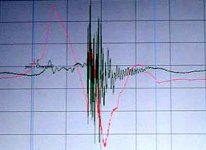
I do it all the time. Poor fundamentals, and chickening out at the last minute. The attached photo is labeled "goodstroke", only because I hit center ball.
The red trace is the forward acceleration, the green trace is side to side swerve.
The red trace shows the cue accelerating from 0g, reaching a peak acceleration about 1/4 the way through. After the peak, the cue is still accelerating, though not as quickly.
Ideally, the hit would occur as the cue reaches zero acceleration again. You can see that the red trace crossed zero before the hit, meaning that it was already slowing down.
The red trace is the forward acceleration, the green trace is side to side swerve.
The red trace shows the cue accelerating from 0g, reaching a peak acceleration about 1/4 the way through. After the peak, the cue is still accelerating, though not as quickly.
Ideally, the hit would occur as the cue reaches zero acceleration again. You can see that the red trace crossed zero before the hit, meaning that it was already slowing down.
Attachments

Did you have something fixed to your tip to measure this?JohnnyP said:The red trace is the forward acceleration, the green trace is side to side swerve.
pj
chgo
Yes. Usually the discussions of these factors quickly run off the rails because some don't understand the relationships of speed, velocity, force, momentum, and acceleration. I hope that doesn't happen this time.mikepage said:Just to clarify, this means at the peak of speed, at zero acceleration.
The technical people can probably answer this with a better answer or explanation.
I recently stumbled on a new type of shot (to me). If you hold the cue stick butt below horizontal and stroke to hit near the top of the CB accelerating through the CB (which to me means the cue tip is actually going faster after it hits the CB), you can put more spin than force on the CB. The result is that the CB will transfer nearly all of its energy to the OB and then stop. This type of shot is useful when the CB is 1 - 6 inches from the OB and you need to move the OB but not the CB.
I am sure there is nothing new under the sun so I just re-invented the wheel with a very nifty shot ? some spin, energy transfer and kill the CB. It is not a power shot but a soft speed shot ? for lack of better terms. Works better than above center draw in some situations.
BTW above center draw may also require an acceleating cue as does a masse.
I recently stumbled on a new type of shot (to me). If you hold the cue stick butt below horizontal and stroke to hit near the top of the CB accelerating through the CB (which to me means the cue tip is actually going faster after it hits the CB), you can put more spin than force on the CB. The result is that the CB will transfer nearly all of its energy to the OB and then stop. This type of shot is useful when the CB is 1 - 6 inches from the OB and you need to move the OB but not the CB.
I am sure there is nothing new under the sun so I just re-invented the wheel with a very nifty shot ? some spin, energy transfer and kill the CB. It is not a power shot but a soft speed shot ? for lack of better terms. Works better than above center draw in some situations.
BTW above center draw may also require an acceleating cue as does a masse.
Last edited:
Bob...I think you could learn something about these shots from Randyg. I've SEEN him strike the CB legally MANY times, with a one inch gap between the CB & OB, at high speed (using an adjusted bridge and grip position), and draw the CB more than table length! In fact, I watched him demonstrate it again to our students last week in Phoenix. I showed it to a class in MI yesterday, and drew the CB 4-5 feet, with almost no effort. It's called the "pierce factor".
Scott Lee
www.poolknowledge.com
Scott Lee
www.poolknowledge.com
Bob Jewett said:I think that a few close ball shots require you to be decelerating at contact to avoid a double hit, but otherwise I think it is best to hit at the peak.
Scott Lee said:Bob...I think you could learn something about these shots from Randyg. I've SEEN him strike the CB legally MANY times, with a one inch gap between the CB & OB, at high speed (using an adjusted bridge and grip position), and draw the CB more than table length! In fact, I watched him demonstrate it again to our students last week in Phoenix. I showed it to a class in MI yesterday, and drew the CB 4-5 feet, with almost no effort. It's called the "pierce factor".
Scott Lee
www.poolknowledge.com
This reads like what I call above center draw. Actually, I guess it is a variation of masse. But then I am one of those untrained in engineering and will patiently wait for corrections to my untutored thinking.

Bob Jewett said:I think that a few close ball shots require you to be decelerating at contact to avoid a double hit, but otherwise I think it is best to hit at the peak.
Not totally knowledgeable at this, I am assuming you are saying that a person hitting a cue ball at say, approx. 5 MPH would be accelerating to that speed and maintaining that speed before actual contact with the cue ball?
Do you feel that newer players have a problem of accelerating through the shot because of inexperience? I guess I mean are they hitting the CB at 4 MPH when going to 5?
And, realistically, the hit should be at a point where your cue stick is at the end of the forward stroke?
Patrick:Patrick Johnson said:Did you have something fixed to your tip to measure this?
pj
chgo
I made an accelerometer board and used double-backed tape to stick it to the butt of my cue. Later, I found a rubber end cap that held the board and slipped over the butt of the cue, so I could move it from cue to cue. Not rock solid, but good enough to show swerve and the general shape of the your forward acceleration.
The signals were fed into a USB data collection system and displayed on a laptop.
I wanted to make a wireless version, but ran out of knowledge.
Attachments


Last edited:

First your title is about acceleration, then you're asking about peak velocity. It might help to know that the two aren't really related. I believe most player's peak acceleration comes several inches prior to contact. The acceleration flattens out to near zero, and contact is made at nearly constant velocity. Understanding the physics terms can be pretty useful when using them.mnorwood said:Is there any type of shot when the peak of the cue speed is not at the point of contact with the cueball?
Thanks,
Marcus
And, at the point of contact, it's not uncommon that people will hit just after their peak velocity (just starting to decelerate).
Fred
You da man, JohnnyP. I knew you were doing this at some point, but I didn't realize you had already graphed it!!! Great job.JohnnyP said:I do it all the time. Poor fundamentals, and chickening out at the last minute. The attached photo is labeled "goodstroke", only because I hit center ball.
The red trace is the forward acceleration, the green trace is side to side swerve.
The red trace shows the cue accelerating from 0g, reaching a peak acceleration about 1/4 the way through. After the peak, the cue is still accelerating, though not as quickly.
Ideally, the hit would occur as the cue reaches zero acceleration again. You can see that the red trace crossed zero before the hit, meaning that it was already slowing down.
Fred
Bob:
I think that a few close ball shots require you to be decelerating at contact to avoid a double hit, but otherwise I think it is best to hit at the peak.
Scott:
Bob...I think you could learn something about these shots from Randyg. I've SEEN him strike the CB legally MANY times, with a one inch gap between the CB & OB, at high speed (using an adjusted bridge and grip position), and draw the CB more than table length! In fact, I watched him demonstrate it again to our students last week in Phoenix. I showed it to a class in MI yesterday, and drew the CB 4-5 feet, with almost no effort. It's called the "pierce factor".
Not sure if you were saying so, but these don't sound contradictory to me. You can get good draw with a decelerating stick. It's the speed at impact that's important, not the acceleration. A bullet is decelerating throughout its flight, but if it hit a cue ball below center (and didn't shatter it) it would cause massive draw.
To avoid the double hit the tip must decelerate quickly after impact, which probably means it must already be decelerating at impact.
pj
chgo
Last edited:
The technical people can probably answer this with a better answer or explanation.
I recently stumbled on a new type of shot (to me). If you hold the cue stick butt below horizontal and stroke to hit near the top of the CB accelerating through the CB (which to me means the cue tip is actually going faster after it hits the CB)
This is a physical impossibility. The cue ball inevitably slows the tip down.
you can put more spin than force on the CB.
Maybe you mean more spin than forward speed? Sure, that's the same as hitting downward. But I doubt you can really hit upward on the CB.
The result is that the CB will transfer nearly all of its energy to the OB and then stop.
Not if you put forward spin on the CB - that will cause it to follow after impact, "hitting upward" or not.
This type of shot is useful when the CB is 1 - 6 inches from the OB and you need to move the OB but not the CB.
Like a stop shot? Why not just use a stop shot?
I am sure there is nothing new under the sun so I just re-invented the wheel with a very nifty shot ? some spin, energy transfer and kill the CB. It is not a power shot but a soft speed shot ? for lack of better terms. Works better than above center draw in some situations.
BTW above center draw may also require an acceleating cue as does a masse.
I don't believe any shot requires an accelerating cue at impact or after. BTW, if by "above center draw" you mean hitting downward above center (the only way it could work), that is masse of a sort.
pj
chgo

Patrick Johnson said:Not sure if you were saying so, but these don't sound contradictory to me. You can get good draw with a decelerating stick. It's the speed at impact that's important, not the acceleration. A bullet is decelerating throughout its flight, but if it hit a cue ball below center (and didn't shatter it) it would cause massive draw.
To avoid the double hit the tip must decelerate quickly after impact, which probably means it must already be decelerating at impact.
pj
chgo
"To avoid the double hit the tip must decelerate quickly after impact, which probably means it must already be decelerating at impact." First half is very true, second half may not be true.
Quantify "good draw" please.....SPF=randyg
Quote:
The result is that the CB will transfer nearly all of its energy to the OB and then stop.
Patrick Johnson said:Not if you put forward spin on the CB - that will cause it to follow after impact, "hitting upward" or not.
pj
chgo
Patrick, If I have a ball about 6 inches off the end rail, the CB at the other end of the table. I shoot to kick behind the object ball using high (forward) english and the cue ball stops dead after impact. Why doesn't the forward allow the CB to advance?