I am unaware of when this might have been "en vogue".
You seem to be not talking about sneaky petes, house cue conversions, which of course have been very popular for a very long time.
When you look at various cue lines, they often start at the bottom with merry widow cues, then progress to pointed cues without veneers, then pointed cues with veneers, then cues with more than four points, box cues, etc.
You can find this trend in a 100 year old catalog, a Gina catalog, a JW catalog, Mali, Meuccie, Joss, and on an on all the way up to the present.
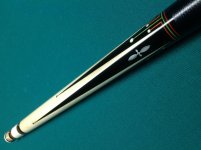
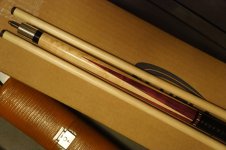
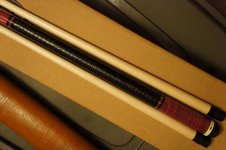
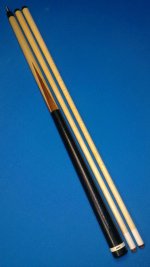
When you get to the eight pointers you will usually find them without veneers around the points. I think the design just gets too "busy" cramming all those veneers in with all those points. But you do find other embellishments using veneers.
The cue that skins posted is a nice example of what I am saying. There are no veneers around the points, but there are veneers used. They are in the rings and what I guess I would call gunsight inlays.
Can a period where non-veneered points were "en vogue" be identified? I am unaware of such a period.
I am very interested in the evolution of cue design and would be very interested if such a trend or period could be identified.
If I had to take a stab at identifying such a period, it would be the eight pointers by such makers as Stroud, Mottey, Gina, Tad, etc from about the mid eighties through the mid-nineties, or maybe 1990 through 2000? Kind of overlaps with the emergence of the popularity of the tuxedo cues which themselves were often done without veneers around the points, though sometimes they did have black and white veneers.
Cues like I am pointing out were made before and of course after the era I am specifying, but they did seem to enjoy an enhanced popularity through the time I am stating. They still are well regarded cue designs and such designs are still done.
.
.