Radial screw??????

JimS

Grandpa & his grand boys.
Silver Member
For a long time I"ve been wanting to ask but hoped I see something that would tell me what "radial" means but I guess I'll just have to ask the stupid question.

I know one when I see one but I have NO IDEA why it's called a radial screw. I can't see how "radial" describes diameter or length or shape or thread count or??? So what's up with Radial?
 
JimS said:
For a long time I"ve been wanting to ask but hoped I see something that would tell me what "radial" means but I guess I'll just have to ask the stupid question.

I know one when I see one but I have NO IDEA why it's called a radial screw. I can't see how "radial" describes diameter or length or shape or thread count or??? So what's up with Radial?

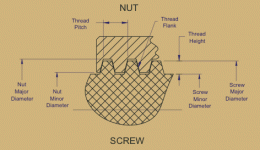
Different screws and bolts have different pitches and forms. Most American and British machine bolts use a 60 degree V form, Acme screws have a flat bottom and nearly vertical sides which is good for movement and this is why most machine tools use them. A radial bolt or pin is neither flat nor V shaped at the bottom. The bottom has a radius. this design came from radial ball screws used in precision machinery such as CNC and even computer printers. With the use of ball bearings, which they are designed to be used with, the screw and nut can move with very little friction and if preloaded, with very minute, if any, backlash.

Dick
 
rhncue said:
Different screws and bolts have different pitches and forms. Most American and British machine bolts use a 60 degree V form, Acme screws have a flat bottom and nearly vertical sides which is good for movement and this is why most machine tools use them. A radial bolt or pin is neither flat nor V shaped at the bottom. The bottom has a radius. this design came from radial ball screws used in precision machinery such as CNC and even computer printers. With the use of ball bearings, which they are designed to be used with, the screw and nut can move with very little friction and if preloaded, with very minute, if any, backlash.

Dick

That's outstanding. One of the most informative posts I've ever read. Rep for you.
 
rhncue said:
Different screws and bolts have different pitches and forms. Most American and British machine bolts use a 60 degree V form, Acme screws have a flat bottom and nearly vertical sides which is good for movement and this is why most machine tools use them. A radial bolt or pin is neither flat nor V shaped at the bottom. The bottom has a radius. this design came from radial ball screws used in precision machinery such as CNC and even computer printers. With the use of ball bearings, which they are designed to be used with, the screw and nut can move with very little friction and if preloaded, with very minute, if any, backlash.

Dick

So.... applied to cue making this would affect the joint by ??? (the term backlash may be the key to my understanding this as I'm confused about that term now. Sorry to be a "dick" and I appreciate the education.)
 
I'm not positive but I think backlash refers to the amount of "slop" certain threads have.
 
How about an image to help

An Acme thread
 

Attachments

  • acme-nutscrew.gif
    acme-nutscrew.gif
    10.5 KB · Views: 471
Last edited:
And then a couple of real images

3/8-10

regular.jpg


Radial

Radial.jpg
 
Last edited:
radial pin

Since I am the person that named it the "Radial" pin I think I can shed some light on why it has this name.

I designed it on my computer and used an arc between the peaks of the threads. That is where the name comes from.

It was designed to be an "interfearance fit". That means there is some compression on the wood that it threads into eliminating all "slop".

I also named the Uni-loc pin.

Bill Stroud
 
The radius on the thread creates more surface area that's in contact with the wood. Also, the threads are not as "sharp". Therefore they don't "cut" into the shaft as quickly which creates a sloppy fit. That's cool. Rep to you too buddy! :D

I had no idea that you named those two.
 
Just a couple of observations by looking at the radial pin.

I would think it would be vital for the tap to be "exact" or even a "frogs hair" under to get the compression one was looking for and needing. Also I can see where maybe crossthreading could be an issue.

And as a side note, if the shaft ever loosened any or one didn't snug the shaft to the butt and hit a hard shot, I can see a possibility of pushing through the threads.

Maybe I am way off, just an observation.
 
radial

It depends on the cuemaker. They can bore the pilot hole to several sizes.
They need plug gauges to determine the exact size.
Smaller hole tighter fit.

The radial holds up very well. To see why look at a cross section of the wood in the shaft. What you will see is a series of humps with awide base between the threads. This is what gives it its' strenght. I have never seen a properly prepared shaft strip thresds.

Bill Stroud
 
VERY informative responses from all of you and great observations and additional questions from Hal. I really appreciate the time spent to educate me.... and the many others who are looking at this thread.
 
bstroud said:
Since I am the person that named it the "Radial" pin I think I can shed some light on why it has this name.

I designed it on my computer and used an arc between the peaks of the threads. That is where the name comes from.

It was designed to be an "interfearance fit". That means there is some compression on the wood that it threads into eliminating all "slop".

I also named the Uni-loc pin.

Bill Stroud

Oh, does that mean you get a royalty for every pin sold from the Uni-Loc corporation? Since they patented what you made they should pay you right? I wonder how they got away with forming a corp. with a name you invented?
 
Sorry to bring up an old thread, but I still don't understand what Blud was saying earlier in the 3/8x11 thread about disagreeing with the radial pin's design because it makes the cue play "too stiff," by not allowing enough flex at the joint. Doesnt make sense to me. How does the type of pin affect flex and deflection, if both flat faces of the joint are in contact with one another. Also, isn't a 3/8x10 considered a BIG PIN as well??

Thanks

blud said:
In my opinion, a radial, pin has to much mass for the joint, being to stiff, causing more deflection than you really want. Keep in mind that ALL joints must have movement when playing. The joint does flex a little.

...I don't agree with the design, and mainly, it makes the cue play to stiff....Some guys love them, I don't.

...when you hit the cue ball, with a big pin or radial, it stiffens up the hit and has not as much flex within the cue, as needed.........If I didn't have my own design, I would go with a 3/8X10. It's not to big, or too heavy.....
blud
 
fullsplicefiend said:
Sorry to bring up an old thread, but I still don't understand what Blud was saying earlier in the 3/8x11 thread about disagreeing with the radial pin's design because it makes the cue play "too stiff," by not allowing enough flex at the joint. Doesnt make sense to me. How does the type of pin affect flex and deflection, if both flat faces of the joint are in contact with one another. Also, isn't a 3/8x10 considered a BIG PIN as well??

Thanks

There has been much discussion on this. The Radial is heavier than a standard all-thread screw because of a fat alignment barrel in the mid-section of the pin. This was designed for ease of centering the pin in the butt. Do a search for pics and you will see what I am talking about. Now, many have followed with adding an alignment barrel to all types of joint screws...3/8-10, 3/8-11, etc. This would add more weight to these as well.

Blud must not have one on his???

Chris
 
But not all Radial type pins have that locating diameter, only certain ones do. So it would depend on which type you put in the cue right?
 
yeah but what does weight have to do with flex, especially since the barrel part is in the butt?
 
Back
Top