
You are using an out of date browser. It may not display this or other websites correctly.
You should upgrade or use an alternative browser.
You should upgrade or use an alternative browser.
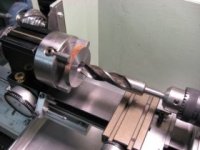
Drilling index holes in lathe chuck
- Thread starter 63Kcode
- Start date

24 is the most common for cue lathes

24 is the most common for cue lathes
24 does make more since! Glad I ask!
Larry
Hi,
Are you going to do 5 point work, or cut the 20 slot billet?
Just for thought (That might be dangerous too).
Alton
I hope not. At least not at this stage of my cue making. With 24 holes I can do 3,4,6 and 8 pointers. Would there be an advantage to having 48 holes?
Larry

I hope not. At least not at this stage of my cue making. With 24 holes I can do 3,4,6 and 8 pointers. Would there be an advantage to having 48 holes?
Larry
I have 3 sets of 24 & 40 and 72 . Works good. Jim
How many holes would be good to have? I was thinking (Dangerous I know) 32 would be good, but wanted imput before I commited to a number.
Thanks Larry
How are you planning to DRILL these holes?...JER

How are you planning to DRILL these holes?...JER
If it were me (and it is not, sorry if I have stepped out of place) I'd use the method posted here :
http://www.jimboarmy.com/phpbb3/viewtopic.php?f=6&t=2052&p=25061
It works fairly well if you are careful and have good eyesight (or good glasses).
Dave

you picking on me? :grin:If it were me (and it is not, sorry if I have stepped out of place) I'd use the method posted here :
http://www.jimboarmy.com/phpbb3/viewtopic.php?f=6&t=2052&p=25061
It works fairly well if you are careful and have good eyesight (or good glasses).
Dave
hey, it works great
although i wish i would have made a 32 also :wink:


Reading the thread linked to Brett's indexer reminded me of something I did to mark My divisions on My deluxe indexer. Someone mentioned using a sharpie to mark theirs then cleaning It off after use. I did the same thing, only I color coded Mine using different color sharpies, to make them permanent. I marked off 4 points with a green at first, then hit each point between those with red, and so on. So say, If I wanted 4 divisions, then I would use the green holes only, If I wanted 8 divisions then I use green and red, etc. This idea also helps to more easily keep track of the divisions in between the points I marked, for when I want to do a different width billet strip in between the primary divisions. Some were left unmarked so that helps with keeping track of the points in between and not getting them mixed up. It works for me, and virtually eliminates the chances of Me getting the divisions mixed up from counting them out each and every time I use It.
it's brent , but i answer to anything thats close :wink:Reading the thread linked to Brett's indexer reminded me of something I did to mark My divisions on My deluxe indexer. Someone mentioned using a sharpie to mark theirs then cleaning It off after use. I did the same thing, only I color coded Mine using different color sharpies, to make them permanent. I marked off 4 points with a green at first, then hit each point between those with red, and so on. So say, If I wanted 4 divisions, then I would use the green holes only, If I wanted 8 divisions then I use green and red, etc. This idea also helps to more easily keep track of the divisions in between the points I marked, for when I want to do a different width billet strip in between the primary divisions. Some were left unmarked so that helps with keeping track of the points in between and not getting them mixed up. It works for me, and virtually eliminates the chances of Me getting the divisions mixed up from counting them out each and every time I use It.
you picking on me? :grin:
hey, it works great
although i wish i would have made a 32 also :wink:
No way I'd pick on you Brent. 1 - you're bigger than I am, and 2 - I don't want you to let your dog chew on my cue before it ships
I was refering to the method for marking divisions around a ring/circle that I described, the one I learned from a Dave Gingery book. From the link :
davek from the lighter side said:If you decide to make your own there is a great method for dividing up your own circles graphicly. Essentially you make a strip of paper that goes perfectly around the disk (overlap and cut through both layers with a knife and the strip will be very very close to perfect). Then use this method :
http://books.google.ca/books?id=nqy...esult&ct=result&resnum=1#v=onepage&q=&f=false
to put 24, 36, 48, 55, 63,127, or howevermany equal divisions onto the strip. Then mount the plate (with strip attached) on the drill press using the center hole as a pivot-point, set up a fixed indicator on the table to point to the division lines, line one up and drill then on to the next next next next. If you want a professional (understandable) explanation get the Deluxe Accessories book from this series :
http://www.lindsaybks.com/dgjp/djgbk/series/index.html
You can see some of his dividing plates on the cover.
Dave
Ha!!!
Wow, no chatter?...
Saves a lot of time, but, I'd single point bore this..:wink:
What a nice project.
And Joey,
Thanks for the Taig Post.. That is cheap..
Alton
Wow, no chatter?...Saves a lot of time, but, I'd single point bore this..:wink:
What a nice project.
And Joey,
Thanks for the Taig Post.. That is cheap..
Alton
Attachments
it's brent , but i answer to anything thats close :wink:
LOL Sorry bout that buddy, My bad, not sure where I pulled that name:grin: Just a typo, At least I hope so after all this time, if not then I've spilled more marbles then I realize

This works pretty well. Fits perfectly on a 6" chuck.
http://forums.azbilliards.com/showthread.php?t=128620&highlight=Index*
Frank
http://forums.azbilliards.com/showthread.php?t=128620&highlight=Index*
Frank

This works pretty well. Fits perfectly on a 6" chuck.
http://forums.azbilliards.com/showthread.php?t=128620&highlight=Index*
Frank
Hey Frank. I remember that thread well, and really liked your idea. I still use a spin indexer mounted to my ways via a pedestal. Did you ever figure out a way to disengage the spindle from the transmission so you could use the power feed when indexing? I looked under the cover of my machine (I have the same lathe but belt drive...I think you have gear head?) and couldn't see a way to do that. I looked on ebay a while back to see if I could find the exact same plate, but don't think I saw it. I might buy one of those still, nothing wrong with two methods.
Kelly
Hey Frank. I remember that thread well, and really liked your idea. I still use a spin indexer mounted to my ways via a pedestal. Did you ever figure out a way to disengage the spindle from the transmission so you could use the power feed when indexing? I looked under the cover of my machine (I have the same lathe but belt drive...I think you have gear head?) and couldn't see a way to do that. I looked on ebay a while back to see if I could find the exact same plate, but don't think I saw it. I might buy one of those still, nothing wrong with two methods.
Kelly
I have an old atlas 24" lathe set up as you have. I removed the chuck, reversed the tail-stock putting it near the spindle and mounted a 5-c spin indexer on the end. This is where I made all of my tubes of deco-rings for some time. I would start the lathe and use the feed so as to get smooth, no manual labor grooves. I finally just started using the CNC. Much easier getting the proper width of the grooves for the different thickness veneers and such. I still have it taking up space in the shop. I need to move it into the back room, dismantle and sell the parts on e-bay.
Dick