That's assuming the "A" joint is a "problem" for you. For me, it's another opportunity to tune the weight/balance/playability of the cue. Why would I want to eliminate that? Being well versed in building one piece butt cues, I can attest to the difficulty of tuning weight/balance/playability. Having an "A" joint gives another dimension to the build that can be utilized to enhance the cue.....or possibly another dimension that can be utilized to screw the cue up. I guess that depends on the builder. In my humble opinion, of course. Not arguing, just disagreeing.....partially.
Eric,
You make a good point and disagree with panache and class as always.
I am of the same school and thinking as Bob Flynn and full core all of my 5 point cues which is 80% of my work. Since I have been full coring I have not seen 1 cue bump between centers or move. I credit this to the core element and the Gorilla Glue's expansion aggregate in the annulus gap between the dowel and the cored wood.
As far as the extra dimension with The A-Joint I understand and concur with your method. In the past I spent way too much time to land my cue weight by calculating a ton of things. When the person who orders a custom cue from me says I want 18.5 that's what it should be.
After building a fully cored cue without the A-Joint and tapering to final size I simply put the cue, shaft, bumper and pin on the scale. Then I add the known weight for my coatings and wrap. What ever is left from the 18.5 for example, I add that weight bolt size. Real simple!
I screw in and epoxy my weight bolt behind my pin and glue in an insert which will accept my pin after curing and facing. I generally do not use my rear weight bolt position unless the cue wood is so light the forward bolt makes the cue too front heavy. It that case I will put a bolt in the back which is about 1/3 lighter than the front one to keep the moment arm of my weight and balance envelope in my design wheelhouse. My cues are designed to be forward balance about 1" to 1.5" more than the normal or conventional standards.
When I do an A Joint on my 4 pointers, my A-Joint bolt is installed on a 18 1/2" dowel not a tenoned handle and I core everything aft of the A-Joint.
I have been fully coring my cues for 5 years and before that I always cored aft the A-Joint. Because of coring I put in extra time and effort but I think it is worth the peace of mind to know my cues stay straight and nail the weight objective every time within a few grams.
After cutting my 5 point grooves on the dowel between the indexer and the live center my machined points always stay perfect from .920 to .838. No air brush or sharpie pen on these babies. I never have to shim adjust them as they never move between the dowel centers when tapering the whole butt down. I know there are some (
you have to talk to the wood ) nay sayers that will question this and if you do, look closely at the secondary point elevation on the first cue that was turned on the 30" dowel. That is where the rubber meets the road. Holding concentricity is truly a wonderful thing. Full 30 inch dowels and coring got me to 100% repeatability except when if make a human mistake not wood moving beyond my control.
I don't disagree with a tenoned handle method of cue building as is has been a standard for many many years but I do listen to many discussions here about handle and forearm wood moving and resting for time after light cuts. Like you Eric,
"I would quit making cues if I had to do all of that stuff". After glueing up my points, my cues goes from .920 to .850 within 20 minutes and is sealed and hung ready for inlays and/or final cuts. I just choose not to put all of my eggs in one basket (
the handle or forearm moving) concerning straightness down the road. Now shafts, that's a different story, I may talk to them just a little. :help: Just my take on the subject.
Respectfully,
Rick
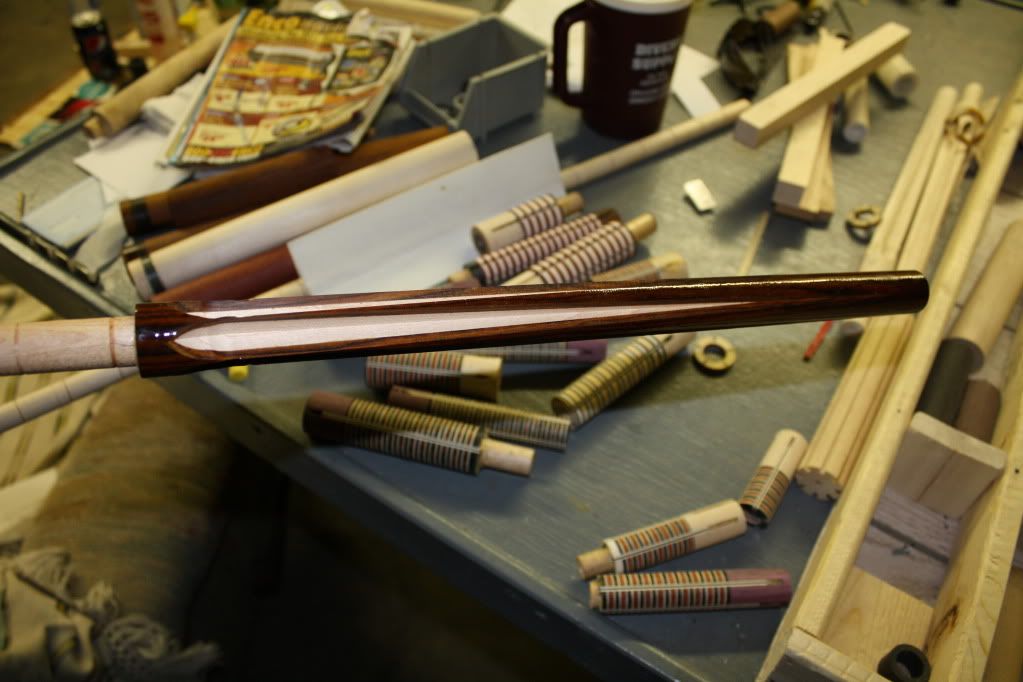
Fully cored 5 pointer with forearm faced at 12 1/8". Grooves were cut after the forearm is glued to the dowel. Before turing and facing, the milled pockets are filled with epoxy and the dowel is turned and returned to .738.
5 pointer before points glue up, epoxy fill, turning, facing.
4 pointer before A-Joint Closure. Parts aft of the A-Joint are cored and glued. I don't cut grooves on the dowel on 4 pointers because it goes too deep into the continuous dowel and I wish to glue all of my points in at the same time.