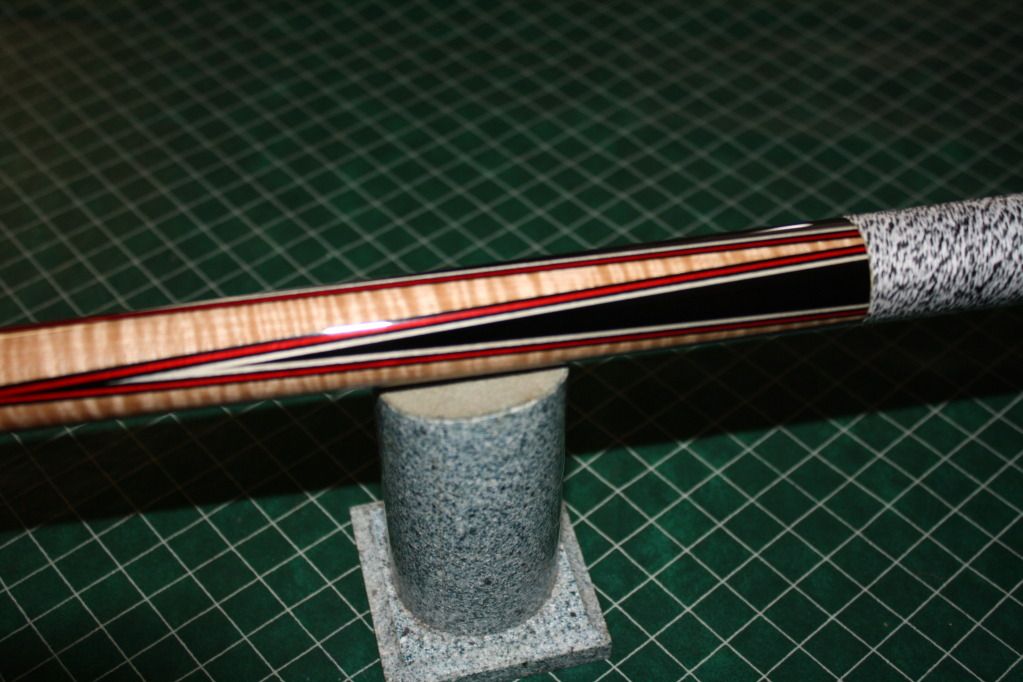
epoxy finish

I had problems with bubbles while applying epoxy with a foam brush. I think the brush was the problem. Once I started putting it on with my finger (with a rubber glove) 90% of the bubbles went away.

I had the same thoughts. If you apply any real pressure with the foam brush it's bubble city. When I just barely grazed it with the brush, the bubble problem was minimal. I will have to try it with a rubber glove next time or maybe one of my wife's pampered chef rubber frosting spatchelas lol.
 
I had the same thoughts. If you apply any real pressure with the foam brush it's bubble city. When I just barely grazed it with the brush, the bubble problem was minimal. I will have to try it with a rubber glove next time or maybe one of my wife's pampered chef rubber frosting spatchelas lol.

I can't stress enough to do thin coats. My first coat doesn't even completely cover the cue once it soaks in a little. It is easy to put too much on using your finger.

I just use good quality disposable rubber or nitrile(sp?) gloves. Once you have put it on with your finger with the lathe spinning you can see high and low spots like a spiral. Just wipe your finger length wise up and down the cue. This changes the high and low spots to length wise and it really levels out nice while the cue rotates and cures. This method leaves a lot less sanding.

It only took me 2 years to figure that out and cut the sanding time in half. I have to credit Chris Hightowers finishing video for the idea but is was one of those "how could I have never thought of that" suggestions that can make cue building alot less agonizing.

One thing I have learned in cue building is some of the simpleist ideas or tequniques can save alot of time, headache and agony.
 
I use a playing card. No bubbles and you can press on it for a VERY thin coat.
This is my sealing coat of finishing Epoxy before the clear coats. Cuts down on the cost and time of several coats of clear.
 
I use a playing card. No bubbles and you can press on it for a VERY thin coat.
This is my sealing coat of finishing Epoxy before the clear coats. Cuts down on the cost and time of several coats of clear.

I always use a playing card for smoothing epoxy. It works great.

The bubbles that come out of the wood, come out of the open grain. I see the bubbles always on Wenge and other woods that have an open grain. I have seen it occasionally on Paduak. Closed grain woods like epony don't bubble.

I use a G5 seal coat and really rub in in until it squeeks. Some times you have to sand the first coat and do it again. Shellac works well also.

If you get bubbles in the hardened finish....... you just have to sand them out and do it again. not fun...

Kim
 
Hi,

If you heat up the cue and epoxy to 90 degrees and use your finger to press in that first coat firmly. You will never speak of those dam bubbles again.:bash: On the first coat I only do half of the cue so I can take my time to press in the epoxy into the grain. The secondary coats go faster and you can do the whole cue before the stuff gets hot and stiffer. I have seen some statements by some top cue makers here that say if you use G5 that it will lift under the finish. I have never experienced this since going to the hot application for the last six years and I track about 95 % of my cues in the field. Before the hot application, I did have some lifting of my finish on a lot of my beta cues I gave away to my APA players as ginny pig tests in the field. I had to refinish about 15 cues within six month. No one got mad because they got the cues for free and this did not hurt my reputation or my name. My records show that most of those cue were prepped in the colder months. Most were exotics with oil content and nun were maple. Heat opens the grain and lets the glue get good adhesion.

The bad part about bubbles is that they turn into pock mark craters when you sand.:barf: I fought those dam things for years as the back room in my pool hall was not that warm in the winter here in the midwest. The bubbles to me was an intermittent nightmare thing until the light went off and I realized it was a seasonal thing.

Today, I put my cues in the spray booth with the small heater on for 5 minutes and the bare cue gets to 90 + degrees. I put the cue on the wood lathe and make sure the room is above 70 degrees while applying.

Put the G5 in microwave and bring it to 90 to 100 degrees. Harbor freight sells those infrared temp meters for 29 bucks. You don't really need one but I like to apply all my cue epoxy within a 90 to 100 degree envelope because I am anal, like gadgets and can't help myself. There are no woods that I found that are problematic because of oil content using this method.

I wipe the G5 on with my clean bare fore finger and use rubbing alcohol on a paper towel right away to keep that finger clean for the next coat in 3 minutes. Never had any luck getting the coating right with a card using G5. It might work good with finish cure but not with 5 minute stuff from my experience with it as the viscosity changes too fast.

Again, the only way to get rid of the bubbles is temperature IMO.

Of all skill sets required to build and finish a cue, putting on the epoxy correctly and sanding that substrate dead flat like a florescent light was the hardest things for me to master 100%. It requires a lot of experience to get in stroke. If your temps are all over the place you will never get consistency and repeatability to your control process.

Good Luck,

Rick

Here is a cue I just finished and buffed. I put 4 coats of G5 on in a 12 minute period and sanded 24 hrs later to a super flat layer without any risk of burning through and having to start over. 4 coats is the ticket for that. When the substrate is super flat sanded only then can you get stellar results with your clear coat.

If you sight your finished cue up to a light source and see waves in your surface you have work to do if you wish to have world class results. It all starts with the foundation, you must get that right. If you are worried about burning through when sanding the high spots out you'll never have the balls to go deeper and flat all of the way. I know this for fact. 4 coats is about .012 per side and gives you a lot of headroom to sand it flat.

IMG_4578.jpg


If I do not go 4 coats there is a risk of burning through and the natural tendency is to sand in the specific areas where your high spots live. You must use full sheets of sand paper or a special sanding block over the entire footprint until all high spots are down and everything is level. Before you can do that you have to want to do it and that makes for extra steps in the building of the foundation with the right temp.

IMG_4580.jpg
 
Last edited:
Hi,

I wipe the G5 on with my clean bare fore finger and use rubbing alcohol on a paper towel right away to keep that finger clean for the next coat in 3 minutes.


You should never apply any Epoxies with your bare fingers, always use a glove.
Exposure to Epoxies and hardeners is cumulative and eventually you will have issues which can vary from a rash to cardiac failure.

Using alcohol can actually thin the epoxy and make it easier for it to absorb into your skin.

http://www.fram.nl/workshop/controlled_vacuum_infusion/allergy.htm
 
You should never apply any Epoxies with your bare fingers, always use a glove.
Exposure to Epoxies and hardeners is cumulative and eventually you will have issues which can vary from a rash to cardiac failure.

Using alcohol can actually thin the epoxy and make it easier for it to absorb into your skin.

http://www.fram.nl/workshop/controlled_vacuum_infusion/allergy.htm

Cue,

I guess I will cut fingers off of nitril gloves and use one at a time of my forefinger. That should not be a big deal.

Thanks very much,

Rick
 
heat

I do heat my G5 before I apply it but I have never heated the cue. I am going to try that next.

I read a post somewhere that when you apply the epoxy on a warm cue, as the cue cools off it sucks the epoxy into the cue instead off gassing out bubbles.


Thanks Rick

Kim
 
Hi Kim,

If you use heat there is no bubbles. I have not seen them for many years.

I think they come from the re activity of the resin and the hardener. When is is cooler there is more off gas for some reason. That is not science just my opinion. Your theory of gas coming from the pours of the wood may be right, I just don't understand it at that level.

If you look at the mixing card and you see bubbles when you are spreading the shit that's where some of it is from for sure. When I spread it hot, no bubbles on the card.

I know you heat your epoxy. What is the ambient temp of the room environment. If it is under 70 degree that could be the problem.

Also I forgot to mention that the lathe RPM is critical to getting the epoxy to lay on flat with out leaving high ridges. On the slower more viscus stuff I have heard it flows out very smooth and people leave the lathe spinning. With 5 minute you have to message it just right and turn the lathe off.

Rick

PS: I am going to protect the finger with nitrile as Cue suggested. I have been using that cream on my finger that printers use so ink does not get into there skin. I put it on before I spread with my finger for the 4 applications. After reading his link I am going to a finger rubber. Why press a possible health issue.
 
Last edited:
Rick
What rpm do you spin when laying epoxy?
I'm using west, 207

Darcy,

I don't know what RPM to use for slow cure as I don't use it. Anyway I use setting # 5 on my wood lathe. My Laser Tach is locked up in Darrin' shop until June 1st or I would give it to you today.

Rick
 
I've been spinning at 340, seems pretty good but I still have a few waves.
I'm pretty impressed though, my first epoxy finish and I like the look.
 
I've been spinning at 340, seems pretty good but I still have a few waves.
I'm pretty impressed though, my first epoxy finish and I like the look.

I spin the lathe at 60-65 RPM and do 3 coats. I am happy with the results.
 
I spin the lathe at 60-65 RPM and do 3 coats. I am happy with the results.

With the 5 minute I am about 800+ but don't have my tach available to verify. I put in on then just it a few sweeps across the butt and off goes the lathe.
 
Last edited:
I'm confused, Rick I thought you shot PPG clear over the G5

Steve,

4 coats G5 5 minute 2 to 3 mins between coats to form a monolithic substrate with PPG clear coat on top after sanding. I don't spin the cue when applying clear in the both.

Rick
 
Steve,

4 coats G5 5 minute 2 to 3 mins between coats to form a monolithic substrate with PPG clear coat on top after sanding. I don't spin the cue when applying clear in the both.

Rick

Ok, you got my interest Rick. Lol. You don't spin the cue when you spray auto clear? How do you do that? Surely you don't spin the gun, lol.

Joe
 
Ok, you got my interest Rick. Lol. You don't spin the cue when you spray auto clear? How do you do that? Surely you don't spin the gun, lol.

Joe

Joe,

I don't spin the the cue using the dc motor system until the coats are sprayed. I use the motor system to spin very very slow maybe 30 rpm between coats while the material flashes.

While spaying I jog the cue by hand to apply even coats side to side.

Rock
 
Last edited:
Back
Top