Hi,
If you heat up the cue and epoxy to 90 degrees and use your finger to press in that first coat firmly. You will never speak of those dam bubbles again.:bash: On the first coat I only do half of the cue so I can take my time to press in the epoxy into the grain. The secondary coats go faster and you can do the whole cue before the stuff gets hot and stiffer. I have seen some statements by some top cue makers here that say if you use G5 that it will lift under the finish. I have never experienced this since going to the hot application for the last six years and I track about 95 % of my cues in the field. Before the hot application, I did have some lifting of my finish on a lot of my beta cues I gave away to my APA players as ginny pig tests in the field. I had to refinish about 15 cues within six month. No one got mad because they got the cues for free and this did not hurt my reputation or my name. My records show that most of those cue were prepped in the colder months. Most were exotics with oil content and nun were maple. Heat opens the grain and lets the glue get good adhesion.
The bad part about bubbles is that they turn into pock mark craters when you sand.:barf: I fought those dam things for years as the back room in my pool hall was not that warm in the winter here in the midwest. The bubbles to me was an intermittent nightmare thing until the light went off and I realized it was a seasonal thing.
Today, I put my cues in the spray booth with the small heater on for 5 minutes and the bare cue gets to 90 + degrees. I put the cue on the wood lathe and make sure the room is above 70 degrees while applying.
Put the G5 in microwave and bring it to 90 to 100 degrees. Harbor freight sells those infrared temp meters for 29 bucks. You don't really need one but I like to apply all my cue epoxy within a 90 to 100 degree envelope because I am anal, like gadgets and can't help myself. There are no woods that I found that are problematic because of oil content using this method.
I wipe the G5 on with my clean bare fore finger and use rubbing alcohol on a paper towel right away to keep that finger clean for the next coat in 3 minutes. Never had any luck getting the coating right with a card using G5. It might work good with finish cure but not with 5 minute stuff from my experience with it as the viscosity changes too fast.
Again, the only way to get rid of the bubbles is temperature IMO.
Of all skill sets required to build and finish a cue, putting on the epoxy correctly and sanding that substrate dead flat like a florescent light was the hardest things for me to master 100%. It requires a lot of experience to get in stroke. If your temps are all over the place you will never get consistency and repeatability to your control process.
Good Luck,
Rick
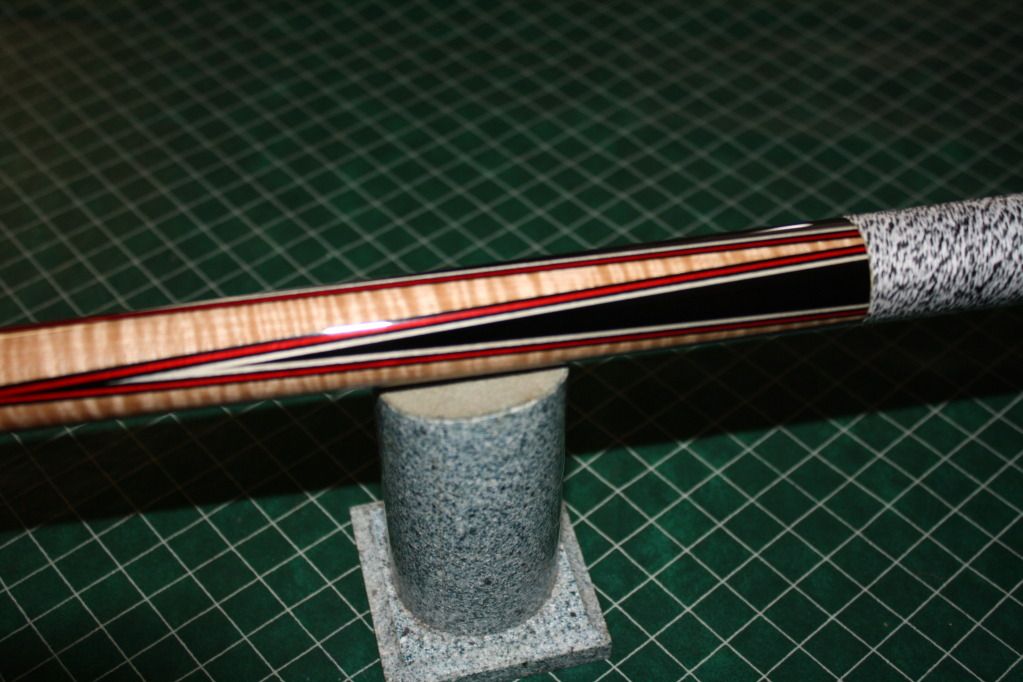
Here is a cue I just finished and buffed. I put 4 coats of G5 on in a 12 minute period and sanded 24 hrs later to a super flat layer without any risk of burning through and having to start over. 4 coats is the ticket for that. When the substrate is super flat sanded only then can you get stellar results with your clear coat.
If you sight your finished cue up to a light source and see waves in your surface you have work to do if you wish to have world class results. It all starts with the foundation, you must get that right. If you are worried about burning through when sanding the high spots out you'll never have the balls to go deeper and flat all of the way. I know this for fact. 4 coats is about .012 per side and gives you a lot of headroom to sand it flat.

If I do not go 4 coats there is a risk of burning through and the natural tendency is to sand in the specific areas where your high spots live. You must use full sheets of sand paper or a special sanding block over the entire footprint until all high spots are down and everything is level. Before you can do that you have to want to do it and that makes for extra steps in the building of the foundation with the right temp.