Best Pocket Size

I would say 4.25" corners and 4.75" sides. Right now I'm playing on ultra tight pockets @ 3 7/8" on the corners and it's brutal. It's frustrating, but it makes me better and I if there's any flaw in my aim, I know about it REAL quick. But when I go to other poolrooms, I feel like I'm tossing pebbles into a trash can. I think 4.25" corners are tough enough to require good focus and aim, but not so brutal that they spit out balls the way my current tables do.
 
picture.php


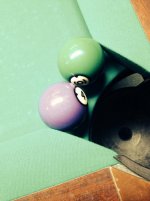
This is what my 4 1/2" pockets look like. If I was the the OP I would set the table up first and play on it for awhile before changing pocket sizes. I think one of the problems with tight pockets, or pockets that are tighter than what you compete on, if you do, is that it changes the way you play. You cant cheat the pocket as much on a tight pocket table and you cant hit a rail much before the pocket are a couple of the things different. To me, if you are trying to win you should not have to be thinking so much about what shots are available or not because you may be playing on a table that plays vastly different than what you practice on due to pocket size. At this point I am not sure if I would go to 4 1/2" pockets again or not if I had to do it again, although i think my 4 1/2" pockets may be a tad on the tight side. I made a template of my pocket openings and they are smaller than a new Diamond BB which I thought were 4 1/2". Maybe after a couple of years playing I will feel differently, but as being kind of a beginner its a lot to take in, especially under pressure.
 
picture.php


This is what my 4 1/2" pockets look like. If I was the the OP I would set the table up first and play on it for awhile before changing pocket sizes. I think one of the problems with tight pockets, or pockets that are tighter than what you compete on, if you do, is that it changes the way you play. You cant cheat the pocket as much on a tight pocket table and you cant hit a rail much before the pocket are a couple of the things different. To me, if you are trying to win you should not have to be thinking so much about what shots are available or not because you may be playing on a table that plays vastly different than what you practice on due to pocket size. At this point I am not sure if I would go to 4 1/2" pockets again or not if I had to do it again, although i think my 4 1/2" pockets may be a tad on the tight side. I made a template of my pocket openings and they are smaller than a new Diamond BB which I thought were 4 1/2". Maybe after a couple of years playing I will feel differently, but as being kind of a beginner its a lot to take in, especially under pressure.

Those look smaller than 4 1/2". They appear to be 4 3/8".

While not scientific...if you put a piece of paper over the 2 OB you have in your picture and mark the distance from edge to edge (through the contact point), you should have 4.5". If you take that same distance marked on the paper and put it over the points of the pocket, it looks to be smaller by about the width of a pocket facing (which I am assuming is 1/8").

....Or I guess you could just measure them directly :rolleyes:
 
Those look smaller than 4 1/2". They appear to be 4 3/8".

While not scientific...if you put a piece of paper over the 2 OB you have in your picture and mark the distance from edge to edge (through the contact point), you should have 4.5". If you take that same distance marked on the paper and put it over the points of the pocket, it looks to be smaller by about the width of a pocket facing (which I am assuming is 1/8").

....Or I guess you could just measure them directly :rolleyes:

Yeah, I think you are right. When I measured they were about 4 3/8" so maybe they cut the cushions to make a 4 1/2" pocket then added the facings and it reduced the opening.I guess Probably better that way, at least its easier to cut something shorter than to cut it longer. :D
 
I vote buckets for home tables. I want to have fun on mine. 5" corners, 5.5" sides. This is the factory GC setup.
 
part of the game is cheating the pocket for position. and looser pockets allow more banks and combos. as well as shots that dont hang up all the time.
small tight pockets do help your game improve but dont help the game itself. if the game needs to change so it is tougher to run out in nine ball there are better ways to do it.

plus tight pockets keep beginners from making any balls so they give up the game. and it makes the game frustrating if you arent real good. that hurts pool.
 
This might sound strange, but even with loose pockets, you still aim to a very specific part of the pocket, depending on the situation at hand.

So, you can still execute to the same precision that you would need to on tight pockets. When I play on my bucket pockets on my home GC4, I usually get the center of the OB within a 1/4" of the exact pocket target I had picked out.

You can set a tolerance in your own head. If you have buckets but miss the "target" by 1/2", (but ball still drops), you can set that shot up again and keep working it. If you want to be even harder on yourself, you can make that tolerance 1/4", etc.
 
My opinion on this has changed in the past few years.

It has now become very clear to me that 4.5 inch corner pockets ARE NOT tight, especially on a table with a shorter shelf. 5 inch pockets are absolute buckets.

I currently think 4.5 inch pockets are about the right size for serious players (not pros). If you think 4.5 inches is too tight than you're probably not that good of a player -- hate to be so blunt but I think that's probably accurate.

The other thing about home tables is -- it's your table. You play on it all the time and become acclimated to it. So it will not play as tight as a different table with the same exact dimensions simply because of the familiarity.

The only other reason I wouldn't tighten my table up even more is because I would be afraid nobody else would ever want to play on it. Hmmm....I'm not sure that would be such a bad thing after all.
 
Pool is a collection of games, therefore in my opinion, if you seek to play all games well, a balanced approach is needed for pocket sizes. For the common games, namly 14.1, 9 or 10 ball, 8 ball, onepocket and banks, I feel that the Diamond pro has the best pockets out there currently. Having said that, I think that even these are probably too tight if 14.1 is a game that folks still have an interest in playing.

As has been stated earlier, having large or "loose" pockets does not help or hurt the player. I had a champion player explain to me that you play to a portion of a pocket, not just trying to pocket the ball generally.

Further, I feel that anything approaching 4" and below with a deep shelf approaches the absurd and is bad for pool and the collection of games it represents. Maybe if rotation based games were all that were out there (and for some folks, this is true, as it is all they play), then really tight pockets are fine (though I doubt it). But banks for instance is an extraordinarily challenging and beautiful game that would absolutely be savaged by pockets that tight.

So, to sum up, get a diamond and be happy.

Cheers and shoot straight,

JL
 
I played a few hours on the mark Gregory masterpiece pictures below, Augusta, ga.

I borrowed a napkin and pen to get measurements and I am gonna get john burns to my house and put him to sweatin.

Just measured the napkin,,, 3 7/8 attend of slate, just under 4.5@ points.

That is what I want
 

Attachments

  • image.jpg
    image.jpg
    99.6 KB · Views: 387
Last edited:
My opinion on this has changed in the past few years.

It has now become very clear to me that 4.5 inch corner pockets ARE NOT tight, especially on a table with a shorter shelf. 5 inch pockets are absolute buckets.

I currently think 4.5 inch pockets are about the right size for serious players (not pros). If you think 4.5 inches is too tight than you're probably not that good of a player -- hate to be so blunt but I think that's probably accurate.

The other thing about home tables is -- it's your table. You play on it all the time and become acclimated to it. So it will not play as tight as a different table with the same exact dimensions simply because of the familiarity.

The only other reason I wouldn't tighten my table up even more is because I would be afraid nobody else would ever want to play on it. Hmmm....I'm not sure that would be such a bad thing after all.
So what do pros play on in tournaments most the time. The players requested 4.25 and 4.75 pockets at the last mosconi cup and the event directors complied, but what happens at tournaments with a 64 player field? I find it hard to believe they're bringing in mechanics to reduce the pocket size on all the tables they're playing at the start of the tournament. I assume they're playing with 4.5 inch corners on most of the tables at least.
 
Last edited:
Depends on the tourney. If they bring in tables like they do at the US open 9 ball they are using Diamond Pro-Am's with the pro cut pockets (4.5) which is standard from the manufacturer. If the tourney is held at a poolroom, the pockets are what they are. The room owner might have new cloth installed but that may be about it.


So what do pros play on in tournaments most the time. The players requested 4.5 and 4.75 pockets at the last mosconi cup and the event directors complied, but what happens at tournaments with a 64 player field? I find it hard to believe they're bringing in mechanics to reduce the pocket size on all the tables they're playing at the start of the tournament. I assume they're playing with 4.5 inch corners on most of the tables at least.
 
When you read the forum you get the impression that all americans play on 4 inch pockets or below, sometimes. 4 inch pockets with deep shelves would be a disaster for pool, especially 14.1 and banks. Nobody wants to see a nicely hit ball end a run in 14.1 because of ridiculous pockets.

For tournaments with brand new equipment and cloth 4 1/4 or 4 3/8 inch pockets are probably ok. Those tables mostly have perfectly set up pockets and new cloth, and well hit balls will slide in. In the real world of pool hall play, pockets sometimes have slightly worn pocket facings or are cut at the wrong angle. The tighter the pocket, the more critical this becomes. Also playing on worn cloth and maybe balls that are worn etc means that the margin of error becomes too small.

People have this idea that if you shrink the target you automatically become more accurate. This is only true to a certain extent and only for the players whose mechanics are allready very good. Some (or most) people will probably never be accurate enough to run racks on a 4 inch, deep shelf pocket table unless they actually move in to the pool hall for 12 hours a day.

What usually happens is that the smart players learn to shy away from certain shots that would be considered to be a natural part of the game on a normal table. So the game will change instead. No more long banks, no more english draw shots along the rail. Long combinations? Forget it.

Some people will object to this by stating that these shots will go in, if hit perfectly. The problem is that nobody hits shots perfectly every time and the first to realize this are the better players. If you watch snooker you will soon discover that certain shots are never attempted (unless the frame is secure). That does not mean that these shots are impossible, players make these shots in practice all the time. They just play the percentages, that is all. So what will you achieve by tightening the pockets and deepening shelves? You will turn pool into a boring, tactical buntfest. Once the banks and power shots are taken away, safeties will become the bread and butter of the players. Congratulations, you just made pool even more boring and unwatchable for the general public.

Another thing is: Who are the ones who complain the most about the pockets being too lose? The player in the chair, that's who! I can't count the number of times I've made a run in straightpool only to hear the player in the chair complaining about the pockets being buckets etc. Well, we are playing on the same table, so why don't you run out the set, then?! Tight pockets are a solution to a problem that never existed. Nobody is running complete sets, even in 9 ball, if the races are to 9. And even if they did occationally do it, so what? Don't you want to see that, once in a rare while?

I agree completely.
 
I just had my slates replaced on my table free of charge because the company deemed them to be defective after the seams kept coming apart. The old Italian slates had much deeper shelves than the new ones from Brazil, and the radius of the shelf edges on the new ones is bigger. Nothing at all was done to the rails, so they were and still are 5" at the corners and 5 1/2" at the sides.

The table used to play real tough for 5" pockets with those deep shelves, but now it is too easy. I completely underestimated the effect of shelf depth alone on my table's playability.

Now, if I went ahead and reduced the corners to 4 1/2", the shelf would be even shallower and the pocket facing angles would be more accepting of hard-hit balls. Would this make the table tougher or easier? Hard to know for sure until I played on it for a while.

I think there is a lot more to a table's difficulty level then just pocket opening size.
 
When you read the forum you get the impression that all americans play on 4 inch pockets or below, sometimes. 4 inch pockets with deep shelves would be a disaster for pool, especially 14.1 and banks. Nobody wants to see a nicely hit ball end a run in 14.1 because of ridiculous pockets.

For tournaments with brand new equipment and cloth 4 1/4 or 4 3/8 inch pockets are probably ok. Those tables mostly have perfectly set up pockets and new cloth, and well hit balls will slide in. In the real world of pool hall play, pockets sometimes have slightly worn pocket facings or are cut at the wrong angle. The tighter the pocket, the more critical this becomes. Also playing on worn cloth and maybe balls that are worn etc means that the margin of error becomes too small.

People have this idea that if you shrink the target you automatically become more accurate. This is only true to a certain extent and only for the players whose mechanics are allready very good. Some (or most) people will probably never be accurate enough to run racks on a 4 inch, deep shelf pocket table unless they actually move in to the pool hall for 12 hours a day.

What usually happens is that the smart players learn to shy away from certain shots that would be considered to be a natural part of the game on a normal table. So the game will change instead. No more long banks, no more english draw shots along the rail. Long combinations? Forget it.

Some people will object to this by stating that these shots will go in, if hit perfectly. The problem is that nobody hits shots perfectly every time and the first to realize this are the better players. If you watch snooker you will soon discover that certain shots are never attempted (unless the frame is secure). That does not mean that these shots are impossible, players make these shots in practice all the time. They just play the percentages, that is all. So what will you achieve by tightening the pockets and deepening shelves? You will turn pool into a boring, tactical buntfest. Once the banks and power shots are taken away, safeties will become the bread and butter of the players. Congratulations, you just made pool even more boring and unwatchable for the general public.

Another thing is: Who are the ones who complain the most about the pockets being too lose? The player in the chair, that's who! I can't count the number of times I've made a run in straightpool only to hear the player in the chair complaining about the pockets being buckets etc. Well, we are playing on the same table, so why don't you run out the set, then?! Tight pockets are a solution to a problem that never existed. Nobody is running complete sets, even in 9 ball, if the races are to 9. And even if they did occationally do it, so what? Don't you want to see that, once in a rare while?

Very well said!!!! :clapping:
If rotation pool needs to be tougher like some say why not go to 15 ball rotation instead of 9 or 10 ball? That will make it tougher to run tables.
 
As much as differentiating the pocket size based on the game makes sense (1-pocket AND 8-ball should both be played on tight pockets) I think that you also need to base it on the players to a degree. A bunch of bangers playing league 8-ball should maybe be playing on 4.5 inch pockets. SVB vs Hohmann in a 8-ball match should be playing on far tighter pockets then that.

For pro pool I truthfully do not think ANY game should be played on pockets larger then 4.125 inch pockets exactly cut like the Fatboy Rails that TAR once used. Those were perfect pockets for pro pool, they played tight but took EVERY well hit ball shot at them. The TAR rails that replaced them that were "supposed" to be identical unfortunately were cut slightly different and spat out certain shots that were actually hit well and many casual fans could not distinguish the difference and simply went onto the "tight pockets suck" bandwagon.

Poorly cut tight pockets suck, well cut tight pockets like TAR once used elevated the game to a level we had never seen it before or since when Alex and SVB played their 10-ball match on the Fatboy Rails and SVB ran 2 6-packs and a 7-pack under those conditions.
 
In my previous post I said the pros requested that the pockets at the last Mosconi cup be 4.5 and 4.75 and the event directors complied. I meant to say 4.25 and 4.75. I just edited it.
 
Back
Top