
Break Balls and Cueing

dmgwalsh

Straight Pool Fanatic
Silver Member
I almost hesitate to post in this atmosphere, but what the hell.

I am interested in finding out what type of english and/or follow/draw/center people use on different side of the rack break shots.

I know that both Sigel and Rempe, in their instructionals, said when the line between the object ball and the cue ball is perpendicular to the long rail, or when the cue ball is closer to the center of the table than the object ball, you use draw, and that when the object ball is closer to the center of the table you use follow.

But I am not sure that it is that simple. We all see Marop looking to see where the cue ball is going to hit the rack and adjusting his cue ball as a result. Niels Feijen was always looking to see where it would hit. Rempe in the San Souci match said he needed to know where the cue ball would hit to figure out what to put on the cue ball.

I am interested in finding out what you guys do . I guess the cue ball can contact the rack at the top of the ball, the middle of the ball, the bottom of the ball. It is that way for all 4 balls on any particular side.

I'd be interested in hearing what you guys put on the cue ball based upon each one of these positions of contact and why. If it changes because of whether or not it is a backcut angle or not, I'd be interested in hearing that too.

This has probably been covered before, but I have never really figured out what to hit them with and have usually just done the simple high or low a la Siegel and Rempe in their instructionals.
 

Attachments
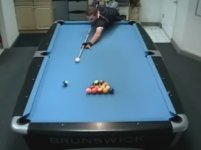
  • js 124 1-08-9_0001.jpg
    js 124 1-08-9_0001.jpg
    22 KB · Views: 302
Last edited:
To further complicate the thought Dennis, given the identical position, one man's high outside english is different than anothers since their strokes, follow through, smoothness etc. will produce different results.

When the CB and OB are parallel and hitting the lower two rows I use follow with a touch of inside english to go to the short rail, long rail and out. If the shot is higher on the rack I'll use outside draw.

Most any time the CB is closer to the rail I use only follow with no sidespin.

I've had great success running 16 balls this way! :thumbup:

edit : In the photo you provided, IMO this is a good example of using a touch of inside english which will bring the CB into the rack at a slightly sharper angle by allowing the point of contact to shift right a tad.
 
Last edited:
this has nothing to do with you thread, but I didn't see the need in starting a new one for a simple question.

I only play 14.1 by myself at home and I'm fairly new to the game...

so say you run two racks of 14.1 that is a total of 28 balls? You don't count the break ball(s)? Why not?

You have to realize you are not racking 15 balls the second time, only 14. So, the first rack you run 14 of 15, leave one ball, ( thats 14 down). Now, you rack 14 balls, run them all, and leave one. 14 + 14 = 28. :)
 
When I'm hitting the break ball well and getting a nice spread I sometimes get left way up in the kitchen with few options. Not sure what unintentional spin I'm putting on the CB for this to happen? Cannot use cuetable at work but its your basic break shot hitting the second row in the stack.
 
dennis: thanks for getting us back on track. complicating this issue further; i get a lot more follow on my 13mm shaft than my 12mm shaft which draws very well. i have scratched in the corner on follow breaks using my 12mm when my 13mm forces the cue to the bottom rail. i think that the follow/draw "rules" are for general purposes. the variables are so great that sometimes you just pay your money and take your chances.

some computer nerd should make an interactive breakball program where you can set up various BB positions and punch in the variables like hard follow or draw.
 
Last edited:
When I started paying attention to where the cue ball contacts the rack my game went up a notch or two. As sausage pointed out, stroke has a lot to do with it. WIth a stroke like John's you can apply the rules of Sigel more often because he can force the cue ball to do what he wants. If it's a draw breakshot he can hit it hard enough to draw it back to the kitchen and then back to the center of the table. If it's in the follow postion he can apply enough top spin to force it to the bottom rail and beat the scratch.

I don't have that power stroke so I try to judge where the cue ball is going to contact the ball in the stack and basically play position off that ball. If the cue ball is going to contact the top of a ball and I hit it with draw I will probably end up the kitchen with a long shot. If I hit the same shot with follow it should rebound off the ball stack and put on the brakes and stay near the center of the table. If its going to hit the bottom of the ball and I hit it with draw I will probably draw it right into the corner pocket, just because you hit it with draw dosen't mean it is going to go backwards off the stack. If I hit that shot with follow it will arc forward after contact and hit the bottom rail. So basically where it hits the object ball in the stack determines the direction it is going to travel after contact so you adjust your english so the cue ball ends up some where predictable. I hit a lot of breakballs with center ball so the cue ball just stuns off the rack and stays close by.

This is what works for me, not saying it will work for everybody. Sometimes it might be better to just hit em hard and hope. lol

-Bill
 
Last edited:
If its going to hit the bottom of the ball and I hit it with draw I will probably draw it right into the corner pocket, just because you hit it with draw dosen't mean it is going to go backwards off the stack. So basically where it hits the object ball in the stack determines the direction it is going to travel after contact.

-Bill

Using draw, I've gone into the corner pocket more than I could believe possible. If fact, in some intances it is with consternation that I've scratched, thinking it impossible. I'll have to study where the cue ball hits the stack to better understand this.

Right or wrong, I find that I often hit the break shot with outside english or no english. I use outside English because I'm better able to "make" the shot, or help it in. Unfortunately, if you do not hit this shot hard enough, you can get stuck in the pack. If you hit it with some speed, you can often get a real nice spread.

I also prefer a fairly steep angle when addressing break shots, because you have a less likelyhood of scratching and you don't have to hit the break as hard.

My worst break shot is using inside english, as I am not confident in my accuracy hitting with power.

Lastly, I would like to hear some comments about hitting certain breakshots with the butt slightly elevated. I've had some success with this, but not sure it is worth the risk given the chance of missing.

Thanks,

Chief Doug
 
By the way, what a great topic. This is essentually the key to having high runs...the effectiveness of getting into the pack, out, and having a shot.
 
I'd be interested to know if people change the rules a bit for an 8-foot table.

it has been my experience when i had an 8' Ventura Pro, that hard follow on a Bball to the bottom rail is more likely to scratch because there's just not as much rail on either side of the rack.

bill: that's a good assessment.

By the way, what a great topic. This is essentually the key to having high runs...the effectiveness of getting into the pack, out, and having a shot.

salamander: i believe that most runs end right after the break. it would probably be smart to have a day of practicing only break-balls.
 
Last edited:
You guys with your *quality* strokes knowing if you'll hit the top of the ball, side of the ball, or bottom of the ball...ppseeesshhh. Soon as I try that I undercut the ball and hit the wrong part of the ball & stick to the rack!
 
Right or wrong, I find that I often hit the break shot with outside english or no english. I use outside English because I'm better able to "make" the shot, or help it in. Unfortunately, if you do not hit this shot hard enough, you can get stuck in the pack. If you hit it with some speed, you can often get a real nice spread.
salamder: i've heard it called; "helping english" and i have used it but i don't know if it really helped much. i mainly use it when i'm afraid to follow but concerned about getting stuck in the pack. but if memory serves, i think that john recommends on one of his videos, no english at all on break-balls. just follow or draw.
 
salamder: i've heard it called; "helping english" and i have used it but i don't know if it really helped much. i mainly use it when i'm afraid to follow but concerned about getting stuck in the pack. but if memory serves, i think that john recommends on one of his videos, no english at all on break-balls. just follow or draw.

Definately "helping" english in my case. I'll have to try hitting the ball more flat. I will say that one advantage to using outside is that it help to stall the cueball. Sometimes if you hit just follow, you end up on the end rail.

I'm not good with the wei table, but I think it would be interesting to set up various break shot's and discuss the "best" way to address the break shot.

Oddly enough, I've watched many acustats that discuss how to hit below the rack break shots, but very few talk about the traditional above the rack. Particularly the nuances depending upon angle and position of object ball.
 
Last edited:
Oddly enough, I've watched many acustats that discuss how to hit below the rack break shots, but very few talk about the traditional above the rack.
rempe has some good advice for behind the rack breaks but when the B-ball is in the center of the pack, he says; "just hit it, balls are going to go everywhere." well, i did just that when i was on 84 balls and i scratched in the corner. i wish i had put a ton of follow on that ball because i was in-stroke and close to 100. i've a bone to pic with king james..... ;)
 
To further complicate the thought Dennis, given the identical position, one man's high outside english is different than anothers since their strokes, follow through, smoothness etc. will produce different results.

That is true and if someone doesn't have the stroke to accomplish something they have to adjust. I have used a ton of high before and looped around the rack and into the corner pocket when only a bit of high was called for.
When the CB and OB are parallel and hitting the lower two rows I use follow with a touch of inside english to go to the short rail, long rail and out. If the shot is higher on the rack I'll use outside draw.

This is when the angle is the traditional draw angle, right? When it is high use force draw, about a tip below to bring the cue ball back to the table.(or like Thorsten hit it hard and bring it to the kitchen and back again)Both Rempe and Sigel show that second shot, a little loop and two rails to the middle when lower on the rack.

Most any time the CB is closer to the rail I use only follow with no sidespin.

That is the more traditional rule of Rempe and Sigel.

I was wondering when the contact point on one of the 4 balls in the rack changes what you put on the cue ball.
I try to judge where the cue ball is going to contact the ball in the stack and basically play position off that ball. If the cue ball is going to contact the top of a ball and I hit it with draw I will probably end up the kitchen with a long shot. If I hit the same shot with follow it should rebound off the ball stack and put on the brakes and stay near the center of the table.

If its going to hit the bottom of the ball and I hit it with draw I will probably draw it right into the corner pocket, just because you hit it with draw doesn't mean it is going to go backwards off the stack. If I hit that shot with follow it will arc forward after contact and hit the bottom rail.

So basically where it hits the object ball in the stack determines the direction it is going to travel after contact so you adjust your english so the cue ball ends up somewhere predictable.

I hit a lot of breakballs with center ball so the cue ball just stuns off the rack and stays close by.

-Bill

Bill: So it sounds like you are saying, if the cue ball hits the top of the ball in the rack, you put high on it to counteract the natural tendency of the ball to go uptable.

If it is going to hit the bottom of a ball in the rack, you put high on it so when it follows down, it arcs.


Three follow up questions:

1. Does this hold true whether you have the draw angle or the follow angle a la Sigel?

2. Does your answer change depending upon if the ball to be contacted is the 1st, 2nd,3rd or last ball in the row??

3.What if the cue ball is going to hit the middle of the object ball?


I was watching Joe Tucker's analysis on break shots with the draw angle and cueing changes depending on where and which object ball you are contacting and will summarize them later.

I am surprised that all these big ball runners on this forum have no opinion on this. It is something they either confront or don't on most break shots.
 
Last edited:
So it sounds like you are saying, if the cue ball hits the top of the ball in the rack, you put high on it to counteract the natural tendency of the ball to go uptable.

If it is going to hit the bottom of a ball in the rack, you put high on it so when it follows down, it arcs.


Three follow up questions:

1. Does this hold true whether you have the draw angle or the follow angle a la Sigel?

2. Does your answer change depending upon if the ball to be contacted is the 1st, 2nd,3rd or last ball in the row??

3.What if the cue ball is going to hit the middle of the object ball?

1. Yes in my case. I have had the draw angle numerous time and drawn the cue ball off the rack and into the corner packet because I hit the bottom of the ball.

2. Yes, top two balls with draw almost always scratchs in my case, bottom two balls draw is ok, cue ball can be controlled with the amount of draw to stay in the center of the table.

3. Middle of the object ball is my favorite, hit it with center and the cue ball should rebound on the angle it went into the ball, very predictable what direction it is going to take.

Quick story. Gabe Owen was playing in his first straight pool tournament at the Qlympics. He was on an 84 ball run (highest of his career at that time). He had the perfect Sigel draw angle and scratched off the stack. He looked at me and said "how did that happen?, I hit it with draw". I told him he hit the bottom of the object ball in the stack, he just said "never would of thought of that"
 
I told him he hit the bottom of the object ball in the stack, he just said "never would of thought of that"
he scratched in the foot-rail corner, right? i've done that myself using draw. it doesn't seem possible. so if you're going into the bottom of a ball in the rack, use hard follow?

dennis: if memory serves, we discussed how draw/follow will effect the path of the cue enroute to the rack with regard to finding the exact hit on a ball and there was little consensus. the further away your break-ball, the more the cue is going to curve into the pack. i guess just practicing break balls is the best thing.

it'd be nice if one of the pros here would get a high-speed video camera and do a video of just break balls from all angles, speed and spin so that we can see exactly how the cueball behaves upon contact. i'm sure that even some of the most advanced players would be interested in watching that.
 
After watching this video of Niels Feijen run 259 http://video.google.com/videoplay?docid=-4055665300780803274# I've changed the way I break. If you haven't seen it you should fast forward to watch all his breakshots. He hits it harder than anyone I've seen so far. After hearing Archer and Varner say the only time they use side english is under the rack I've gone to only using draw when it's an inverse angle and follow if its even or obtuse.
 
Back
Top