changed out a joint screw

whammo57

Kim Walker
Silver Member
Yesterday I changed out a joint screw for a player. The cue had a brass 3/8-10 screw. I replaced it with a black G10 screw and added back the 3/4 oz of weight.

The day before I would have told you that the pin makes no difference, Today I will tell you that it does make a difference. It changed the hit and the sound of the cue. It's feels more solid and sounds crisp when you hit the cue ball. I'm still not sure why.

I'm a believer.....................

Kim
 
Kim what I believe is the G10 pin flexes at the joint, which simulates more of a one piece cue.
Frank
 
Yesterday I changed out a joint screw for a player. The cue had a brass 3/8-10 screw. I replaced it with a black G10 screw and added back the 3/4 oz of weight.

The day before I would have told you that the pin makes no difference, Today I will tell you that it does make a difference. It changed the hit and the sound of the cue. It's feels more solid and sounds crisp when you hit the cue ball. I'm still not sure why.

I'm a believer.....................

Kim


I am also a believer - except I believe the material makes no difference.

Change another 100 and report back.

Dale(who knows the one about 1 point on a curve)
 
Taking out 1 0z of weight in the front and adding it to the rear
makes a ton of difference IMO.
Had that weight been added in the middle while making the cue would
have made that cue hit even better IMO.
 
G10 pins transfer "feel" better from the tip through the joint. It won't change the hit itself but it will change the feel quite a bit over any metal pin.
 
Taking out 1 0z of weight in the front and adding it to the rear
makes a ton of difference IMO.
Had that weight been added in the middle while making the cue would
have made that cue hit even better IMO.

Good point................

Kim
 
I am also a believer - except I believe the material makes no difference.

Change another 100 and report back.

Dale(who knows the one about 1 point on a curve)

That's what I thought too....................

Kim
 
I wrote this somewhere else but fits here as well;

...when a player strikes the cue ball, that vibration comes back to his hand (feedback) and tells him what happened. If you have a specific mass in the joint, it will affect or interrupt that vibration. That diameter and length will also affect the cue's overall flex and liveliness. Imagine the difference between a brass Radial pin and a G10 radial pin. The two pins will have a much different feel. I do not believe one is necessarily better than the other, just different. I also believe it is just one part that makes up the cue's over all playability and feel.

I don't believe thread count and pitch have a whole hell of a lot to do with all of it.

I also think there is a noticeable difference if you use steel vs brass vs aluminum. Each one has its own specific mass and thus having a difference effect on the feedback and flex.

As Joey said, changing the pin to a different material, especially in Kim's case to where you lose a significant amount of forward weight, it will affect the overall balance and playability.

To say the pin size and material having no effect is ignoring physics.

Just my opinion...
 
I wrote this somewhere else but fits here as well;


I also think there is a noticeable difference if you use steel vs brass vs aluminum. Each one has its own specific mass and thus having a difference effect on the feedback and flex.

As Joey said, changing the pin to a different material, especially in Kim's case to where you lose a significant amount of forward weight, it will affect the overall balance and playability.

To say the pin size and material having no effect is ignoring physics.

Just my opinion...

Well, Issac Newton just called and he says the pin's job is to hold the shaft
to the butt...tight - and straight. After that it's all just Phillosophy.
Or was that Physical Phillosophy? or was that Issac Asimov?

Dale(hit - feel - balance - playability)
 
Well, Issac Newton just called and he says the pin's job is to hold the shaft
to the butt...tight - and straight.

If this were the case, we'd all use 5/16-18. More threads make for a more secure fit....
 
o' boy

just wait until you guys get rid of all those man made materials you use for pins and go to something really modern, organic materials like wood pins,

OH NO if you all did that i would be out of business, nevermind
 
Pin

And one again we prove the adage.
No one ever flunked out of cuemaker school and had to
go back to just being a physicist.
 
And one again we prove the adage.
No one ever flunked out of cuemaker school and had to
go back to just being a physicist.

Hahaha....... very good point......

I don't claim to know why it's different I just know that I can feel the difference.

Kim

Sent from my SAMSUNG-SGH-I727 using Tapatalk 2
 
Chris Byrne said if he changed out the unilock in my Lucasi to a 3/8/10 it would make it a much better cue.
Any thoughts on that?
 
Hi,

I agree that balance point makes a big deal in the way the cue feels to the players stroke. Most of my cues have a 1/2" 13 tpi weight bolt behind the pin epoxied and threaded in the forearm and either no rear weight bolt or a very small small balance adjustment weight bolt in the rear because I don't have a A joint bolt in my cue. By using this method I don't have to deal with the weight and balance attribute of a cue until I take the final taper pass on the blank and have the shafts at final. Then I can adjust the cue and land the weight to the exact number the customer requested, every time within a few grams.

Putting all the additional weight in the rear is not a good idea in my specs as my balance point is designed to about 1" forward of the so called standard.

So I don't think I will be using the light weight pins soon but I can see it as an adjustment feature for balancing and A joint cue with a dense forearm material . I really don't like the way they look however. I am a fan of chrome plated brass.

Rick
 
Last edited:
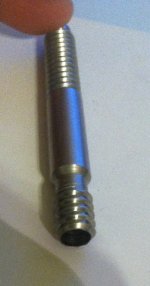
Here's an option if you want less than an ounce of metal joint screw if you don't like titanium or aluminum or G10 .
Drilled up about 1/4 to the top of the barrel (1/4 hole ) SS 3/8 11.
SS is pretty strong. The top 1 1/2 is solid steel.
You can fill the hole with wood plug and epoxy.
Or even some heavier powder and epoxy if you want to make it heavier.
The heavier that joint is, the less feedback you get in your grip hand imo.
Schuler figured that out eons ago.
 

Attachments

  • sspin.JPG
    sspin.JPG
    57.5 KB · Views: 221
Back
Top