Question for guys that are into physics

Johnnyt

Burn all jump cues
Silver Member
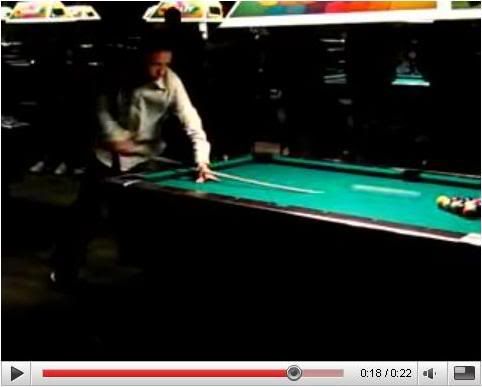
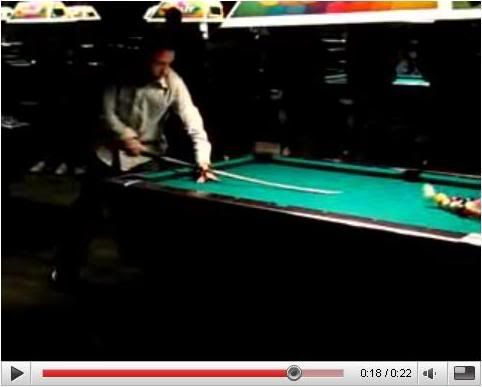
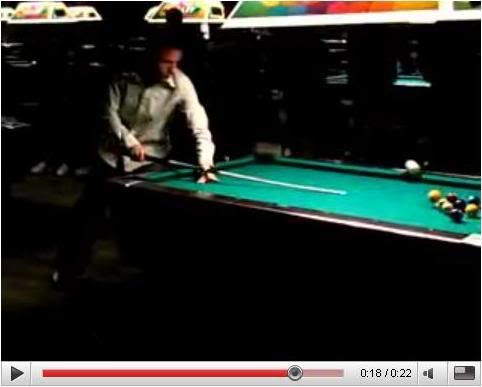
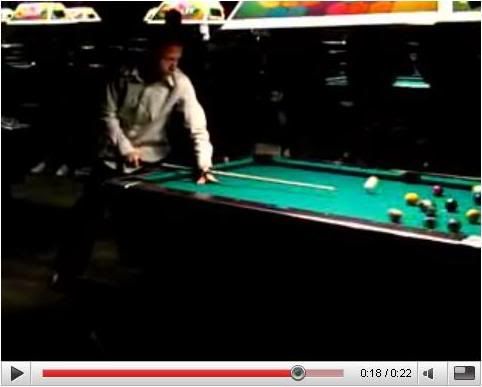
Question for you guys into physics out there. When I use to break in 9-ball more than a few people that watched said my Q-ball was in the air when it hit the one ball. After it hit it would go in the air a couple of inches to a foot or more, then stay around the middle of the table. I always tried to hit above center and use to elevate the cue slightly just before contact. Is it possible the Q-ball was air born when it hit the one? I really made balls on the break with this, more so than other ways I've read about. Thanks. Johnnyt
 
I know nothing of physics but yeah, the cue ball is usually airborn when it hits the head ball. The divot in the slate at the foot spot is proof positive of that. I actually did a test on this once. Extremely advanced methods were used. I spread baby powder across the bed of the table between where the cue ball started and where it hit the rack. Looking at the dots in the powder showed that the CB bounces down to the rack. Hell, the burn mark spots on the cloth should have told me that but I read about that baby powder thing somewhere and had to give it a try.
MULLY
what a pain in the ass getting baby powder off the table
 
Last edited:
Johnnyt said:
Question for you guys into physics out there. When I use to break in 9-ball more than a few people that watched said my Q-ball was in the air when it hit the one ball. After it hit it would go in the air a couple of inches to a foot or more, then stay around the middle of the table. I always tried to hit above center and use to elevate the cue slightly just before contact. Is it possible the Q-ball was air born when it hit the one? I really made balls on the break with this, more so than other ways I've read about. Thanks. Johnnyt


Yeah, I'm fairly certain you can get some slow-motion videos on youtube. First, it's astounding how much height you actually get on the break and second, I think the sound you get from jumping can mask how hard you actually hit it. I say this and I'm a bit of a jumper, too (my friends are probably laughing as they read this). Basic knowledge of physics will tell you that there's nothing to gain from getting air on your break. You should try to keep it to a minimum. Once you find out how, please let me know how you did it so my friends stop laughing.
 
Jude Rosenstock said:
....You should try to keep it to a minimum. Once you find out how, please let me know how you did it so my friends stop laughing.

The more you keep your cue parallel to the slate when you are shooting the less your CB will jump in the air. It also depends of the power... Sure

IMO that's well if the CB jumps a bit after the contact with the OB. There is less chances that other balls moves the CB from its position...
 
Last edited:
Johnnyt said:
Question for you guys into physics out there. When I use to break in 9-ball more than a few people that watched said my Q-ball was in the air when it hit the one ball. After it hit it would go in the air a couple of inches to a foot or more, then stay around the middle of the table. I always tried to hit above center and use to elevate the cue slightly just before contact. Is it possible the Q-ball was air born when it hit the one? I really made balls on the break with this, more so than other ways I've read about. Thanks. Johnnyt
On "power breaks," the cue ball can hop as it travels to the rack. This is due to the striking the cue ball above its center of mass. (Or, pit of the peach, as some call it.) This can happen by breaking with an elevated cue. But, hopping can occur even if you are shooting completely level if you strike the cue ball with top, as there is still a downward force that will cause the cue ball to hop. In any event, the harder you hit the cue ball, the longer the first hop will be. The distance traveled by the cue ball on subsequent hops will, of course, be smaller.

With every hop, there are 2 components - and upward portion, and a downward portion. That is, for a "hopping cue ball," when it strikes the table and starts a hop, it is heading up. Right before it hits the table again, it is heading down. At some point (in the middle of a hop) it is at its highest point. For a hopping cue ball, it repeats this cycle once or more until it either hits the rack, or it settles to the table and simply rolls.

That being said, if the cue ball contacts the head ball of the rack while it is on an "up," the cue ball can shoot to the roof. If it hits on the way down, it can cause the little white dots on the cloth (which are all over the table on the breaking line anyway). Other things can happen, but you get the drift.

For me, the perfect break has the cue ball hit the rack at the exact instant (or just slightly before) it lands a hop. I like to think this is one long hop from when I hit the cue ball until it hits the rack, but I highly doubt it ;)

-td
 
Last edited:
I think it's due to two factors, one we all tend to hit down a little on the cue ball which is compounded by the speed of the stroke. Second, the ball settles into the cloth a little and when you smash it out of that little divit it's like a little ramp.
 
It's not really physics, you are merely doing a tiny tiny jump shot. You are hitting down because of the elevated cue and cause the ball to go into the felt and back up.

I recently changed my break (and stance), where my cue is level, I break from the box, and I just push the cue straight through at the rack. It doesn't look as explosive as the power breaks, but man, does it destroy the rack. And it controls the cue ball.

When you are jumping the ball and it hits the head ball, you are not getting a full hit. You are hitting above the center of the head ball, causing whitey to fly up in the sky.

You could even take something off of your break and get a better spread because of the fuller hit.

Experiment!
 
billbOK said:
The more you keep your cue parallel to the slate when you are shooting the less your CB will jump in the air. It also depends of the power... Sure

IMO that's well if the CB jumps a bit after the contact with the OB. There is less chances that other balls moves the CB from its position...


Yes, much easier said than done for some (me, esp).
 
One day about 15 years ago I noticed those burn marks about midway to the rack and realized that the CB was airborn for the first 2-2.5' of my break. If you break long enough from the same spot you'll end up with a whitish patch where the CB keeps landing on its way to the rack. It usually contacts the rack on the second hop...which is why the CB tends to hops upon impact.

This realization led me to watch top breakers and the results were interesting. First, they strike the ball better so their pattern on the cloth is much tighter (nerf-ball shape & size where mine is an NFL football). Second, where the CB first touchs down varies quite a bit depending on strike angle and resulting CB speed.

The most impressive si when you land right on the nose of the 1 ball! That makes one helluva cracking noise. These are the breaks that tend to sail the CB directly upwards and into the lights.

The ultimate is when the timing is so perfect that the CB strikes the 1 ball and felt in near unison and the CB seems to stick to the felt afterwards...these are the "flat" breaks people speak of. Mike Gulyassy seemed to be able to do this at will...his breaks had a special rumble to the them from striking the bed so hard.

SVB's break is another very good example of this type of break. He has the skill required to land on the head ball over and over and over. I'll post a series of pics in a moment.
 
td873 said:
For me, the perfect break has the cue ball hit the rack at the exact instant (or just slightly before) it lands a hop. I like to think this is one long hop from when I hit the cue ball until it hits the rack, but I highly doubt it ;)

-td

I'm pretty sure science supports your view. If the QB is on an "up" for a "down" when with hits the head ball, it's a glancing blow, which means that it will not deliver maximum energy to the rack. In the OP's case, that "leftover" energy is expended in raising the cueball in the air.

But, to get really picky, you save some enery if the QB spends less time touching the cloth (friction). Who knows which factor is larger?

I would say if you're breaking that hard and managing the QB, you don't need to worry too much about the finer points of physics.

My break is pitiful because my table time is after my wife goes to bed and it's too loud to practice breaking. :(
Tom
 
Hey thanks for all your input. I can't play anymore but I got pretty good results from elevating the cue a bit. I wouldn't change it...I thought it looked cool when the QB went into the air...but I drank a lot and did mind alt...nevermind. I have broke trhee lights over the table in my travels. Boy do they get pissed off when that happens. Bad prt was one of them in my own room. Thank you all again. Johnnyt
 
Here are the pics of SVB. You will note that he begins with a low body position with a steep cue angle. As he is practice stroking, he makes slight upward movements with his body in preparation for neraly standing up when he strikes the ball.

At impact, SVB has stood up a bit and dropped his arm thru so the cue ends up nearly parallel with the slate (the tip is above the CB center for some follow to help the CB squat after impact). Look how quickly the CB rises even though the cue was nearly parallel!

As you can see, SVB is landing on the head ball (this is a barbox so its easy to sail all the way to the rack) and bouncing the CB back the center of the table with follow for a squatting action. He happens to hit this break slightly off center so the CB clides to the side rail as it curves forward.

SVBBreak100.jpg

SVBBreak125.jpg

SVBBreak150.jpg

SVBBreak200.jpg

SVBBreak225.jpg

SVBBreak250.jpg

SVBBreak275.jpg

SVBBreak300.jpg


Here's the vid at full-speed.
http://www.youtube.com/watch?v=_zg4KMjgY0k
 
Last edited:
Jude Rosenstock said:
Yes, much easier said than done for some (me, esp).
You've got to adjust your stroke when breaking. Try to do it with slow speed and progressively give more power until you can do it with a lot of speed. You will print the good movement. The much harder is to keep it LOL. If I don't play some days, the first shot I loose is the break...

Here are some tips I apply for the break shot :

BODY POSITION - keeping a slightly higher position than for the other shots

DISTRIBUTION OF BODY WEIGHT - (for right handed) support the most of your weight on the left part of your body (left leg and bridge hand), so you are more stable and can give more speed to your right arm

AIMING - be very accurate concerning the point of contact of your tip on the CB, and of the CB on the OB (aiming)

SHOOTING - once you are ready to shoot (like every shot) keep your eyes on the contact point of the CB on the OB, back swing and shoot... as you follow through the shot natrurally you follow the movement down with your head (really don't know how to tell in English). Watch some break from Earl it will be much understandable... it helps to keep the CB on the table LOL

Hope it helps

Sorry for the poor english... :(
 
mosconiac said:
Here are the pics of SVB. You will note that he begins with a low body position with a steep cue angle. As he is practice stroking, he makes slight upward movements with his body in preparation for neraly standing up when he strikes the ball.

At impact, SVB has stood up a bit and dropped his arm thru so the cue ends up nearly parallel with the slate (the tip is above the CB center for some follow to help the CB squat after impact). Look how quickly the CB rises even though the cue was nearly parallel!

As you can see, SVB is landing on the head ball (this is a barbox so its easy to sail all the way to the rack) and bouncing the CB back the center of the table with follow for a squatting action. He happens to hit this break slightly off center so the CB clides to the side rail as it curves forward.

Nice post thanks !
 
Johnnyt said:
Question for you guys into physics out there. When I use to break in 9-ball more than a few people that watched said my Q-ball was in the air when it hit the one ball. After it hit it would go in the air a couple of inches to a foot or more, then stay around the middle of the table. I always tried to hit above center and use to elevate the cue slightly just before contact. Is it possible the Q-ball was air born when it hit the one? I really made balls on the break with this, more so than other ways I've read about. Thanks. Johnnyt

I was talking to Nick Varner about this last week. Unless your break stroke is perfectly level (highly unlikely), then the cueball is airborn most of the time with a hard breakshot.

Proof of this is that a little hole always develops under the foot spot; which is caused by the downward force of the one ball into the cloth because the cueball is striking the one ball from above center on the breakshot.
 
cause and possible fix for break ball hop

Johnnyt said:
Question for you guys into physics out there. When I use to break in 9-ball more than a few people that watched said my Q-ball was in the air when it hit the one ball. After it hit it would go in the air a couple of inches to a foot or more, then stay around the middle of the table. I always tried to hit above center and use to elevate the cue slightly just before contact. Is it possible the Q-ball was air born when it hit the one? I really made balls on the break with this, more so than other ways I've read about. Thanks. Johnnyt
When the CB hops into the air off the lead ball, it is almost always due to the CB hitting the lead ball above the equator. For more info (and super slow motion video), see:


To reduce ball hop, try to keep the cue more level (less elevated) at impact.

Regards,
Dave
 
stuckart said:
It's not really physics, you are merely doing a tiny tiny jump shot. You are hitting down because of the elevated cue and cause the ball to go into the felt and back up.
---------------------------------------------------------------------------------------------
I know that pool is a "mind game"....but I wish I could get past the laws of physics :smile: I think I've seen Mike Massey do it a couple of times...:smile: Just kidding

Seriously, if you are interested in physics...it all comes down to vectors. I agree that almost all break shots involve a 'mini jump' and I learned to use this style of break too. I liked the jumping CB to show me a square hit and to get it up and out of the way of caroms (for a moment) and when it comes down the primary force is DOWN and not sideways to a pocket or somewhere I don't want to be. But IIRC and you look at it from the physics perspective then there is a vector of the force and mass of the CB going in a certain direction and it hits the 1 ball then the one ball exerts a force opposite to that (and with the mass of the rack behind it). On a perfectly square hit the mass of the rack outweighs the CB and all that force needs to go somewhere...since it can't go down or sideways, it must go up.

For the most powerful break....all that force needs to go into moving the balls and not wasted on the jumping CB, however that may not be the 'safest' break or the best for position.


td
 
Johnnyt said:
Question for you guys into physics out there. When I use to break in 9-ball more than a few people that watched said my Q-ball was in the air when it hit the one ball. After it hit it would go in the air a couple of inches to a foot or more, then stay around the middle of the table. I always tried to hit above center and use to elevate the cue slightly just before contact. Is it possible the Q-ball was air born when it hit the one? I really made balls on the break with this, more so than other ways I've read about. Thanks. Johnnyt
Nearly every medium-firm to hard shot you play is a jump shot. Really. If you don't believe me, try putting a coin on the cloth a little in front of the cue ball for a range of shots and see if you hit the coin. Bar bets can be won with this knowledge. You should send part of your winnings to Alan McCarty of Predator who showed me this simple test.

So, since on a very hard shot the cue ball will bounce a couple or three times before settling on the cloth, the question is not whether the ball is off the cloth when it hits the head ball but rather how far off. It is possible to make the length of the first hop equal to the distance to the head ball, but it's unlikely. In that case the cue ball would be on the cloth when it hit the head ball. If you carefully inspect the cloth where nine ball players play, you can often see the first and second landing patches between the break position and the head ball.
 
grindz said:
Seriously, if you are interested in physics...it all comes down to vectors. I agree that almost all break shots involve a 'mini jump' and I learned to use this style of break too. I liked the jumping CB to show me a square hit and to get it up and out of the way of caroms (for a moment) and when it comes down the primary force is DOWN and not sideways to a pocket or somewhere I don't want to be. But IIRC and you look at it from the physics perspective then there is a vector of the force and mass of the CB going in a certain direction and it hits the 1 ball then the one ball exerts a force opposite to that (and with the mass of the rack behind it). On a perfectly square hit the mass of the rack outweighs the CB and all that force needs to go somewhere...since it can't go down or sideways, it must go up.
Actually, the added weight behind the 1-ball makes the CB bounce back some. That's why slight follow is required to have the CB come to rest near the center of the table. The CB goes up due mostly to it being airborne slightly. For more info and super slow motion video demonstrations of all of the effects, see:


Regards,
Dave
 
Back
Top