
You are using an out of date browser. It may not display this or other websites correctly.
You should upgrade or use an alternative browser.
You should upgrade or use an alternative browser.
Latest activity
Filters
Show only:
Pool cue lot!
- By Tsuki
- For Sale Items
- 0 Replies
-FG Triple 60 w Viking butt
-very lightly used purple Bk air rush w sports grip
- 25oz breaker
-j&j leather case
- FG glove
-claw for cues
- chalk
$1300 obo!
-very lightly used purple Bk air rush w sports grip
- 25oz breaker
-j&j leather case
- FG glove
-claw for cues
- chalk
$1300 obo!
Attachments
-
 IMG_1090.jpeg512 KB · Views: 78
 -
 IMG_1091.jpeg201.2 KB · Views: 75
 -
 IMG_1092.jpeg509.8 KB · Views: 58
 -
 IMG_1093.jpeg505.6 KB · Views: 56
 -
 IMG_1094.jpeg518 KB · Views: 50
 -
 IMG_1095.jpeg622.3 KB · Views: 46
 -
 IMG_1096.jpeg564.8 KB · Views: 42
 -
 IMG_1097.jpeg570.7 KB · Views: 40
 -
 IMG_1098.jpeg573 KB · Views: 38
 -
 IMG_1099.jpeg547.2 KB · Views: 70
National and Gandy Cue History

- By Chopdoc
- Billiard and Pool History in the U.S.
- 29 Replies
My Current Collection


National and Gandy Cue History
- By Chopdoc
- Billiard and Pool History in the U.S.
- 29 Replies
I am going to dedicate a thread to National and Gandy cue history. While I work on building it I will add to this post, and add more posts, but this will get us started. I will also be posting pictures of my cues as I go along and invite others to please post cue pictures or history information. Please note any historical errors and i will make corrections, I know there are some. Yes, I had AI arrange the outline.
1948 – 1966: The Chicago Foundation
1971: The Corporate Merger and Unified Production
Archival Materials Referenced
3-1964 National Billiard News

6-1971 National Billiard News

6-1971 National Billiard News


September 1975 National Billiard News

November 1978 National Billiard News

1970's
December 1973 National Billiard News

May 1969 National Billiard News

1948 – 1966: The Chicago Foundation
- The Root Entity: National Billiard Chalk Company operates out of its primary manufacturing facility at 1948 West Fulton Street, Chicago, Illinois. The company is founded by Ben Nartzik (BCA Hall of Fame) and later managed by Leland Taylor.
- Manufacturing Baseline: During this era, custom machinery templates are developed for high-volume cue production. This establishes the blueprints for the classic HC (House Cue) and premium RG catalog lines, featuring sharp point work, unique ring layouts, and stacking vinyl veneers.
- The Master Builder Influx (1967): Industry legends Richard Helmstetter, Craig Peterson, and Bill Smith ("Mr. 3 Cushion") were actively working on-site during this exact foundational relocation window. This elite workshop presence injected elite custom design principles directly into the high-volume automated manufacturing templates right as the Chicago pipeline integrated into the Macon footprint.
- The Backyard Move (1967): Under Leland Taylor's direction, National Billiard Chalk Company relocates its entire physical manufacturing plant from Chicago to Macon, Georgia. The new facility is built on a site directly adjacent to the existing Gandy industrial footprint.
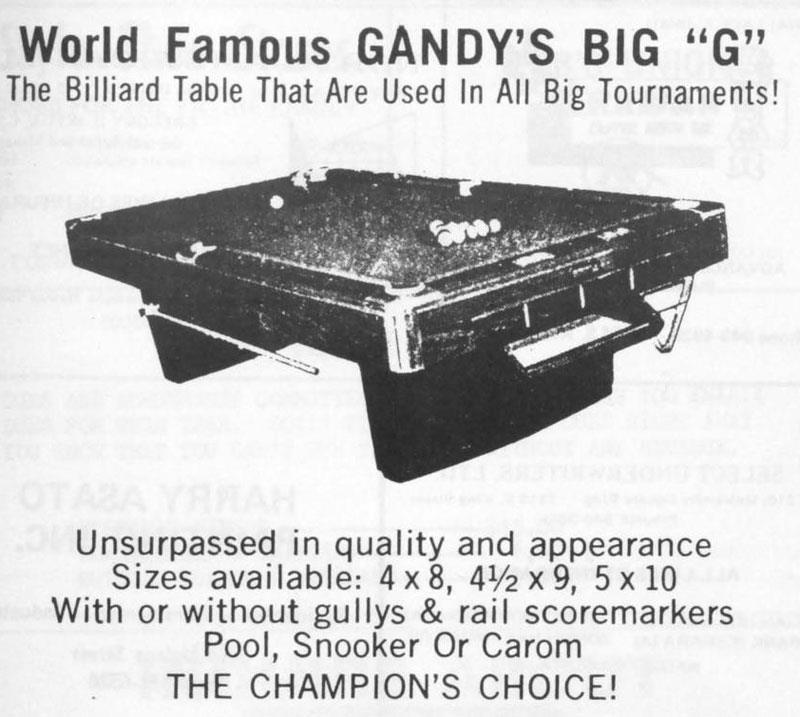
- The 11th Street Infrastructure (May 1969): Gandy is already heavily established at the 510 11th Street complex. A May 1969 advertisement for Macon Billiard Supply Co. (featuring Roy Gandy, President) shows the facility pushing its "Champion Line" of pool tables, including The Big "G", The Hustler, and The Sportsman. Because Gandy is securing massive national commercial table contracts, they require a high-volume accessory, chalk, and house cue ecosystem to bundle with their table shipments.
- The Shop Floor Mastery (circa 1970): Rigoberto "Ricco" Cervantes takes over local production leadership on the shared Macon shop floor. He brings precision custom design principles to the high-volume automated manufacturing lines, refining the application of stacking, "L"-shaped vinyl veneers pressed into precisely milled grooves.
1971: The Corporate Merger and Unified Production
- The Official Buyout (December 1971): A full-page announcement in The National Billiard News states that Gandy’s Industries, Inc. (President Roy Gandy) has officially purchased National Billiard Chalk Co..
- The Dual Identity Setup: Roy Gandy publicizes that the National brand name will be retained with zero immediate changes to manufacturing or distribution. Kim Gandy (Roy’s son) is placed in charge of the chalk division. Concurrently, Gandy utilizes Macon Billiard Supply Co. as its direct commercial distributor arm out of the exact same 510 11th Street building.
- The Structurally Identical Era: Because the inventory pools, worker hands, and machinery are fully unified under one roof, the Late National cues and Early Gandy cues roll off the exact same shared assembly tables. The product lines are identical, using a polished stainless steel joint collar on the butt face paired with a piloted aluminum shaft insert.
- Catalog Convergence: The Gandy Industries price sheet utilizes an exact verbatim copy of the National Tournament catalog text. Both catalogs share the exact same model numbers (HC-100 through HC-150 and the flagship RG-1000), material descriptions, and pricing hierarchy.
- Standardizing Forensics: As the production line stabilizes under the Gandy label, specific internal machining choices become standard. Gandy standardizes its internal weight-bolt geometry and depth to match its unified pool table accessory packages. To cut down on production steps for commercial rooms, many early 1970s runs bypass the installation of rubber bumpers, leaving a completely flush, bumperless wood butt cap.
- The Custom Anomalies: Custom workshop experimentation flourishes during this window. High-end custom wood components are occasionally introduced to the standard machinery, creating undocumented collector anomalies such as custom Titlist blank house cue conversions bound to the standard piloted aluminum shaft insert setup.
- The Pro Circuit Push (Late 1973): National advertising expands, featuring prominent touring professionals like Donna Ries (hot off her 1973 U.S. Open Straight Pool Championship runner-up performance). The cue lineup expands its pricing ceiling to accommodate premium wood combinations and elaborate inlay packages.
- The Sourcing Shift: Gandy shifts its corporate capital and focus entirely toward mass-producing its dominant tournament-grade commercial pool tables (the Gandy Big "G" line).
- Outsourcing the Lathes: To stop running physical cue lathes in Macon while keeping a cue section in their table catalogs, Gandy contracts manufacturing to Gordon Hart at Viking Cue in Madison, Wisconsin.
- Architectural Parting of Ways: This transition effectively ends the "Macon Era" design architecture. The cues lose their distinct early-70s weight bolt system, flush bumperless caps, and piloted aluminum shaft inserts. They transition into standard Viking architecture, characterized by 5/16-18 brass pins/inserts, wood shaft pilots, and standard Viking push-in rubber bumpers.
Archival Materials Referenced
- Gandy Collection Inventory List: Documenting known survivor variants including bumperless configurations, linen wraps, nylon wraps, and unique shaft splits.
- National Tournament Catalog Spread: Detailing models HC-80 through RG-1000 with original retail pricing scales ranging from $27.50 to $100.00.
- National Billiard Chalk Brochure Cover: Stamping the historical manufacturing origin point at 1948 West Fulton Street, Chicago, Illinois.
- The National Billiard News (December 1971, Page 12): The definitive page anchor detailing Roy Gandy's official ownership acquisition, the 1967 factory relocation text, and the photo profile of Rigoberto Cervantes at the lathe.
- Macon Billiard Supply Co. Advertisement (May 1969): Proving early localized table production (The Hustler, The Sportsman, Big "G") out of the 510 11th Street site prior to the official chalk company merger.
3-1964 National Billiard News
6-1971 National Billiard News
6-1971 National Billiard News
September 1975 National Billiard News
November 1978 National Billiard News
1970's
December 1973 National Billiard News
May 1969 National Billiard News
Shipping cue
- By Chopdoc
- Main Forum
- 80 Replies
Thanks.'I' never saw/met any customers back in the factory, or otherwise!
No worries.
I might tap you for other historical info about the shop and the cues as I go forward.
I am not sure if this is a National or a Gandy, and I don't think there is any way to tell for sure, unless I track down Dick Antonini, the original owner of this cue.
Jim Buss Cue AUCTION ENDS 9/20
- By stomper
- eBay Auctions
- 0 Replies
Great cue underpriced, come steal it!
Going to try CF, any suggestions?

- By chuckpilegis
- Cue and shaft reviews
- 34 Replies
I think if you like a protaper and 12.2 or12.3 mm tip you should go with the Jacoby or the older RhinoJason thanks for that reply. You say you have a number of CF shafts. Can you say, rate the top 3 you like best and why? I'd like to have a pro taper, 12.3 to 12.5 mm tip and when you say "plays closer to wood", my objective is to not have the CF shaft have a thin, hollow, "tink" sound when striking the CB, or at least not a real pronounced sound/feel like this. The combo wood/CF shafts intrigue me.
Shaw vs. Doung Quoc Hoang

- By skip100
- Main Forum
- 101 Replies
Wasted talent seems a bit much, but more than a grain of truth there.
Load more