adding weight

snipershot

Go ahead.....run for it.
Silver Member
I've made a few cues that needed weight added and instead of a traditional weight bolt, I drilled a hole in the but and epoxied in a 5/16 brass rod. I didn't want to use lead, and my thinking was that by using a longer piece of skinny brass for weight instead of a fat steel or lead weight, I would spread the weight more evenly through the cue. I chuck up the rod in my lathe and make little cuts in it to have something for the epoxy to grab, then I fill the hole with epoxy. Lastly, I push the rod in, and all the excess epoxy overflows. I wipe it off, and let it sit for a couple days and that's pretty much it. Its worked pretty well so far, but I haven't had much playing time with them yet. Any pros or cons doing it this way?

Joe
 
Sounds like the weight better be right because adjustments are going to be difficult.


Mario
 
Well, you've proven that it can be done so that would fall into the 'pro' category.
My first concern would be that of hydraulic action, ie, splitting the cue.
There will be some affect on balance point and as Mario stated, difficulty in future wght. adjustments.
If it's something you want to do, do it `til you don't like it anymore.

KJ
 
I've made a few cues that needed weight added and instead of a traditional weight bolt, I drilled a hole in the but and epoxied in a 5/16 brass rod. I didn't want to use lead, and my thinking was that by using a longer piece of skinny brass for weight instead of a fat steel or lead weight, I would spread the weight more evenly through the cue. I chuck up the rod in my lathe and make little cuts in it to have something for the epoxy to grab, then I fill the hole with epoxy. Lastly, I push the rod in, and all the excess epoxy overflows. I wipe it off, and let it sit for a couple days and that's pretty much it. Its worked pretty well so far, but I haven't had much playing time with them yet. Any pros or cons doing it this way?

Joe

You can do essentially the same thing more easily using threaded rod.
It also has the distinct advantage that you can try out variations
in weight and location before you epoxy it in.

Dale
 
I've made a few cues that needed weight added and instead of a traditional weight bolt, I drilled a hole in the but and epoxied in a 5/16 brass rod. I didn't want to use lead, and my thinking was that by using a longer piece of skinny brass for weight instead of a fat steel or lead weight, I would spread the weight more evenly through the cue. I chuck up the rod in my lathe and make little cuts in it to have something for the epoxy to grab, then I fill the hole with epoxy. Lastly, I push the rod in, and all the excess epoxy overflows. I wipe it off, and let it sit for a couple days and that's pretty much it. Its worked pretty well so far, but I haven't had much playing time with them yet. Any pros or cons doing it this way?

Joe

Drill the butt with a 5/16 drill. I have one that is 10 in long. Tap the hole 3/8-16. You can get a long tap on Ebay for cheap.

I use steel 3/8-16 set screws. You can get them 1/4, 1/2, or 1 in long.

Crank them in the hole with a T handle allen wrench and lock them together. Fully adjustable.

Don't put so much weight in the butt to make the cue tail heavy.

Kim
 
I do the same as Kim. The set screws are readily available just about anywhere. You don't have to buy them from a cue supplier for 4 times the amount.
 
Sounds like a future buzzer to me.

Screws are locked together by tightening each set screw against the one below it. This technique is used to lock set screws in industrial machinery.
If it works there it probably will work ok in wood..........

I have seen many long one piece weight bolts buzz and rattle.

No glue involved. Never had one loosen or buzz.

Kim
 
I've used a regular weight bolt before, but I was just curious about using the solid brass rod. I've seen some Richard Harris cues that had the butt full of epoxy with the date under it, and that's where I got the idea. Ill give the set screws a shot. What do you mean Joey? Is my cue gonna buzz? Right now it feels rock solid and hits pretty good. Of course its only a few weeks old, lol. Back to the drawing board, lol.

Joe
 
Joe, I had a custom sneaky that was a great player. Unfortunately it warped like a banana. I put the cue in the lathe to cut off the fore arm to salvage what I could. Part way thru, the cut off tool ran into something hard.

It was a big 1/4" aluminum rod that had been epoxied in. Apparently, the prong and fore arm must have been cored and put together after the rod was in. The core hole was much larger than the rod itself and the rod was
crooked in the hole, which led me to believe that the epoxy might not have been allowed to set before the cue was put together.

Not much relation to your story, just funny the things you find in a cue sometimes.

I was using the cue in the winter and had kept it in an aluminum case. Even tho the car was warm for the trip to the hall, the aluminum case would get pretty cold in a short distance.

Always wondered if the aluminum bar was getting cold and was the culprit in making the cue warp, or maybe not.
 
I bore my a 5/16 x 11" into the handle from the rear, tap this the same as other's have said and I use set-screws as has been described earlier. 3/8 x 16 set screws come in sizes from 1/4" up to 3" in length in 1/8 inch increments up to 1" and then 1/4" increments to 1.5" and then 1/2 inch increments to 3". I use 5/8" set screws as they are the most economical by weight. 3/8 x 16 set screws are 2.5" per ounce so at 5/8" each weighs 2/10ths of an ounce. I also keep a box of 1/4" so that I can get the weight of the cue to within a 1/10 oz. Every cue that I have ever built (some where between 1200 and 1600) has had this feature and you would be hard pressed to find one of my cues with a buzz.

You can also change the balance point somewhat with this system. I could, of coarse, glue them in place but that limits the owner, if wanting to sell the cue, to just people desiring that particular weight.

Dick
 
I use a brass radial connecting screw that i cut a slit in for tightening. I added a extension onto the radial tap so i can tap extra deep. brass 3/8-16 set screws can be purchased at msc for 1.65 each (you have to order 100 pcs) Brashttp://www1.mscdirect.com/cgi/NNSRIT2?PMAKA=67603241&PMPXNO=2027142&cm_re=ItemDetail-_-ResultListing-_-SearchResultss
 
Hi,

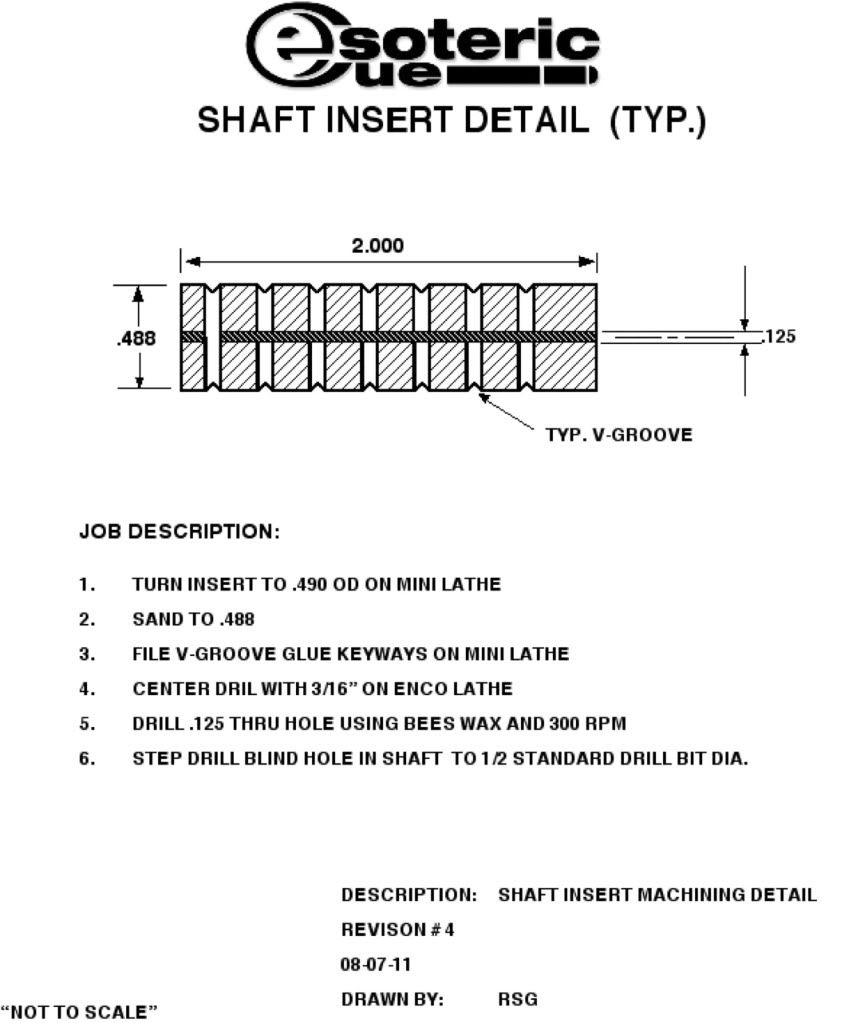
After tapering the butts to final dimension, when needed, I epoxy a 1/2" x 13 tpi weight bolt in my nose before I install the pin so I do not aft weight my cues by just using the butt weight. Before installing the pin I epoxy a 1/2" x 2" garolite insert as a pin anchorage to tap to my pin threads and alignment barrel. This way I can nail the weight and balance CG of the cue perfect every time at the weight I want.

I have been doing it this way for years now and I recently found out that Harvey Martin used weight behind his pin all the time.

Rick

The reddish brown ring seen around the pin is the garoite dowel (pin anchor) epoxied in the cue after the forward weight was epoxied in.

IMG_4395.jpg


Shaft insert used for a pin anchor after forward weight is installed.

SHAFTINSERTPDF.jpg
 
Last edited:
I've made a few cues that needed weight added and instead of a traditional weight bolt, I drilled a hole in the but and epoxied in a 5/16 brass rod. I didn't want to use lead, and my thinking was that by using a longer piece of skinny brass for weight instead of a fat steel or lead weight, I would spread the weight more evenly through the cue. I chuck up the rod in my lathe and make little cuts in it to have something for the epoxy to grab, then I fill the hole with epoxy. Lastly, I push the rod in, and all the excess epoxy overflows. I wipe it off, and let it sit for a couple days and that's pretty much it. Its worked pretty well so far, but I haven't had much playing time with them yet. Any pros or cons doing it this way?

Joe


Joe, I do things a little different. If I have to add weight not including the cues weight bolt if one is used the first thing I do is add weight to the cues front by using a longer pin. I keep 6 or 7 feet of threaded dowels of each of the following pins 3/8-10, 5/16-18, 5/16-14, and 3/8-11. So when I have added weight in this manner I have made the cues pin that were up to 6 1/2 inches long. I have also added weight in a cues handle by making the threaded dowel at the A-joint longer like I did with the pins above.

I have seen cues built by other builders who drilled and threaded holes in the cues handle to add weight. Meucci come to mind when taking about adding weight in the handle in the way I described above. I personally would never do that because I suspect that you can be creating a Buzz factory over time but I am not expert and the method I use In my opinion is one of more sound methods I have seen or heard that anyone uses to date.

Let us know how your method works, I think there could be problems over time, no disrespect intended only an observation.
 
Back
Top