buying blanks

hey

That would depend if he was getting a lot more than Adam cue.
:eek:


If I had a business where I could buy an Adams cue for $250 change the wrap, sign and refinish it and then sell it a month later for $5000...............hmmmmmmmmmmm $$$$$$$$$$$$$$$$$$$$$$$
Steve
 
What if a famous maker was buying his Blanks from Adam Cues:eek:, and the owner finds out, do you think that would cause any cues built by that cue maker to loose their Value?

Do you recall Bob Wier. He claimed to be building cues and was not building anything. He just bought them.
 
If I had a business where I could buy an Adams cue for $250 change the wrap, sign and refinish it and then sell it a month later for $5000...............hmmmmmmmmmmm $$$$$$$$$$$$$$$$$$$$$$$
Steve

The last Cue maker to get caught selling cue made by Adams, under his own name was Robert Weir. From my understanding Robert marketed the cues as his own from his Business in Texas. He even had catalogs made and no where it was mentioned that Adam was not only making the blanks but the entire cue from bumper to tip, the cues even had the Weir Logo on them.

Anyone have any additional information about the Robert Weir story? Like how he was caught in the deception.

I suspect that if some one were buying Blanks and other components from Adam, and assembling cues from them, it would be very difficult to identify it for certain. Like you said Steve, the price of their cues would fall like a stone if word ever got out, and any collector who owned cues from that person would do anything to protect their investment, kinda Scary Huh!!!!!:eek:
 
Do you recall Bob Wier. He claimed to be building cues and was not building anything. He just bought them.

Yes I do, I did not see your post so I already posted that above this one.

Sorry about that
 
I know my following comments might not be very well received but here goes anyway: :)
I really feel some on here are trying to hold cuemakers to a standard that no other field I know of is held to.
Full Disclosure????
I have read that the customer expects to be told where the guy bought his blank. I can understand if the customer wants to know if he made it himself or if he had someone else do some of the work. But a simple "yes or no" answer is all that is owed. How can it be someone's business who the cuemakers gets any of his parts from?????? That is like asking for the cuemakers wholesale parts sources.
Now it might be to the cuemakers advantage to tell the customer if he has a blank from a famous maker or if it was from a Titlist. But to think the cuemaker must disclose his sources is unreasonable.
Did he do it all himself or did he have help? That is about all the information I can see he owes anyone. Once that fact is established the product speaks for itself.
 
The last Cue maker to get caught selling cue made by Adams, under his own name was Robert Weir. From my understanding Robert marketed the cues as his own from his Business in Texas. He even had catalogs made and no where it was mentioned that Adam was not only making the blanks but the entire cue from bumper to tip, the cues even had the Weir Logo on them.

Anyone have any additional information about the Robert Weir story? Like how he was caught in the deception.

I suspect that if some one were buying Blanks and other components from Adam, and assembling cues from them, it would be very difficult to identify it for certain. Like you said Steve, the price of their cues would fall like a stone if word ever got out, and any collector who owned cues from that person would do anything to protect their investment, kinda Scary Huh!!!!!:eek:
I knew him since he was a kid. He liked hanging around the pool room. He liked doing this and that. He had a pool room in NC for a while before he got started with the cue thing. He invited me to his house and I had no idea because he never said anything. His family were in the paper business and like out of "Lifestyles of the rich and famous". He just seemed to like screwing around though, kind of the black sheep.
 
Another issue is putting a well made blank into the hands of an incompetent maker (trust me they are out there). The blank maker would get blamed, for example, for the points not lining up. The incompetent maker couldn't tell his customer he received the blank well oversized and just didn't know how to either keep the points straight or straighten them by gradually offseting the center(s). For that reason alone, if I produced high quality blanks, I'd sell them only to cuemakers I knew were competent to work with them and no one else.

For example when John Davis was first coming back a few year ago one genius took a John Davis second splice blank and made it a horrid looking wrapless, a use that would have never been approved by John. Mercifully, someone bought the cue second hand and had someone cut a wrap channel and put a wrap on it.

People don't realize that even some of the saints of cuemaking have had helpers doing a good deal of work on the cues. Mind you the helper is working to the specifications and standards of the maker on his equipment. At what point, though, would the cue cease to be an x-maker cue?

Martin


Was just wondering how many cuemakers would admit to buying blanks instesd of making there own....for lack of knowledge or to save time and money. And for those that dont....what do you guys think of the ones that do?
I personally would still buy a cue that I liked even if the builder didnt make the blank himself....as long as he told me that.

For some builders that have been around a long time, they might have a helper or two who turn out the blanks, so there not really doing it anyway. So why not buy them and save time and labor?
just a few questions...................
Steve
 
hey

I know my following comments might not be very well received but here goes anyway: :)
I really feel some on here are trying to hold cuemakers to a standard that no other field I know of is held to.
Full Disclosure????
I have read that the customer expects to be told where the guy bought his blank. I can understand if the customer wants to know if he made it himself or if he had someone else do some of the work. But a simple "yes or no" answer is all that is owed. How can it be someone's business who the cuemakers gets any of his parts from?????? That is like asking for the cuemakers wholesale parts sources.
Now it might be to the cuemakers advantage to tell the customer if he has a blank from a famous maker or if it was from a Titlist. But to think the cuemaker must disclose his sources is unreasonable.
Did he do it all himself or did he have help? That is about all the information I can see he owes anyone. Once that fact is established the product speaks for itself.


I agree with you completely. Once he said I didnt make the blank....thats all that is required. That would give me enough information to then make my decision to buy or not to. I wouldnt expect him to tell me where or how much he paid or anything else, but a custom cue is normally percieved to be entirely made by that cuemaker.
I have bought at least 8 cues from cuemakers who told me the blank wasnt theres.......and love them. But I was fairly given that choice
Steve
 
I'm all for anything that'll help weed out the bad actors. Misrepresentation is disrespectful to the customer at whatever level, and when there is such a large base of quality makers to choose from - it amounts to seeing how deep you can cut your own throat before... Having said that, I also think that if I'm entering into a working relationship with a cuemaker, suggesting we start off with a pre-nup & attacking all the "legal-ese" side boards from a full disclosure stance is bordering on the same level of disrespect.
My own guiding belief would be that you need to let the customer lead the way in information seeking. If I ask questions, I want honest answers. If I ask deeper, more informed, questions - I want more detailed honest answers. You really have to love what you do to be a cuemaker because, on average, the wage rate - except maybe in the highest echelons - is well below what would be expected for equivalent machine & material knowledge and expertise vs SO MANY other fields. My experience - limited compared to many - has been that the best of those I've dealt with relish the opportunity to delve deeply into what they're doing for a customer when they sense a real appreciation & understanding of what is entailed.
Then, of course, the best of customers has to understand that you can work or you can talk on the phone, answer e-mails, etc. We can't expect to monopolize a maker's time - we don't expect to do busines that way with our auto mechanic or HVAC tech...
 
Last edited:
I agree with you completely. Once he said I didnt make the blank....thats all that is required. That would give me enough information to then make my decision to buy or not to. I wouldnt expect him to tell me where or how much he paid or anything else, but a custom cue is normally percieved to be entirely made by that cuemaker.
I have bought at least 8 cues from cuemakers who told me the blank wasnt theres.......and love them. But I was fairly given that choice
Steve

Not sure I agree. I really don't care what they paid for the parts compared to what the cue cost, but I would like to know who made the blank. As there are some that are of better quality than others and it would mean more to my peace of mind knowing who he worked with.

With that, is it rude to ask a cuemaker who made the blank on his cue?

Jim
 
Well, it seems we are getting a bit out of control here.

"full disclosure" is being taken a bit far.

I think the potential buyer should know if the maker made it all, or if someone else made (in this case) the blank. If someone like Spain or Davis made the blank, I would think that is something you would WANT your customer to know. Maybe you don't want them to know it is a Prather blank; however you have to admit that their full-splice blanks are pretty f'n nice looking!

If it is sound construction, and quality wood properly dried and aged, it will be a quality blank. AS THE CUE MAKER it is your duty to your customer to use the best quality blanks you can get or make. I don't know about you, but speaking for myself, I think John Davis makes a better full splice blank that I can make at this time. Maybe later I will be able to do work of that caliber, and if I sell a cue with his blank, I am certainly not going to hide this fact or try to pass it off as my own blank.

I guess that's my take on this, and personal opinion on the subject.:)
 
Honesty is the best policy... That said, it's up to the cuemaker what he/she wants to disclose. It's up to the customer to ask the right questions and make a decision. You don't like the answer, don't buy!
...and what Mr. Davis just said was right on the money.
 
hey

Not sure I agree. I really don't care what they paid for the parts compared to what the cue cost, but I would like to know who made the blank. As there are some that are of better quality than others and it would mean more to my peace of mind knowing who he worked with.

With that, is it rude to ask a cuemaker who made the blank on his cue?

Jim


Jim, I wouldnt think it was being rude, just trying to be aware of what your getting. If I am spending $1,000 on up, or whatever I am spending, it shouldnt be taken as rude. I would hope
Steve
 
I have read that the customer expects to be told where the guy bought his blank. I can understand if the customer wants to know if he made it himself or if he had someone else do some of the work. But a simple "yes or no" answer is all that is owed. How can it be someone's business who the cuemakers gets any of his parts from?????? That is like asking for the cuemakers wholesale parts sources.
Now it might be to the cuemakers advantage to tell the customer if he has a blank from a famous maker or if it was from a Titlist. But to think the cuemaker must disclose his sources is unreasonable.
QUOTE]

I respectfully disagree. As an informed buyer, it would make a big difference to me whether the blank was made by Schmelke, Prather, Bear, Davis or Spain (or Hightower), and I feel that I should be able to ask my potential cuemaker and be able to discuss the variables, pros and cons. Maybe it wouldn't make any difference to others, but it would to me. JMO.
 
Well, it seems we are getting a bit out of control here.

"full disclosure" is being taken a bit far.

I think the potential buyer should know if the maker made it all, or if someone else made (in this case) the blank. If someone like Spain or Davis made the blank, I would think that is something you would WANT your customer to know. Maybe you don't want them to know it is a Prather blank; however you have to admit that their full-splice blanks are pretty f'n nice looking!

If it is sound construction, and quality wood properly dried and aged, it will be a quality blank. AS THE CUE MAKER it is your duty to your customer to use the best quality blanks you can get or make. I don't know about you, but speaking for myself, I think John Davis makes a better full splice blank that I can make at this time. Maybe later I will be able to do work of that caliber, and if I sell a cue with his blank, I am certainly not going to hide this fact or try to pass it off as my own blank.

I guess that's my take on this, and personal opinion on the subject.:)
It doesn't have to be a negative. Few cuemakers do scrimshaw. It is a positive to say the scrimshaw was commissioned to world famous "so and so" who has pieces in the White House. Collaboration is common in everything from custom cars to guns you name it. My brother in law has an engraved rifle that was done by the same guy who did work for Charlton Heston and Ronald Reagan. He is very proud of that fact, that it was not done by some hack. I can't make a full splice but if I was going to do a few I would get them from someone with the best blanks and a name I would want to be associated with. I don't think the customer would be turned off by that.
 

Attachments

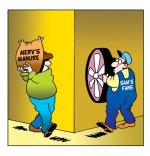
  • when_the_shit_hits_the_fan_321595.jpg
    when_the_shit_hits_the_fan_321595.jpg
    34 KB · Views: 270
I have read that the customer expects to be told where the guy bought his blank. I can understand if the customer wants to know if he made it himself or if he had someone else do some of the work. But a simple "yes or no" answer is all that is owed. How can it be someone's business who the cuemakers gets any of his parts from?????? That is like asking for the cuemakers wholesale parts sources.
Now it might be to the cuemakers advantage to tell the customer if he has a blank from a famous maker or if it was from a Titlist. But to think the cuemaker must disclose his sources is unreasonable.
QUOTE]

I respectfully disagree. As an informed buyer, it would make a big difference to me whether the blank was made by Schmelke, Prather, Bear, Davis or Spain (or Hightower), and I feel that I should be able to ask my potential cuemaker and be able to discuss the variables, pros and cons. Maybe it wouldn't make any difference to others, but it would to me. JMO.
Are you in business for your self?
If so, will you tell your customers your wholesale sources?
Since you seem to be educated in blanks already, your can probably look at any of those above and tell the other five did not make them. Each have their own design techniques, and they look different. So if the cuemaker says he did not make it, then you should be able to make a good guess where it came from by how it is built. And if you do not know enough about the various blank makers construction techniques to judge whether it is their blank or not then it should not matter.
Giving your wholesale sources away is a good way to create a competitor and hurt your business. But to ask a business owner or manufacturer to reveal his wholesale sources is bordering on rude. And I also mean that respectfully.
 
Last edited:
Who really gives a rat fart who built what as long as it is quality and it hits good , at a reasonable price . Have you ever heard anyone who can actually play , for the cash , be concerned if someone outsourced work on their product , unless the source was unsatisfactory ... pelicanzzzzzzz ...:eek:
 
Back
Top