
You are using an out of date browser. It may not display this or other websites correctly.
You should upgrade or use an alternative browser.
You should upgrade or use an alternative browser.
shaft cutting
- Thread starter whammo57
- Start date

I use mine vertical...JER

Vertical, 6 wing.

Vertical with a 3 wing 1/16th slot cutter just like Searing and OB cues use.--Leonard


I found that horizontal with a straight bit led to chatter.
First few passes, vertical with a straight bit and the rest with a 6 wing.
Smooth as a babies bum.
First few passes, vertical with a straight bit and the rest with a 6 wing.
Smooth as a babies bum.


Thanks for the replys....
Just starting out and have had a chatter problem on shafts with router horizontal using a 3/4 by 3/4 straight bit. I seem to lessen the problem by playing with rpm and feed rate....
appreciated it
kim
Chuck the straight bit and get a slot cutter.
Way too much pushoff with those .

Shaft cutting
I've always done it vertically. Both with wing cutters and straight cutters.
I am currently using a 5/16 Bosch straight cutter with great results. But I have the advantage of infinite feed and shaft rotation control
to dial in the settings. Here's a something that I just found on Amazon that might fit the bill for you. One thing to always consider
on wing cutters is max speed.
The big 2 inch ones are limited to 12000 rpm. This one may be able to rotate faster with out the fear of the carbide tip coming off.
http://www.amazon.com/CARBIDE-TIP-6-WING-DRAWER-CUTTER-THREADED/dp/B0012JI6AY
I've always done it vertically. Both with wing cutters and straight cutters.
I am currently using a 5/16 Bosch straight cutter with great results. But I have the advantage of infinite feed and shaft rotation control
to dial in the settings. Here's a something that I just found on Amazon that might fit the bill for you. One thing to always consider
on wing cutters is max speed.
The big 2 inch ones are limited to 12000 rpm. This one may be able to rotate faster with out the fear of the carbide tip coming off.
http://www.amazon.com/CARBIDE-TIP-6-WING-DRAWER-CUTTER-THREADED/dp/B0012JI6AY

I've always done it vertically. Both with wing cutters and straight cutters.
I am currently using a 5/16 Bosch straight cutter with great results. But I have the advantage of infinite feed and shaft rotation control
to dial in the settings. Here's a something that I just found on Amazon that might fit the bill for you. One thing to always consider
on wing cutters is max speed.
The big 2 inch ones are limited to 12000 rpm. This one may be able to rotate faster with out the fear of the carbide tip coming off.
http://www.amazon.com/CARBIDE-TIP-6-WING-DRAWER-CUTTER-THREADED/dp/B0012JI6AY
A 2" diameter cutter spinning at say 12000 RPM's is turning much much faster then a smaller diameter straight cutter turning at the same RPM's.
See if you can find out the recommended surface footage for the cutter from the manufacturer. Like Macguy said, a smaller tool take more RPM's to get the same surface speed of the tool. For example, a 2" diameter cutter at 12,000 RPM is 6283 SFM (surface feet/minute). A .75 diameter tool at 12,000 is 2356 SFM. Run that .75 at 32,000 for the same SFM, and the cut will be much better at the same feedrate. It's all about the chip-load, which is also why the more flutes or teeth, the better the cut.

dave sutton
Banned
I run vertical also. 1/8 and 1/16 3 wing cutter. Finding your speeds is key. Also small cuts. Taking too much off will lead to a rough cut. In the beginning no big deal but as u get to size very lite passes
I posted the speed limits, cause a lot of the newbies just hook up a laminate trimmer and have at it. 2 inch cutter at 30K is a grenade looking for someones day to ruin. Put a cheap speed control on it, and you still don't really know how fast it's going.

I run vertical with 1/8" 4-wing slot cutter. I also find that 1/16" slot cutters leave a cut pattern that needs sanded. And like Steve, I use a speed control. I have everything converted to DC power with infinite speed adjust. My spindle, feed motor & router all have variable speed control. I can fine tune the machine to adjust to almost any cutter but have found the 1/8" slot cutters to be the easiest in achieving smooth cuts. I use Freud bits from Pavlos on here. They aren't cheap but he's got the very best deal on them, period.

Just an fyi I called Whiteside tool and they say their 6 wing Slot Cutters are good to 24K RPM

Thanks for the replys....
Just starting out and have had a chatter problem on shafts with router horizontal using a 3/4 by 3/4 straight bit. I seem to lessen the problem by playing with rpm and feed rate....
appreciated it
kim
Kim,
From my experience in this area, I think the chatter you are getting is doubtless the result of your speed and feed rates not the orientation of your cutter. Also, the more you hog the material the more deflection you will get in the center so be careful to take very light passes as you get to finish dimension. As long as your tool post router set up is very solid the shaft doesn't care which vector it is attacked from between centers.
Here is a link to a thread I posted a few weeks ago concerning using a laser RPM tachometer to monitor your rpm rates that might help you.
http://forums.azbilliards.com/showthread.php?t=230972
One tip I can offer is that the slower lathe rpm speeds and the slowest of feed rates are the key. I use a saw tapering machine with 60 carbide blades running at 1750 rpm or 105,000 cuts per minute ,which makes more cuts per unit of time than my old 2 fluke router set up at 30,000 touches. These guys using 6 wings at 30,000 are getting 180,000 touches per minute. Once you get to a certain high rpm speed on your cutter I think it is academic, but the more touches your get per minute will be beneficial to a smooth rms finish especially if you are cutting silver stitch rings. Run your router balls out and you should be fine. The multi wing cutters is good advice for the router set up.
The feed rate and the lathe speed is the area you need to focus on. The laser devices are less than 25 bucks shipped. Get one and you will be happy.
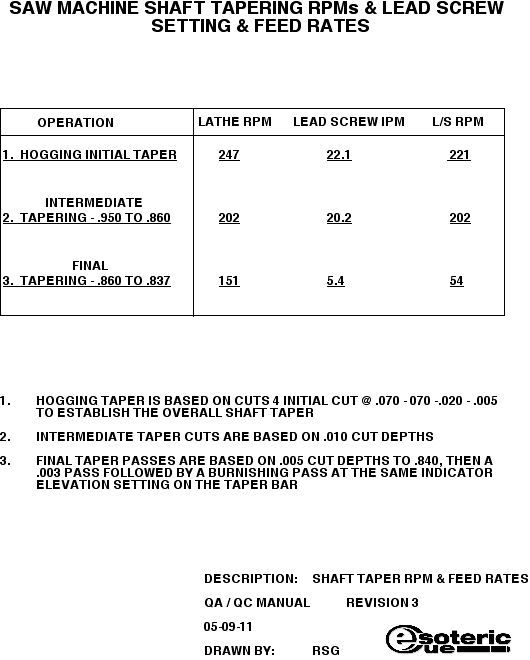
Here is a chart that I use on my set up, it may help you.
Good Luck,
Rick Geschrey
Last edited: